- Harmony is the AI SDR choice for enterprise phone qualification, booking, and live hot transfers.
- Email-first SDR tools fit written prospecting; they do not establish autonomous phone-call capability.
- AI-assisted dialers fit rep-led calling; custom-built voice agents fit engineering-owned deployments.
- Choose enterprise AI SDR tools by approved qualification flows, completed handoffs, and accountable deployment ownership.
Best for enterprise phone qualification: Harmony. Best for written prospecting: email-first SDR tools. Best for rep-led calling: AI-assisted dialers. Best for engineering-owned call logic: custom-built voice agents. This 2026 guide helps mid-market and enterprise revenue leaders choose the right operating model - not confuse a prospecting assistant with a system that runs calls end to end.
Why this matters
Choose the sales task before choosing the software. Generating outreach, connecting calls, qualifying a prospect, and transferring an opportunity are different jobs. A tool that assists with one does not automatically own the others.
For a revenue leader, the purchase decision starts with the gap between a lead arriving and a qualified next step. Define who calls, what the call must establish, and where an interested prospect goes. Then require the vendor to demonstrate that complete path.
An enterprise AI SDR evaluation in 2026 should distinguish assisted work from autonomous execution. If a representative still conducts every conversation, you are buying assistance. If the system conducts the call within approved rules, you are evaluating a different operating model.
What makes the best enterprise AI SDR tools?
Use these criteria before reading the comparison. Each one maps to a production responsibility you must assign.
Task ownership: Specify whether the system drafts outreach, places calls, conducts qualification, books appointments, or transfers interested prospects.
Qualification control: Require an approved flow that defines eligible prospects, required answers, disqualifiers, and escalation conditions.
Completed next steps: Evaluate confirmed bookings and connected transfers - not just generated messages or dial attempts.
Conversation timing: Separate time-to-first-call from in-call response latency. They describe different parts of the experience.
Operational accountability: Name the owner for campaign changes, exceptions, suppression rules, and failed downstream actions.
Security and compliance scope: Review the relevant documentation and your campaign obligations. A platform statement does not approve a calling campaign.
Do not average these criteria into a score that hides a missing requirement. If live qualification is mandatory, written outreach alone fails that requirement regardless of its other features.
Enterprise AI SDR options at a glance
This 2026 comparison ranks operating models by their distinct use cases. It does not treat unnamed products as tested alternatives or assign performance scores without evidence.
Harmony
Best for: Enterprise autonomous phone qualification
Standout mechanism: Approved call flows that qualify, book, and hot-transfer
Key limitation: Sales-assisted purchase; not a self-serve deployment
Email-first SDR tools
Best for: Written outbound prospecting
Standout mechanism: Drafting or executing email outreach, depending on the selected product
Key limitation: Written outreach does not establish phone execution
AI-assisted dialers
Best for: Rep-led outbound calling
Standout mechanism: Organizing or placing calls while representatives conduct conversations
Key limitation: The representative remains the conversation operator
Custom-built voice agents
Best for: Engineering-owned call logic
Standout mechanism: A team-designed calling application with explicitly implemented controls
Key limitation: Your organization owns development and operational maintenance
The table is a decision tree. Start with the row that matches who must operate the conversation, then test whether it completes your required next step.
1. Harmony: best AI SDR option for autonomous phone qualification
Harmony is best for mid-market and enterprise revenue leaders who need an AI SDR to qualify leads by phone and hot-transfer interested prospects. It runs inbound, outbound, and follow-up calls across sales, service, and operations. For revenue teams, the relevant actions are calling, qualifying, booking, and transferring.
The platform uses its own model, built for the phone; it uses LLMs when needed. Its deterministic approach runs approved flows rather than treating every moment as an open-ended conversation.
The stated speed-to-lead capability is calling every lead in under 60 seconds. The stated in-call latency is sub-400 milliseconds. Those are separate claims: one measures how quickly calling starts, while the other describes response timing during a call.
Under 60 seconds means under 1 minute to initiate the lead call; it does not mean a qualification conversation finishes within that interval. Ask for the timing boundary and measurement conditions during evaluation.
Harmony pros:
Runs phone calls end to end rather than only preparing outreach.
Qualifies and books within approved flows.
Hot-transfers to a person when the call requires that handoff.
Supports inbound, outbound, and follow-up calling in one platform.
Platform considerations:
Sales-assisted purchasing requires a buying conversation; this is not a self-serve tool.
Approved flows require your team to define qualification, escalation, and offer boundaries.
CRM, calendar, and transfer requirements need confirmation for your deployment; do not assume a named integration from the category alone.
Best for: Revenue leaders replacing a lead-response queue with an approved phone qualification process.
Verdict: Buy for autonomous enterprise phone qualification after validating the complete handoff in your environment.
2. Email-first SDR tools: best for written outbound prospecting
Email-first SDR tools address written outreach. Depending on the selected product, that means drafting messages, personalizing text, managing sequences, or handling parts of the reply process. Evaluate those functions individually rather than treating the AI SDR label as a feature specification.
This operating model fits a motion where the next step begins in an inbox. It is not evidence that the same product can conduct a phone qualification call or connect an interested prospect to a sales representative.
Email-first SDR tools pros:
Keep the prospecting process centered on written communication.
Give reviewers message content to inspect before campaign execution.
Fit campaigns whose approved call to action is a written reply.
Email-first SDR tools cons:
Email capability does not establish autonomous phone capability.
A reply requires a defined owner and routing process before it becomes a sales action.
Product capabilities differ; drafting assistance and autonomous reply handling are not equivalent.
Best for: Enterprise revenue teams whose immediate requirement is written outbound prospecting, not phone execution.
In a 2026 evaluation, ask the vendor to show the transition from a positive reply to an assigned next step. A polished message is only the beginning. Require a demonstration of opt-out handling, ownership assignment, and the conditions that stop further outreach.
Verdict: Buy for a written prospecting requirement; skip as a substitute for autonomous phone qualification.
3. AI-assisted dialers: best for rep-led outbound calling
An AI-assisted dialer supports a calling process in which representatives conduct the conversations. The selected product determines how calls are organized, placed, and assisted. Dialing support and autonomous qualification remain separate capabilities.
Choose this model when your strategy intentionally keeps a representative on the call. The central question is whether the tool improves that representative’s calling process - not whether it can independently operate an approved qualification flow.
AI-assisted dialers pros:
Preserve representative ownership of the sales conversation.
Address call execution without requiring an autonomous conversation model.
Let you evaluate dialing functions separately from qualification decisions.
AI-assisted dialers cons:
Rep-led calling still requires representative availability.
Dial attempts do not establish qualified opportunities.
Booking and follow-up ownership remain separate requirements unless the selected product demonstrates them.
Best for: Enterprise sales teams that want representatives to conduct outbound conversations while software supports dialing.
Ask the vendor to demonstrate a connected call, a failed connection, and the next action after each. Then inspect how the system distinguishes an attempt from a completed conversation. Your reporting should not make those events interchangeable.
Verdict: Buy for rep-led calling; skip when the requirement is autonomous call execution.
4. Custom-built voice agents: best for engineering-owned call logic
A custom-built voice agent is a calling application your organization designs and operates. Your team specifies the conversation flow, system actions, exception handling, and deployment controls. The application only has the capabilities you implement and verify.
This route fits an organization that explicitly wants to own the calling application. It is not simply another procurement option: development, testing, change management, and operational support become internal responsibilities.
Custom-built voice agents pros:
Let your team define the call logic and exception paths.
Make application ownership explicit.
Allow your organization to design the controls around its particular requirements.
Custom-built voice agents cons:
Your team owns application maintenance and failure handling.
Security, monitoring, and campaign controls require deliberate implementation.
Changes require testing across conversation behavior and downstream actions.
Best for: Enterprise revenue organizations with an engineering team assigned to build and operate the calling application.
For a 2026 build decision, require a written operating plan before approving development. Name the owner for interrupted calls, unavailable systems, qualification changes, and rollback. A prototype that completes a scripted conversation is not the same deliverable as an operated production service.
Verdict: Hold until engineering ownership and production responsibilities are approved.
How these options are ranked
The ranking follows task ownership, qualification control, completed next steps, timing, operational accountability, and security scope. Autonomous enterprise phone qualification comes first because it is the revenue use case addressed here - not because every sales motion needs it.
The remaining options occupy different slots: written prospecting, representative-led calling, and engineering-owned execution. No conversion uplift, customer result, or comparative performance score is assumed. Your required task determines the winner.
Test the complete qualification path
A 2026 buying decision should follow the lead through its final state. Do not stop the demonstration when the call sounds convincing. Ask the vendor to show what happens when the prospect qualifies, declines, requests a person, or cannot complete the next step.
Use this sequence as the demonstration agenda:
Lead received: Show the triggering event and the information the calling process receives.
Eligibility checked: Show the approved rules that permit or stop outreach.
Qualification completed: Establish the required answers without inventing an offer or accepting incomplete qualification.
Next step confirmed: Demonstrate a completed booking or connected handoff, not merely an intention to perform it.
Outcome recorded: Show the final disposition and who owns any unresolved action.
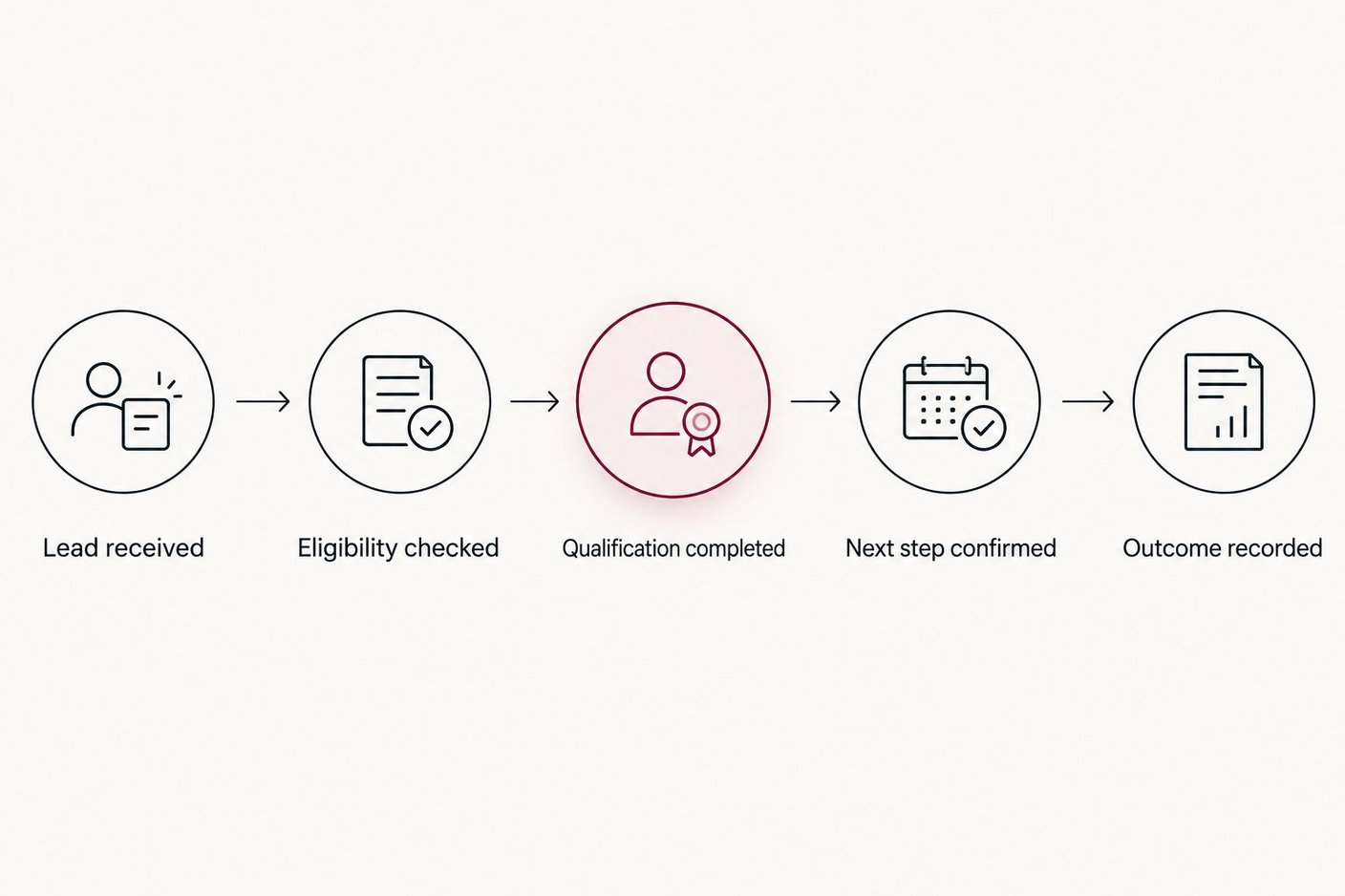
Evaluate the completed next step, not just the conversation.
Make the exception path visible. If a calendar action fails, the prospect should not receive an unsupported booking confirmation. If a transfer does not connect, the workflow needs an approved fallback and an assigned owner.
These are acceptance requirements, not assumed platform features. Put them into the evaluation so the chosen vendor or internal team demonstrates what actually works.
Separate platform controls from campaign approval
Security documentation and calling rules answer different questions. Security review concerns the platform and data handling. Campaign review concerns whom you contact, the purpose of the call, and the permissions and restrictions governing execution.
The stated platform scope is SOC 2 Type II, HIPAA BAA available, GDPR/CCPA-ready, and TCPA-aware. Keep those statements exact. Do not convert them into a blanket claim that any outbound campaign is compliant.
Assign legal and operational review to your intended campaign before launch. Require documented eligibility, suppression, recording, and escalation decisions. Recheck the approved process when the audience, offer, geography, or calling purpose changes.
Which enterprise AI SDR option should you choose?
Choose Harmony when your requirement is autonomous enterprise phone qualification with booking and hot transfers. Choose email-first SDR tools for written prospecting. Choose AI-assisted dialers when representatives should conduct the calls. Choose a custom build only when your organization accepts application ownership.
For an undecided revenue leader, write the required outcome in one sentence: eligible lead contacted, required qualification completed, next step confirmed, outcome recorded. Use that sentence to govern the demonstration. Reject a buying argument that substitutes activity for completion.
FAQ
What’s the best AI SDR option for enterprise phone qualification?
Harmony fits mid-market and enterprise revenue teams that need autonomous phone qualification, booking, and hot transfers. Validate the approved flow and complete handoff against your deployment requirements.
Is an email SDR tool the same as a phone SDR platform?
No. Email-first SDR tools address written outreach, while a phone SDR platform must conduct the call and complete the required next step. Do not infer phone capability from an email feature list.
Should an enterprise sales team choose an AI SDR or an assisted dialer?
Choose an autonomous AI SDR when the system must conduct qualification; choose an assisted dialer when representatives should conduct conversations. Start with conversation ownership rather than the product label.
Does fast lead response mean low call latency?
No. Lead response measures the interval before outreach starts, while call latency measures response timing during the conversation. Require separate definitions and demonstrations.
What should a revenue leader ask an AI SDR vendor to demonstrate?
Ask for the complete path from lead receipt to a confirmed booking or connected handoff. Include disqualification, a request for a person, and a failed downstream action.
Does a TCPA-aware platform make every outbound campaign compliant?
No. TCPA-aware is a platform statement, not approval for every calling campaign. Your organization must review its intended audience, permissions, purpose, and operational controls.
When should an enterprise build its own voice agent?
Build when your organization explicitly wants application ownership and assigns engineering resources to operate it. Approve maintenance, monitoring, exception handling, and rollback responsibilities before development.
One last thing
A booked meeting and a connected transfer are different outcomes. Test them separately. A system can reach the booking step without proving that it can connect an interested prospect to an available person.
Bring your actual qualification rules and transfer conditions to the sales conversation. Ask for the failure path as well as the successful call.
Related guides
Validate your qualification flow
Bring your qualification rules, booking requirements, and transfer conditions to the sales conversation.