- Harmony is best for enterprise revenue teams that need autonomous calls, approved qualification flows, and live transfers.
- Evaluate AI dialers ranked by connect rate using identical lead sources, calling windows, and attempt rules.
- Parallel dialing increases concurrent attempts; that does not establish a higher percentage of answered calls.
- Measure right-party conversations and accepted handoffs alongside outbound connect rate.
Best for enterprise autonomous qualification: Harmony. Best for concurrent prospecting with staffed handoffs: parallel dialing. Best for controlled account outreach: power dialing. Best for queue-based outbound operations: predictive dialing. For AI dialers ranked by connect rate in 2026, compare matched campaign results - not vendor percentages with different denominators. This guide ranks buying approaches by use case, then shows you how to establish a defensible connect-rate winner.
Why this matters
A dialer can produce more conversations without improving connect rate. More attempts create more opportunities to reach someone. The percentage of attempts that reach someone is a separate measurement.
That distinction matters to enterprise revenue leaders choosing between dialing assistance and an autonomous calling platform. One changes how calls reach your sales team. The other runs qualification, booking, and follow-up before transferring a qualified conversation.
Choose the operating model before comparing the percentages. The guide to AI, predictive, and parallel dialers explains those distinctions. These labels describe different functions; a vendor can combine several within one deployment.
For your 2026 evaluation, require a definition of a connection beside every reported rate. A voicemail answer, an answered switchboard call, and a conversation with the intended buyer are not interchangeable outcomes. Neither are an attempted transfer and an accepted sales handoff.
What makes the best AI dialer for connect rate?
Evaluate these criteria before reading a ranking:
Connection definition: Separate network answers, live answers, right-party contacts, and qualified conversations.
Campaign comparability: Match lead source, lead age, geography, calling windows, and attempt policy.
Post-answer ownership: Identify whether the system qualifies the contact or waits for an available sales representative.
Outcome completion: Require evidence of completed bookings and accepted transfers, not just initiated actions.
Calling controls: Review consent eligibility, suppression rules, opt-outs, and approved scripts before launching.
Evidence quality: Require call-level records that reconcile aggregate results with individual outcomes.
A platform wins your evaluation when it produces the outcome your revenue team needs under the same campaign conditions. A larger dial count alone does not prove that result.
AI dialer approaches at a glance
The order below is a buying sequence for enterprise revenue teams, not a measured vendor connect-rate leaderboard. Start with autonomous execution when your requirement includes qualification. Choose another dialing model when your sales team must own the conversation from the first answer.
Harmony
Best for: Autonomous lead qualification and live handoff
Standout mechanism: Runs approved phone flows across outbound and follow-up calls
Key limitation: Conversation latency does not establish an answer-rate advantage
Parallel dialing
Best for: Concurrent prospecting with staffed handoffs
Standout mechanism: Places simultaneous outbound attempts
Key limitation: Concurrent answers require a defined handling plan
Power dialing
Best for: Controlled account outreach
Standout mechanism: Advances through a calling list sequentially
Key limitation: Sequential dialing limits simultaneous attempts
Predictive dialing
Best for: Queue-based outbound operations
Standout mechanism: Adjusts dialing around expected answers and agent availability
Key limitation: Forecasting errors can leave answered calls without an available agent
1. Harmony: best AI dialer fit for autonomous qualification
Harmony runs inbound, outbound, and follow-up phone calls for enterprise revenue and customer experience teams. Its autonomous agents qualify leads, book appointments, and hot-transfer calls when a person needs to take over. Approved flows define how the call proceeds.
Harmony is best for enterprise revenue teams that need autonomous calls, approved qualification flows, and live transfers. The buying decision is about who owns the work after the answer - not simply who places the dial.
The platform states sub-200ms latency and deployment in days. Those claims describe response timing and implementation timing. Neither measures how often a prospect answers an outbound attempt.
Harmony pros:
Runs qualification during the call rather than limiting automation to dialing.
Handles outbound and follow-up calls within the same platform.
Books appointments and transfers qualified conversations to a person.
Uses approved flows to constrain call execution.
Harmony cons:
Sub-200ms latency is not evidence of a connect-rate lead.
Approved qualification flows require your team to define acceptance criteria and escalation boundaries.
Live transfers still require a receiving team and a plan for unavailable recipients.
Best for: Mid-market and enterprise revenue leaders assigning lead qualification and follow-up execution to an autonomous calling platform.
Verdict: Buy for autonomous execution only after a matched pilot verifies right-party conversations and accepted handoffs. Do not treat a technical response-time claim as a prospect-answering benchmark.
2. Parallel dialing: best for concurrent prospecting
Parallel dialing places multiple outbound attempts at the same time. In a staffed prospecting operation, the system connects an answered call to a sales representative. An AI component can perform other call-handling functions, but the dialing method alone does not specify those capabilities.
The mechanism increases concurrent attempts. It does not make every attempted call more likely to receive an answer. Keep conversations per staffed hour separate from live-answer rate when comparing this approach in 2026.
Parallel dialing pros:
Places concurrent attempts rather than waiting for each attempt to finish.
Fits prospecting operations where sales representatives own live conversations.
Makes answered-call routing a central evaluation point.
Supports a clear comparison between dialing throughput and staffed conversation throughput.
Parallel dialing cons:
Simultaneous answers require explicit routing and overflow decisions.
More attempts do not establish a higher right-party contact percentage.
Sales capacity remains part of the operating model when representatives take the calls.
Best for: Enterprise prospecting teams with available sales representatives and a defined plan for concurrent answers.
Verdict: Hold until the pilot proves that answered calls reach available representatives. Reject an evaluation that reports dial volume while leaving simultaneous-answer handling unexplained.
3. Power dialing: best for controlled account outreach
Power dialing advances through a calling list sequentially. The operation handles each call outcome before moving through the queue. This model suits an evaluation where account context and ordered outreach matter more than concurrent attempts.
The dialing method does not, by itself, automate discovery or qualification. Determine separately whether an operator, an autonomous agent, or another call-handling component owns the conversation.
Power dialing pros:
Keeps calling activity in a sequential queue.
Makes the next attempted contact explicit.
Fits outreach that requires account review before a conversation.
Provides a direct basis for comparing outcomes by account and attempt.
Power dialing cons:
Sequential attempts do not provide the concurrency of parallel dialing.
Qualification remains a separate capability to evaluate.
A sequential workflow does not establish a better answer rate.
Best for: Enterprise account teams that prioritize ordered outreach and contact-specific preparation.
Verdict: Buy for controlled sequencing when concurrency is not the requirement. Skip the assumption that slower dialing automatically produces better contacts; establish that through matched results.
4. Predictive dialing: best for queue-based outbound operations
Predictive dialing uses expected answer behavior and agent availability to determine dialing activity. Its objective is to feed an outbound agent queue without making agents initiate every attempt individually. Evaluate the dialing logic alongside the staffing model.
The central trade-off is forecast accuracy. If calls answer before an agent becomes available, the operation needs an approved handling path. A dialing forecast is not autonomous qualification.
Predictive dialing pros:
Adjusts dialing activity around a staffed outbound queue.
Treats agent availability as part of the dialing decision.
Fits operations that manage call pacing centrally.
Predictive dialing cons:
Incorrect forecasts can create answered calls without an available agent.
Agent availability affects whether an answer becomes a conversation.
The dialing method alone does not complete qualification or booking.
Best for: Enterprise outbound contact centers with centralized staffing and pacing controls.
Verdict: Hold until answered-call handling passes operational and legal review. Skip predictive pacing when your requirement is an autonomous operator that completes the conversation rather than feeds a staffed queue.
Define connect rate before comparing vendors
Use a written measurement contract for every shortlisted platform. Do not let a dashboard label decide what counts as a successful connection.
For a 2026 buying decision, track the following outcomes separately:
Live-answer rate
Calculation: Live-person answers divided by attempted calls
What it tells you: Whether attempts reach a person
Right-party contact rate
Calculation: Intended contacts reached divided by attempted calls
What it tells you: Whether attempts reach the intended recipient
Qualification rate
Calculation: Qualified conversations divided by right-party contacts
What it tells you: Whether reached contacts meet your criteria
Accepted-transfer rate
Calculation: Accepted transfers divided by initiated transfers
What it tells you: Whether handoffs reach the receiving team
Lead reach rate
Calculation: Unique eligible leads reached divided by unique eligible leads attempted
What it tells you: Whether the campaign reaches distinct people
Keep the units visible. Attempt-based rates describe calls. Lead-based rates describe people or records. A campaign with repeated retries can look different under each denominator without either calculation being wrong.
Define ambiguous outcomes before launch. A receptionist answer is a live answer, but not necessarily a right-party contact. A calendar action is not a completed booking until the agreed confirmation condition passes.
Rank on the metric that matches the job. Use right-party contact rate to evaluate reach. Use qualified outcomes and accepted transfers to evaluate revenue execution after contact.
Run a matched connect-rate evaluation
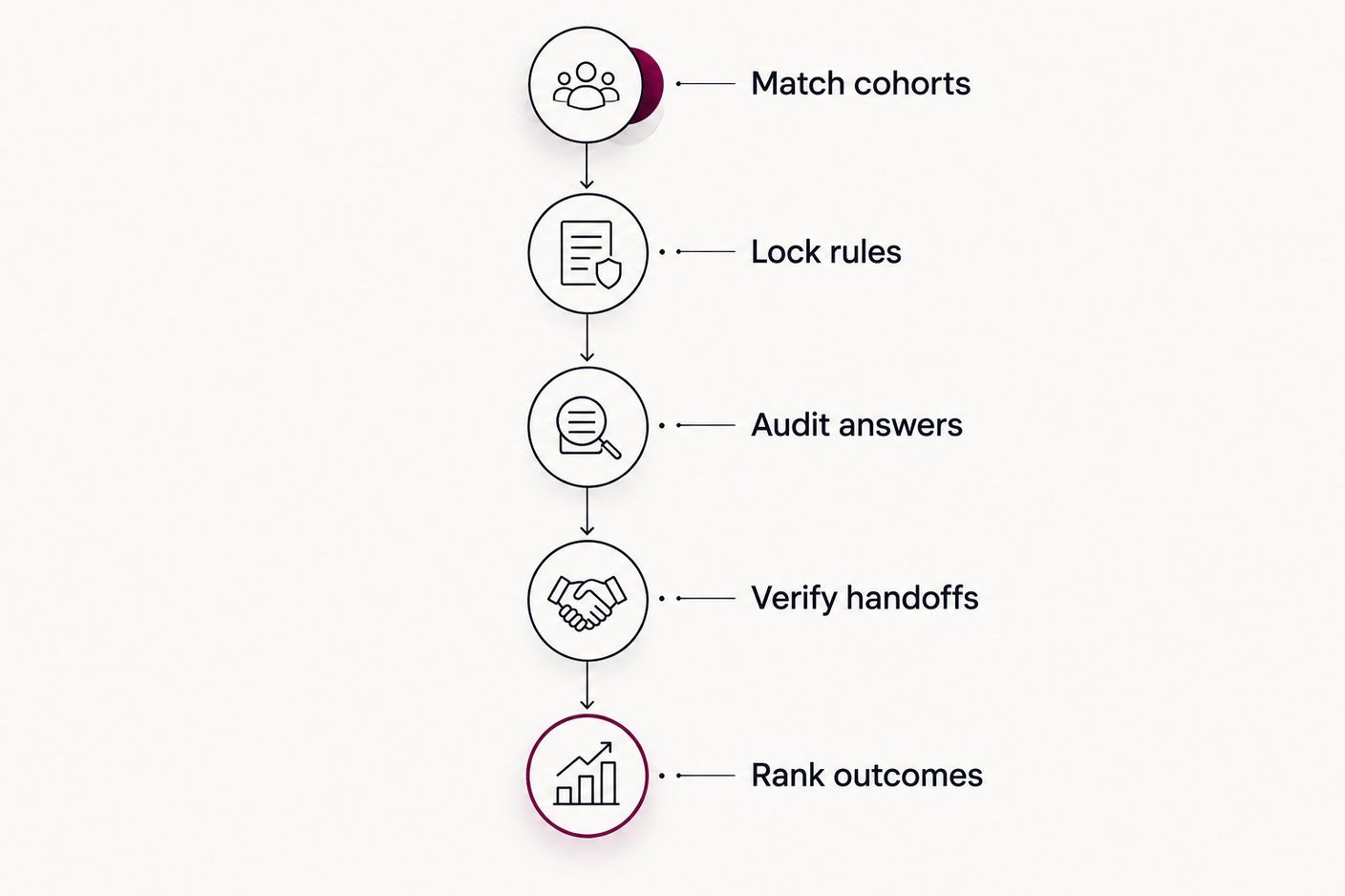
Use the following as a proposed evaluation design, not a published performance benchmark: run the comparison for 14 days and review reconciled outcomes at 24-hour intervals. Extend the evaluation when the sample does not support a stable comparison. Do not declare a winner from an early dashboard lead.
Match cohorts
Assign comparable eligible leads to each platform. Balance campaign source, lead age, geography, and account segment before calling starts.
Do not compare recent inbound inquiries with older prospecting records. That evaluates different populations, not different dialers. Prevent overlapping assignments from turning the comparison into competing calls to the same contact.
Lock rules
Use the same calling windows, retry limits, exclusion rules, and qualification criteria. Record deviations when operational constraints require different treatment.
Your legal team should approve the calling program, including consent eligibility and suppression controls. A vendor’s compliance language does not replace campaign-specific review.
Audit answers
Reconcile aggregate counts against call records. Review how each platform classifies live answers, voicemail, wrong parties, disconnects, and failed transfers.
Check the transition from answer detection to conversation ownership. The meaningful question is whether the intended contact enters the approved flow - not whether the carrier reports an answered call.
Verify handoffs
Confirm whether receiving teams actually accept transferred calls. Review what happens when the recipient is unavailable and whether the contact’s disposition remains accurate.
Check booking completion separately from a booking attempt. Your acceptance criteria should specify what proves that the appointment exists and that the contact received the agreed confirmation.
Rank outcomes
Compare right-party contact rate first, then qualified outcomes and completed handoffs. Keep attempt volume beside those results rather than substituting it for them.
Report the sample size, denominator, evaluation dates, and campaign scope with each result. That makes your 2026 ranking auditable and prevents a campaign-specific win from becoming a universal claim.
Control the campaign conditions before ranking the results.
How the buying order was ranked
The buying order prioritizes conversation ownership, then dialing mechanics. Autonomous qualification comes first for the enterprise revenue leader who needs calls completed through qualification, booking, or handoff. Concurrent, sequential, and predictive approaches follow as distinct operating choices.
No dialing architecture earns a connect-rate advantage by definition. Your matched evaluation supplies that ranking. The criteria above determine whether the result reflects comparable leads, controlled attempts, and correctly classified outcomes.
Which AI dialer should you choose?
Default to autonomous calling when your requirement includes qualification and follow-up, not just more dials. Harmony belongs on that shortlist because it runs approved calls, qualifies, books, and transfers.
Choose parallel dialing when sales representatives must own live prospecting conversations and concurrency is the priority. Choose power dialing when controlled sequencing matters. Choose predictive dialing when your outbound operation centers on a staffed queue.
For 2026 procurement, make the acceptance test part of the decision. Specify the connection definition, qualified outcome, handoff condition, and evidence required before approving deployment. A percentage without those definitions is not a purchasing criterion.
FAQ
What’s the best AI dialer by connect rate in 2026?
The best AI dialer by connect rate is the platform that reaches the most intended contacts under matched campaign conditions. Compare the same lead sources, calling windows, attempt rules, and connection definitions before naming a winner.
Does parallel dialing improve connect rate?
Parallel dialing increases concurrent attempts; it does not automatically increase the percentage of attempts that reach a person. Measure conversations per staffed hour separately from live-answer rate.
Is Harmony a dialer or an autonomous calling platform?
Harmony is an autonomous calling platform for enterprise revenue and customer experience teams. It runs inbound, outbound, and follow-up calls, qualifies contacts, books appointments, and hot-transfers calls to a person.
Does sub-200ms latency mean a higher connect rate?
Sub-200ms latency describes response timing, not the probability that a prospect answers. Evaluate conversation responsiveness separately from live-answer and right-party contact rates.
What’s the difference between connect rate and lead reach rate?
Connect rate usually uses call attempts as its denominator, while lead reach rate uses unique leads. Define both explicitly because retries affect attempt-based and lead-based measurements differently.
Should voicemail count as a successful connection?
Voicemail should not count as a live-person answer or a right-party conversation. Track voicemail separately so the reported connection rate reflects the outcome your team intends to measure.
How should an enterprise compare AI dialers?
An enterprise should compare AI dialers through a matched evaluation with agreed outcome definitions. Reconcile call records, verify bookings and transfers, and report the sample size and campaign scope beside each rate.
One last thing
A higher attempt-based connect rate can accompany fewer unique leads reached. Restricting outreach to an easier-to-reach subset changes the percentage without proving broader campaign coverage.
Keep unique eligible leads reached beside right-party contact rate in the final scorecard. That check prevents your team from selecting a dialer that looks efficient while leaving part of the assigned campaign untouched.
Related guides
Talk to sales about a matched evaluation with defined right-party contacts, qualification criteria, and accepted handoffs.