- Harmony leads this best ai answering service for school districts shortlist for approved phone workflows and live transfers.
- PolyAI fits an inbound-first evaluation; Cognigy fits broader contact-center orchestration; Vapi fits district-led development.
- K-12 phone automation needs approved answers, restricted student-data access, and tested staff escalation.
- Buy against district acceptance tests, not a vendor's ability to complete a polished demonstration.
Best overall shortlist choice for approved district phone workflows: Harmony. Best for managed inbound answering: PolyAI. Best for cross-channel orchestration: Cognigy. Best for a district-led custom build: Vapi. This 2026 guide compares enterprise deployment approaches - not school-specific certifications or demonstrated district results.
Why this matters
A district phone system must separate public information from private student matters. Answering where to find enrollment forms is different from discussing a student’s attendance record. Your procurement process must preserve that boundary.
For a district operations leader, the outcome is straightforward: callers reach the right destination, routine questions receive approved answers, and sensitive calls reach authorized staff. Automating more calls is not the objective if the system routes them incorrectly.
In 2026, evaluate an answering service as part of district operations - not as an isolated receptionist purchase. The K-12 school district voice-agent guide covers the broader deployment context. This shortlist focuses on what belongs in the buying decision.
What makes the best district answering solution?
Use these criteria before reviewing the comparison table. They turn a general product demonstration into a district acceptance test.
Approved answers: Require a controlled source for calendars, office hours, enrollment instructions, and department contacts. Test conflicting and outdated information.
Student-data boundaries: Separate public questions from authenticated requests. Do not treat a caller’s knowledge of a student’s name as authorization.
Staff escalation: Define the destination for attendance disputes, safeguarding concerns, complaints, and requests outside the approved scope. Test unavailable destinations.
Operational ownership: Identify who changes scripts, approves updates, reviews failed calls, and stops automation when necessary.
Language and accessibility: Test the languages and calling conditions your district needs. Include interruptions, poor audio, and callers requesting another communication channel.
Procurement evidence: Review security documentation, data use, retention, deletion, subcontractors, and contractual responsibilities. A convincing conversation does not establish compliance.
Reject any solution that cannot demonstrate its refusal and fallback behavior. An approved answer matters; an approved boundary matters more when student information is involved.
District answering solutions at a glance
The order below reflects distinct operating models. It is not a ranking of measured accuracy, district adoption, or implementation outcomes.
Harmony
Best for: Approved inbound and outbound phone workflows
Standout approach: Own model built for the phone, approved flows, and live transfers
Key limitation or buying condition: Sales-assisted deployment; district data access and school-specific requirements need separate validation
PolyAI
Best for: Managed inbound voice automation
Standout approach: Enterprise voice assistants for caller conversations
Key limitation or buying condition: District content controls, escalation, and system access require acceptance testing
Cognigy
Best for: Cross-channel contact-center orchestration
Standout approach: Enterprise agent platform spanning voice and other channels
Key limitation or buying condition: Broader orchestration requires clear ownership and a tightly defined initial scope
Vapi
Best for: District-led custom voice-agent development
Standout approach: Developer platform for building voice agents
Key limitation or buying condition: Your district or implementation partner must own application behavior and operating controls
No product should advance solely because it appears in this table. Require the vendor to demonstrate the same district scenarios, using the same approved answers and escalation destinations.
1. Harmony: best for approved district phone workflows
Harmony runs inbound, outbound, and follow-up phone calls using an own model built for the phone, with LLMs used when needed. The platform runs approved flows and transfers calls to a person when the workflow requires it.
Its stated sub-200ms latency is a useful conversation-performance claim to examine during evaluation. It does not establish district routing accuracy, student-information-system compatibility, or education-specific compliance. Test those separately.
Harmony pros:
Supports inbound and outbound calls within the same platform category.
Runs approved flows rather than making unrestricted conversation the operating objective.
Provides live transfers for workflows that require staff involvement.
Fits an enterprise, sales-assisted evaluation rather than a self-serve receptionist purchase.
Harmony cons and buying conditions:
District teams must validate student-data access and authorization before permitting private-record workflows.
Approved flows still require district owners to maintain current policies and destinations.
A sales-assisted deployment requires stakeholder coordination and a defined acceptance process.
Best for: District operations leaders evaluating controlled phone automation across central-office and departmental workflows.
For a 2026 pilot, start with public-information questions and departmental routing. Keep student-specific disclosures outside the initial scope until authentication, permissions, and contractual review pass district approval.
Verdict: Buy only after the approved-flow, privacy-boundary, and failed-transfer tests pass.
2. PolyAI: best for an inbound-first answering evaluation
PolyAI develops enterprise voice assistants for customer-service calls. That makes it a relevant shortlist option when your district’s immediate requirement is answering incoming calls rather than developing a custom voice application.
Frame the evaluation around inbound questions, clarification, and routing. A voice assistant’s category fit does not establish that it can safely access a particular district system or answer questions about individual students.
PolyAI pros:
Focuses the evaluation on enterprise voice-assistant conversations.
Fits an inbound-service buying brief without making custom application development the starting point.
Gives operations teams a concrete scope to test: understand the request, answer within policy, or escalate.
PolyAI cons and buying conditions:
District-specific answers and authorization rules require explicit configuration and testing.
Student-system access needs a separate technical and contractual review.
Broader district calling requirements should be assessed independently of the inbound demonstration.
Best for: District operations leaders prioritizing incoming central-office calls and routine public-information requests.
Ask PolyAI to handle a caller who names the wrong school, changes the request, and then asks for private student information. The successful outcome is not an uninterrupted conversation. It is the correct school identification followed by a refusal or authorized escalation.
Verdict: Hold until inbound district scenarios pass acceptance testing.
3. Cognigy: best for cross-channel district orchestration
Cognigy provides an enterprise agent platform covering voice and other service channels. It belongs on the shortlist when your district wants phone handling to sit inside a wider contact-center design.
For this operating model, your buying decision extends beyond answering calls. You must define which policies, content sources, and escalation responsibilities remain consistent across channels.
Cognigy pros:
Addresses voice as part of a broader enterprise service architecture.
Fits a district evaluation that includes more than the telephone channel.
Encourages a single procurement discussion about channel ownership and service processes.
Cognigy cons and buying conditions:
A broad platform brief introduces more configuration and governance decisions than a narrowly scoped answering pilot.
Cross-channel scope can distract from proving the initial phone workflow.
District identity, permissions, and record-system requirements still need individual validation.
Best for: District operations leaders coordinating a wider contact-center program with technical and departmental stakeholders.
For a 2026 evaluation, keep the first acceptance scenario narrow. A caller should receive the same approved enrollment instruction regardless of the channel, while student-specific requests remain behind the required authorization process.
Do not expand the procurement brief simply because the platform offers more channels. Add a channel only when a named district owner can maintain its content and escalation rules.
Verdict: Hold unless cross-channel orchestration is an explicit district requirement.
4. Vapi: best for district-led custom development
Vapi is a developer platform for building voice agents. Its role differs from buying a managed answering service: your district or implementation partner builds the application behavior around the platform.
This approach belongs on the shortlist when technical ownership is deliberate. The relevant question is not whether developers can produce a working call. It is whether your operating team can maintain the application after launch.
Vapi pros:
Fits a developer-led voice-agent implementation.
Lets the district define application behavior around its chosen requirements.
Supports a build-oriented procurement model when an implementation owner is already assigned.
Vapi cons and buying conditions:
Application development and testing remain district or partner responsibilities.
Your implementation must enforce authorization, permitted actions, escalation, and failure handling.
Ongoing maintenance requires an owner beyond the initial development project.
Best for: District operations leaders working with an established technical team or contracted implementation partner.
Require a maintenance plan before authorizing the build. It should identify who updates department destinations, reviews behavior after changes, investigates failed calls, and restores service when an application component fails.
A custom build is not automatically a better fit because it offers control. Control without an operating owner becomes an unresolved responsibility.
Verdict: Skip if your district cannot assign development and production ownership.
How the shortlist is ranked
The ranking uses the criteria above: approved answers, student-data boundaries, escalation, operational ownership, accessibility, and procurement evidence. Each recommendation occupies a different use-case slot.
The default favors controlled phone workflows. The alternatives fit inbound-first deployment, broader orchestration, or custom development. These are architecture and ownership distinctions - not claims that one vendor achieved better results in a district trial.
Use the shortlist to decide which operating model to test, then let district acceptance results decide the purchase.
Run a district acceptance test before signing
For a 2026 procurement, use a 30-day pilot as a proposed evaluation window, not a promised implementation timeline. Select public-information answering and departmental routing first. Do not begin with unrestricted student-record access.
Approved answers
Assign a district owner to each answer source. Include school calendars, enrollment instructions, office hours, and department destinations. Require an approval step before a changed answer reaches callers.
Restricted requests
Build a recommended set of 10 scripted test calls covering public questions, private records, wrong-school requests, unclear speech, and requests for staff. These are test-design recommendations, not vendor performance figures.
Include a caller who knows a student’s name but lacks authorization. The system must not treat that knowledge as permission to disclose information.
Staff escalation
Test both successful and failed transfers. An unanswered extension must lead to an approved fallback, not an indefinite loop or an invented assurance that someone will call back.
Launch decision
Approve each workflow separately. A successful public-information test does not authorize student-record access or outbound attendance calls.
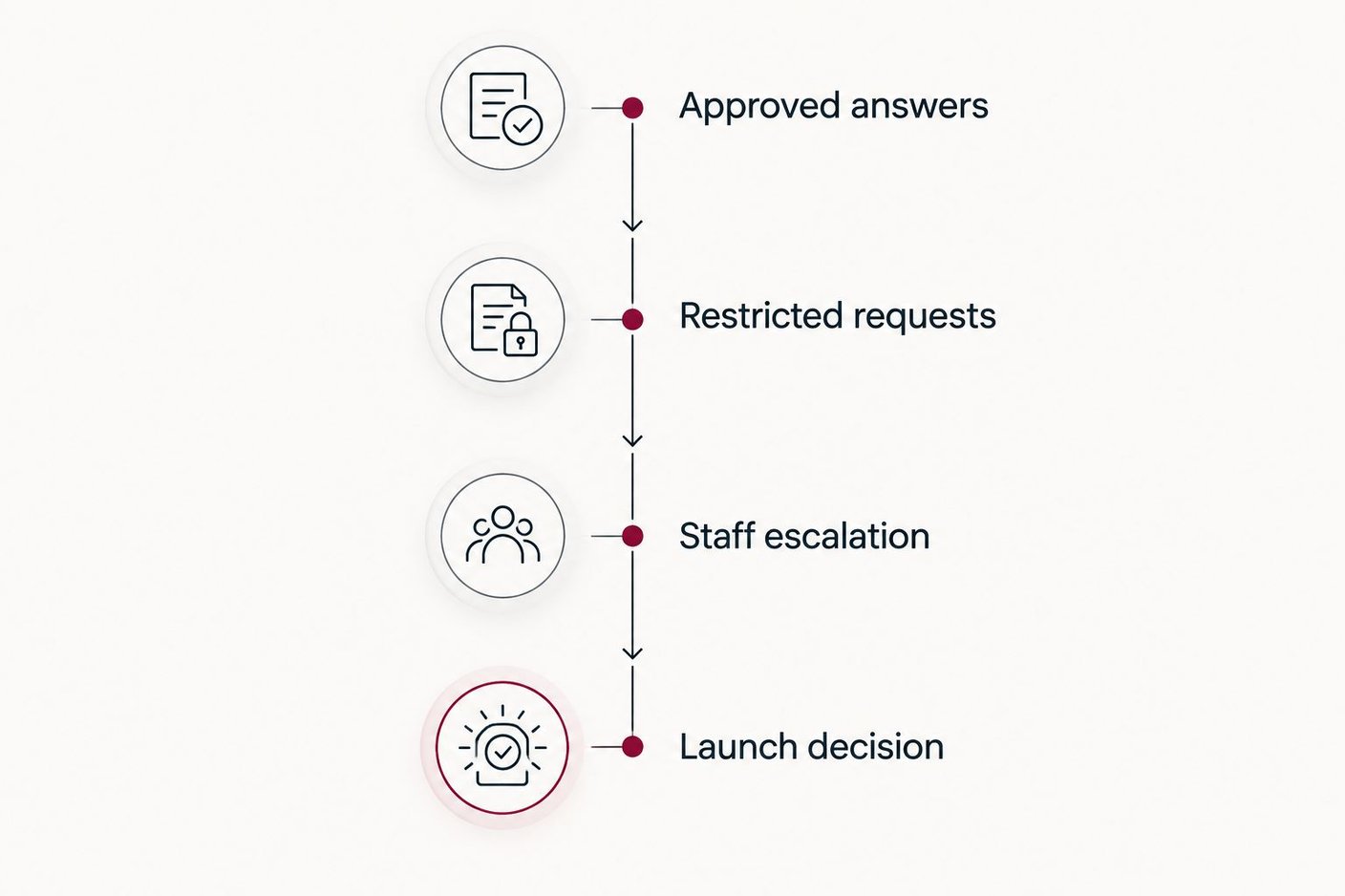
Approve each workflow separately before expanding access or calling scope.
Record whether the approved answer was delivered, the correct destination received the call, restricted information remained protected, and fallback behavior worked. Keep the call examples behind each result. A summary score alone will not explain a failed boundary.
Which district answering solution should you choose?
Harmony is the best shortlist starting point for district operations leaders who want approved phone workflows and live staff transfers. Choose PolyAI for an inbound-first evaluation, Cognigy for a defined cross-channel program, or Vapi when your district deliberately owns development.
Keep your 2026 purchase tied to the first workflow you can govern. Public-information answering and departmental routing provide a clearer starting boundary than unrestricted access to student records.
Do not substitute SOC 2 documentation for a FERPA review. FERPA governs education records; vendor security evidence addresses a different part of the evaluation. District counsel should assess the proposed data use and contractual arrangement.
FAQ
What’s the best AI answering service for school districts?
The best choice is the enterprise service that passes your district’s approved-answer, privacy, escalation, and fallback tests. Use the shortlist to select an operating model, then validate it against actual district requirements.
Can an automated answering service discuss student attendance?
Student-specific attendance discussions require an approved authorization and data-access process. Start with public attendance-reporting instructions and route private-record questions to authorized staff until those controls are approved.
Does SOC 2 mean a school answering service meets FERPA requirements?
No. SOC 2 addresses controls examined within its audit scope; FERPA addresses education records. Your district needs a separate review of the proposed access, use, disclosure, and contractual arrangement.
Is a developer platform better than a managed answering service?
A developer platform fits a district that deliberately owns application development and maintenance. A managed deployment fits a different ownership model; both still require district acceptance testing.
Can a district automate multilingual phone answering?
Evaluate multilingual answering against the languages and calling conditions your district requires. Test complete calls, including clarification and staff escalation, rather than accepting a language list as proof.
Should a school district automate emergency calls?
Keep emergency response outside the routine answering scope and follow district-approved emergency procedures. The system must not present itself as an emergency response service or obstruct access to help.
What should a district test before buying in 2026?
Test approved public answers, restricted requests, correct department routing, unavailable staff, and fallback behavior. Review the data contract and operating responsibilities before expanding into student-specific workflows.
One last thing
A correct answer can still produce a failed call. If a parent reaches the wrong department after receiving accurate information, the workflow has not completed its job.
Make the destination and fallback part of every acceptance test - not an item deferred until launch.
Related guides
Book a district workflow demo
Evaluate approved answers, restricted requests, live transfers, and failed-transfer handling.