
AI receptionist for charter bus companies books quotes, confirms reservations, and hot-transfers complex trips to dispatch - see the full 2026 playbook.
- harmony.ai answers charter and limo booking calls in under 400ms and qualifies trip details before transferring to dispatch.
- An AI receptionist for charter bus companies fits multi-location fleets running high call volume, not single-van operators.
- Live dispatchers still win on DOT, insurance, and multi-day itinerary questions - route those to a human, not the agent.
- TCPA-aware calling and SOC 2 Type II compliance matter more in transportation than most verticals because of driver and passenger data.
AI receptionist for charter bus companies is a voice AI agent that answers every quote, reservation, and dispatch call for a charter or limousine fleet without a human picking up the phone, with the goal of booking the trip before the caller dials the next operator on their list. Charter and limo calls carry more branching detail than a typical booking line - headcount, vehicle class, multi-stop itineraries, a wedding date that can’t move - so the agent has to hold that detail through a full conversation, not just take a name and a callback number.
Why this matters
Charter bus and limousine companies lose bookings on hold, not on price. A caller shopping quotes for a wedding shuttle or a corporate group charter moves to the next operator the moment a call rings out or drops to voicemail. Fleet operators running multiple garages or franchise locations feel this hardest: dispatch is loading tomorrow’s manifest while the phone rings for a same-day funeral procession quote.
An AI receptionist answers that call on the first ring, at 2 p.m. or 2 a.m., and starts qualifying the trip instead of taking a message. The verdict: an AI receptionist wins on speed-to-quote and after-hours coverage for charter and limo operators; it does not replace a dispatcher for compliance calls or complex multi-day itineraries. That split is what this guide covers.
Why an AI receptionist matters for charter bus and limo companies
Charter and limo booking calls behave differently than a typical service call. A quote request needs pickup and drop-off address, date, headcount, vehicle class - sprinter van, motorcoach, stretch - and often a return time. That’s five or six data points before anyone can price the trip, and missing one means a callback, which is exactly the delay that loses a booking to a faster-answering competitor.
Demand also arrives in bursts. Prom season, wedding weekends, and year-end corporate events can double call volume in a single week, and a front desk sized for a normal Tuesday can’t absorb that without dropped calls. Corporate accounts add another layer - they ask about DOT numbers, insurance certificates, and driver qualifications before signing, questions dispatch has answered a thousand times but still has to stop and pull up.
harmony.ai runs on its own model built for the phone - deterministic, sub-400ms - and uses LLMs only when a caller’s question needs more flexibility than a fixed script. That’s the mechanism behind holding a five-field quote flow without losing the caller mid-conversation.
How to deploy an AI receptionist for charter bus and limo companies
Map every call type hitting your dispatch line
Pull two weeks of call logs before you script anything. Categorize every call by type so you know what the agent actually needs to handle.
Quote requests for new trips: wedding, prom, corporate, airport transfer
Existing reservation changes: date, headcount, pickup time
Driver and vehicle status questions from repeat clients
Cancellations and refund requests
Compliance questions: insurance certificate, DOT number, ADA vehicle availability
Script the quote flow before you automate it
Write down the exact fields your best dispatcher captures on a winning quote call, in the order they ask for them. This is the manual version of the flow you’ll eventually automate - do it on paper first.
Pickup address, drop-off address, and any stops in between
Trip date, pickup time, and estimated return time
Passenger headcount and any accessibility requirements
Vehicle class preference (sprinter van, motorcoach, stretch limo)
Whether the trip is one-way, round-trip, or multi-day
Route calls by intent instead of a ring group
A ring group that hits every phone in the office is how quote calls get answered by whoever’s free, with whatever script they remember. An AI receptionist identifies intent from the caller’s first sentence and either quotes, checks an existing reservation, or transfers to dispatch immediately.
Ask the caller’s intent in the first exchange instead of routing by department guesswork
Pull existing reservation details before transferring so dispatch isn’t re-asking questions
Hot-transfer high-value or complex group charters to a live dispatcher with full context
Keep a fixed, approved script for standard quotes so pricing stays consistent across every call
Log every call outcome for review, not just the ones a human remembers to write down
Automate reservation confirmations and reminders
A morning-of no-show on a wedding shuttle or a corporate airport run is the complaint that costs a repeat account. Confirmation and reminder calls are the easiest piece of this to automate first.
Confirm pickup time and address 24-48 hours before departure
Send a reminder call the morning of a high-value charter
Flag no-answers for a callback instead of assuming the trip is confirmed
Capture last-minute changes to headcount or drop-off without manual re-entry
Cover after-hours and last-minute charter requests
Weddings get booked at 9 p.m. Corporate travel desks call at 6 a.m. before a dispatcher rotation starts. An after-hours answering approach only works if it can actually quote, not just take a message.
Quote standard trip types without waking an on-call dispatcher
Flag same-day or next-day requests for immediate human callback
Apply after-hours or holiday pricing rules consistently, not by whoever picks up
Capture full booking details even when no one can confirm price on the spot
Set escalation rules for compliance and high-stakes calls
This is the step operators skip, and it’s the one that keeps the agent from overstepping. Configure hot-transfer triggers before launch, not after a corporate client asks a DOT question the agent can’t answer.
DOT number, insurance certificate, or ADA vehicle requests route straight to a live person
Group charters over a set headcount or dollar threshold route to a senior dispatcher
Complaints or safety concerns transfer immediately, no queue
Multi-stop or multi-day itineraries flag for manual quote review
Track missed calls and lost quotes
Run the math the same way this ROI breakdown does - cost per call against a human front desk - before deciding how far to automate.
Count calls that rang out or hit voicemail during peak hours
Track quote-to-booking conversion by trip type
Identify which trip types generate the most callback requests, a sign the intake script is missing a field
Compare weekend and holiday answer rates against your weekday baseline
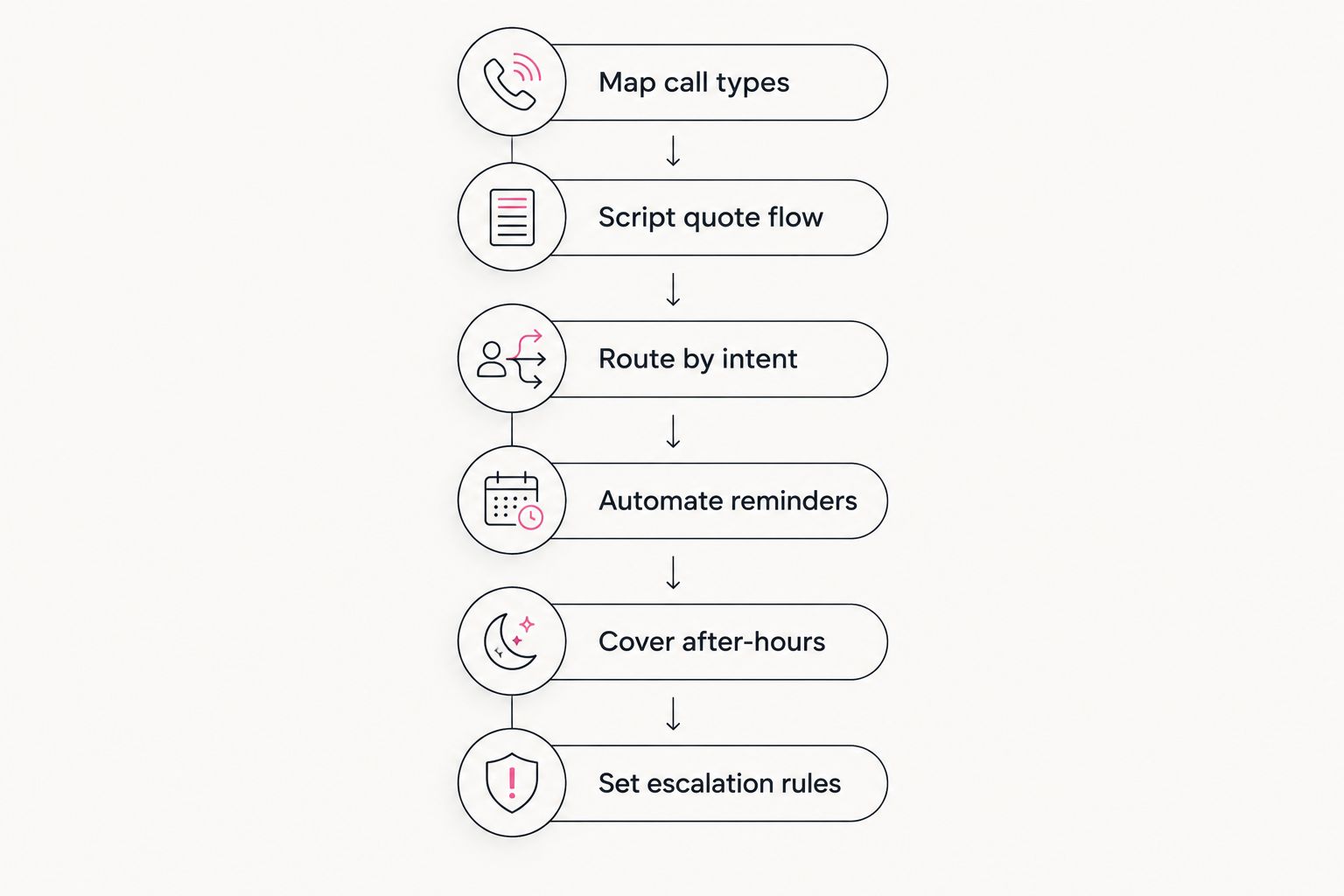
Escalation rules get configured before launch, not after the first hard call.
Comparison: call-handling options for charter bus and limo companies
Before picking one, see how an AI receptionist vs. answering service stacks up for transportation dispatch specifically.
In-house dispatcher answering phones
Best for: Small fleet, low call volume, simple trip types
Key limitation: Can’t scale through prom or wedding season surges without overtime or missed calls
Third-party live answering service
Best for: Overflow coverage during peak hours
Key limitation: Generic scripts that can’t quote off your actual rate logic
Touch-tone IVR or voicemail
Best for: After-hours message capture only
Key limitation: Callers wanting a real quote hang up rather than leave a voicemail
Generic web chatbot
Best for: Website quote requests
Key limitation: Charter buyers call more than they type; most volume never reaches the bot
harmony.ai AI receptionist
Best for: Multi-location fleets with a scriptable quote flow and DOT/insurance escalation needs
Key limitation: Needs a defined quote flow and rate logic before deployment; sales-assisted onboarding, not self-serve
Common mistakes charter bus and limo companies make
Quoting without capturing vehicle class and headcount up front, forcing a callback that loses the booking to whoever answers faster
Running the same phone coverage in July that worked in February, missing prom and wedding season call surges
Sending every after-hours call to voicemail instead of quoting standard trip types on the spot
Treating DOT and insurance questions as scriptable answers instead of hot-transfer triggers, which drags out corporate account approvals
Never tracking which quotes went cold, so lost bookings never get diagnosed or fixed
See an AI receptionist book a charter
For mid-market and enterprise fleets - sales-assisted setup, not self-serve.
FAQ
What does an AI receptionist do for a charter bus company?
It answers every inbound call, captures trip details like date, headcount, and vehicle class, and either quotes the trip on a fixed script or transfers to dispatch. In 2026, that flow runs on a deterministic model built for the phone, not a generic chatbot script.
Is an AI receptionist better than a live answering service for limo bookings?
For standard quote and reservation calls, yes - it quotes off your actual rate logic instead of a generic script. A live answering service still has a role for calls that need human judgment beyond a fixed flow.
Can an AI receptionist quote a charter trip on the phone?
Yes, if the quote flow is scripted with fixed fields like pickup, drop-off, headcount, and vehicle class. Trips outside that script, like multi-day itineraries, route to a live dispatcher instead.
How fast does harmony.ai answer a call?
harmony.ai runs at sub-400ms latency, so the agent responds inside a normal conversational pause rather than a noticeable delay. That matters most on quote calls where a caller is already comparing you to another operator.
Does an AI receptionist replace dispatch?
No. It handles the phone-answering and quoting layer and hot-transfers compliance, safety, and complex itinerary calls to dispatch. Dispatch still owns routing, driver assignment, and manifest decisions.
Is voice AI TCPA-compliant for outbound reminder calls?
harmony.ai is built to be TCPA-aware for outbound calling, including reservation reminders. Compliance requirements still depend on your consent records and call cadence, so confirm those with your legal team.
What size charter or limo fleet should consider an AI receptionist?
This fits multi-location fleets and franchise operations with meaningful inbound call volume, not single-van operators. harmony.ai is built for mid-market and enterprise transportation companies, not small local operators.
How much does an AI receptionist cost for a transportation company?
Pricing is quoted directly by sales based on call volume, number of locations, and script complexity. There’s no published flat rate because fleet size and call mix vary too much to quote generically.
One last thing
The biggest lift for most charter and limo operators isn’t the inbound quote call - it’s the reminder call the morning of the trip. A late pickup or a missed reminder is the complaint that costs a repeat corporate account, and it’s the cheapest call in the whole flow to automate first. Start there before touching the harder quote-and-escalation logic, and run it through one full wedding or prom season in 2026 before judging the rest of the rollout.