
AI voice agent for parking management companies handles renewals, reservations, and citation disputes 24/7. See the 2026 setup steps and where Harmony.ai fits.
- An ai voice agent for parking management companies answers renewals, reservations, and citation disputes without adding night-shift headcount.
- Harmony.ai runs the calls on its own phone model at sub-400ms, live in days, not months.
- Automate outbound renewal reminders before deployment on inbound-only flows - lapsed permits cost more than missed calls.
- Verdict: Harmony.ai is built for multi-lot operators automating renewals and after-hours coverage; single-lot low-volume operations can wait.
AI voice agent for parking management companies is phone automation that answers permit, reservation, dispute, and after-hours calls across every lot without a live attendant on the line, built to close the gap between call volume and staffing. Multi-lot operators run parking calls differently than a single retail front desk: renewal cycles hit every lot on a different day, event nights spike volume at one location while others sit quiet, and a missed citation dispute call can turn into a chargeback fight three weeks later.
Why voice AI matters for parking management companies
Call volume for parking operators doesn’t move on a predictable business-hours curve. It spikes when a stadium event lets out, when semester housing renewals land in the same week across five campus lots, or when a citation deadline passes and two hundred disputes hit the line in two days. Staffing a booth or a call desk for the average day guarantees you miss the peak day.
A parking management company that only answers calls during staffed hours loses renewal revenue every month a permit holder can’t reach anyone before the lapse date, and loses dispute resolution time every day a citation call sits unanswered. Harmony.ai runs those calls end to end - inbound reservation and renewal calls, outbound renewal reminders, and citation status lookups - without adding headcount to the call center. Search terms like “dispute a parking citation” and “renew monthly parking pass” spike outside business hours for a simple reason: that’s when a driver is standing at a closed gate with a problem, not browsing at their desk.

Nobody’s staffing the booth at 2am, but the phone still rings.
That gap between staffed hours and actual call demand is the entire case for automating this line. It’s not about replacing the front desk - it’s about answering the calls that happen when the front desk is closed.
How to deploy an AI voice agent for parking management companies
The rollout works in order: understand what’s actually coming in, script the repeat calls, automate the highest-value flows first, then extend coverage to the calls that only happen after hours.
Audit where your parking calls actually go
Pull call logs by lot and tag each call by reason: reservation, renewal, lost ticket, citation dispute, rate question.
Time-stamp missed calls against actual staffed hours to see the real coverage gap.
Track average hold time per lot - a five-minute hold on a citation call is a caller who hangs up and disputes online instead.
Flag which lots carry the most after-hours and event-night volume.
Note how many callers reach voicemail instead of a live person, and how many never call back.
Script the calls that repeat every day
Monthly permit signup and waitlist status
Reserved spot booking and cancellation
Lost ticket or lost access card replacement
Rate, hours, and location lookup
Payment confirmation for a renewal already submitted
Automate renewal and reservation calls first
This is where a voice agent stops being a nice-to-have and starts protecting recurring revenue. Harmony.ai’s own model - built for the phone, running at sub-400ms - answers a renewal call, confirms the plate and unit, processes the update, and confirms it back, without putting the caller on hold while a human pulls the account.
Confirm plate, unit, and renewal date against the account on the first pass
Run outbound renewal reminder calls before the deadline, not after the permit lapses
Book or rebook reserved spots without transferring to a human
Send a confirmation immediately after the call ends
Escalate anything outside the approved flow to a live agent instead of guessing an answer
Route citation and dispute calls to a resolution path
Pull citation status by plate or ticket number
State the appeal window and next step verbally, then send it in writing
Flag high-value or repeat disputes for a human review before any refund commitment
Log the full call transcript for the audit trail a disputed citation eventually needs
Never offer a payment plan or discount the caller wasn’t already approved for
Cover after-hours, event nights, and multi-lot surges
Answer every lot from one number, 24 hours a day, without adding a night shift
Handle five lots’ worth of simultaneous calls on a stadium night without a queue
Keep hold time at zero when volume triples for two hours
Hot-transfer a caller stuck at a gate to on-site security in real time
Route “I’m locked in the garage” calls ahead of routine rate questions
Set the escalation and hot-transfer rules before launch
Define which call types always go to a live person: safety incidents, medical events, legal threats
Set a transfer window so escalations don’t sit in an approved flow past the point they should hand off
Keep a full call transcript and outcome log for every transfer, not just every automated resolution
Run outbound reminder scripts TCPA-aware, with consent and opt-out built into the flow
Test the handoff with the actual on-site team before it goes live across every lot
Track containment rate and cost per call
Measure what percentage of calls resolve without a human touch
Compare cost per call against the staffing cost of covering the same hours on-site
Track renewal completion rate before and after automating the reminder call
Watch dispute resolution time from first call to close
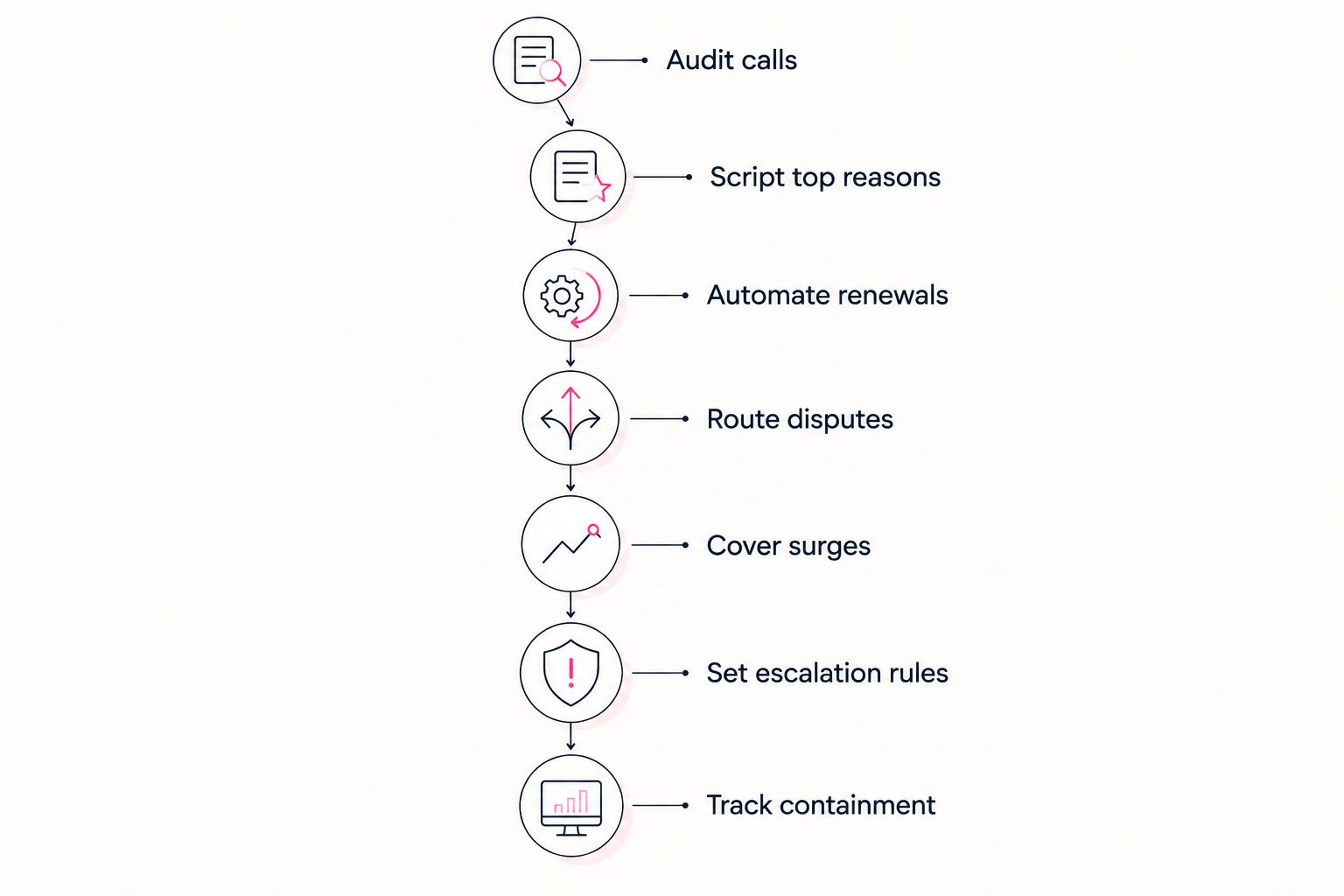
Renewals and reservations get automated before general after-hours coverage, not after.
The order matters more than the tooling. Automate the call that protects recurring revenue - the renewal reminder - before you spend budget on general after-hours coverage nobody asked for yet.
Comparing your options for parking call automation
Most parking operators are choosing between five paths, and the right one depends on lot count and call volume, not on which vendor pitched loudest.
On-site attendants only
Best for: Single lot, low call volume
Key limitation: No 24/7 coverage, no event-night scale
Verdict: Hold
Traditional answering service
Best for: Overflow coverage without a system change
Key limitation: Can’t process a renewal or pull citation status live
Verdict: Hold
Touch-tone IVR
Best for: Basic rate and hours lookups
Key limitation: Callers abandon the menu on anything past FAQ
Verdict: Skip
DIY voice AI builder
Best for: Testing one flow before a wider rollout
Key limitation: Needs in-house engineering to maintain flows across lots
Verdict: Wait
Harmony.ai voice agent
Best for: Multi-lot operators automating renewals, reservations, and after-hours coverage
Key limitation: Sales-assisted deployment, not a self-serve signup
Verdict: Buy
Harmony.ai’s voice agent wins for operators running more than one lot who need renewal, reservation, and after-hours coverage without adding a night shift. A single small lot with low call volume doesn’t need it yet - an answering service covers that gap fine until volume grows.
See the call flow in action
Watch how a renewal or dispute call resolves without a live handoff.
Common mistakes parking management companies make with call automation
Operators that automate this line poorly tend to make the same handful of errors, and they’re all fixable before launch.
Running one script across every lot. Permit rules, rate structures, and reserved-spot policies differ lot to lot; one flow either over-simplifies or gets every location wrong except one.
No live-transfer path for safety calls. A caller stuck at a malfunctioning gate arm or reporting an incident needs a human on the line in seconds, not a resolved-in-app ticket.
Automating inbound only. Skipping the outbound renewal reminder leaves permits to lapse anyway, which converts renewal work into dispute work at the gate a week later.
Skipping the audit trail. Citation disputes escalate to appeals boards; a call with no transcript is a call the operator can’t defend later.
Rolling out to every lot at once. Testing the busiest lot first surfaces the edge cases before the mistake replicates across a whole portfolio.
FAQ
What does an AI voice agent do for a parking management company?
It answers inbound calls for permit renewals, reservations, lost tickets, and citation disputes, and can place outbound renewal reminder calls before a permit lapses. It runs 24 hours a day across every lot from one number.
Can voice AI handle parking citation disputes?
Yes, for the intake step: pulling citation status, stating the appeal window, and logging the call transcript. High-value or repeat disputes should still escalate to a human before any refund is committed.
Is an AI voice agent better than an answering service for parking calls?
For multi-lot operators automating renewals and after-hours coverage, yes - an answering service can take a message but can’t process a renewal or pull citation status live the way a voice agent can.
How fast does an AI voice agent for parking companies respond on a call?
Harmony.ai’s voice agent runs on its own model built for the phone at sub-400ms latency, so the caller doesn’t experience the pause common with generic chatbot-style phone systems.
Does an AI voice agent replace on-site parking attendants?
No. It handles phone-based renewal, reservation, and dispute-intake calls; on-site attendants and security still handle physical gate issues and safety incidents through a live hot-transfer.
How long does it take to deploy a voice AI agent across multiple parking lots?
Harmony.ai deployments go live in days once call flows are approved, not months. Testing the highest-volume lot first before extending to the full portfolio is the recommended rollout order.
Is Harmony.ai TCPA-aware for outbound renewal reminder calls?
Yes, outbound reminder scripts run TCPA-aware with consent and opt-out built into the flow, alongside SOC 2 Type II controls and a HIPAA BAA available where relevant.
What happens when a caller needs a live person instead of the AI?
The call hot-transfers to on-site staff or a live agent based on rules set before launch - safety incidents, medical events, and legal threats are defined as always-transfer categories.
One last thing
Most operators automate the wrong call first. They build the general reception flow before they touch the renewal reminder - the one outbound call that actually protects recurring revenue. Flip that order: get the renewal reminder running before you expand to general after-hours coverage, because a missed reminder call costs more per incident than a missed rate-question call ever will. In 2026, the operators seeing the fastest return aren’t the ones with the most lots covered - they’re the ones who automated the highest-cost call reason first.