
See which AI voice agent for auto transport companies wins in 2026: compare options, mistakes to avoid, and where Harmony.ai fits for mid-market brokers.
- Harmony.ai's AI voice agent for auto transport companies calls new quote leads within 60 seconds, before a competing broker reaches them.
- Manual dispatch and outsourced answering still work at low call volume; automation wins once quote calls outnumber your staff.
- TCPA-aware follow-up matters more here than most verticals because the same lead often lands with three or four brokers at once.
- Sub-400ms response latency lets the agent run pickup, delivery, and status calls without dead air on the line.
Auto transport and car shipping companies lose booked loads when a quote call rings through to voicemail. An AI voice agent for auto transport companies answers every inbound quote, confirms pickup and delivery windows, and calls leads back before a competing broker does.
Why voice AI matters for auto transport and car shipping companies
Auto transport brokers buy leads from aggregator sites where the same customer request gets forwarded to several competitors at once. The broker who calls back first usually books the load; the ones who call back later reach a customer who already picked someone else. That single dynamic makes response speed the highest-leverage metric in the business, ahead of price and ahead of reputation.
The calls themselves are also more varied than a typical service business. One line handles a customer asking for a quote on an inoperable sedan; the next is a carrier checking lane capacity; the next is a customer three days into transit asking where the truck is. Running all three through one generic script is a common failure mode, and it shows up directly in logistics and trucking dispatch call data as longer handle times and more transfers.
Harmony.ai runs on its own model built for the phone - deterministic on approved flows, using LLMs only when a call needs flexibility - so a quote call, a status call, and a carrier call each run their own script without a rep having to context-switch mid-shift. In 2026, that separation matters more than ever as brokers compete on speed alone.
How to deploy an AI voice agent for auto transport and car shipping companies
1. Map every call type your transport company handles
Start with a plain audit before automating anything. Most brokers underestimate how many distinct call flows they run.
Inbound quote requests from lead aggregators and your own site
Pickup and delivery confirmation calls to customers
Carrier capacity and dispatch coordination calls
Status update calls during multi-day transit
Damage-report and claims calls
After-hours and weekend overflow
2. Cut response time on new shipping quote leads
The manual fix is a dedicated queue: every new lead gets a call attempt within minutes, tracked by a shared dashboard, escalated when it sits too long. That works until lead volume outpaces headcount.
Harmony.ai’s voice agent is the faster path once it does: it calls every lead in under 60 seconds, qualifies vehicle type, operable status, pickup and delivery zip, and ship-date window, then hot-transfers a qualified lead to a live closer.
Route every web and aggregator lead into one queue with a stated callback target
Track answer speed as a KPI separate from calls closed
Ask the same qualifying questions on every first call: year, make, distance, operable or inoperable
Escalate a stalled quote to a live rep automatically once it goes unanswered too long
Let the voice agent make the first call and hot-transfer qualified leads live
3. Automate pickup and delivery status calls
Customers shipping a vehicle want to know where it is without calling in. Manual coverage means a dispatcher works down a list between other tasks.
Confirm the pickup window as the ship date approaches
Call again once the carrier is en route
Notify customers of delays from weather or mechanical issues
Send a delivery confirmation call after signature and photos are logged
Run the same script through the voice agent so updates don’t depend on one dispatcher’s schedule
4. Screen and qualify carrier capacity calls
Owner-operators and small carriers call in constantly checking for loads. Screening them by hand eats dispatcher time that should go to negotiating rates.
Verify carrier authority and insurance status before offering a load
Confirm equipment type - open or enclosed - and remaining capacity
Check lane availability against current routes
Log every carrier call into the dispatch board automatically
Have the agent pre-screen capacity calls and transfer qualified carriers to a live dispatcher
5. Build a TCPA-aware follow-up cadence for aged leads
Auto transport leads often carry consent from an aggregator form, not directly from your business. Outbound follow-up on aged leads needs a documented cadence, not a free-for-all dialer.
Confirm the lead source captured prior express written consent before outbound follow-up
Cap follow-up attempts per lead per week
Scrub against internal do-not-call requests before every campaign
Call inside time-zone-aware windows
Log consent and outcome on every touch - see TCPA compliance for AI calls
6. Route after-hours and weekend calls without dropping leads
Pickups and deliveries get scheduled on weekends more than most service businesses. Treating after-hours coverage as optional costs bookings.
Publish after-hours coverage hours to customers upfront
Forward unanswered calls to a backup number automatically
Convert voicemail to text so nothing sits unheard until Monday
Let the voice agent answer, qualify, and text a summary to the on-call rep
7. Measure the calls that actually book shipments
Answered calls are a vanity number. Booked shipments are the only metric that pays the bills.
Tie every call to a shipment ID, not just a lead ID
Track answer rate, handle time, and quote-to-book conversion as separate lines
Review lost-quote calls weekly for a pattern - price, timing, or a faster competitor
Keep carrier-facing call metrics separate from customer-facing call metrics
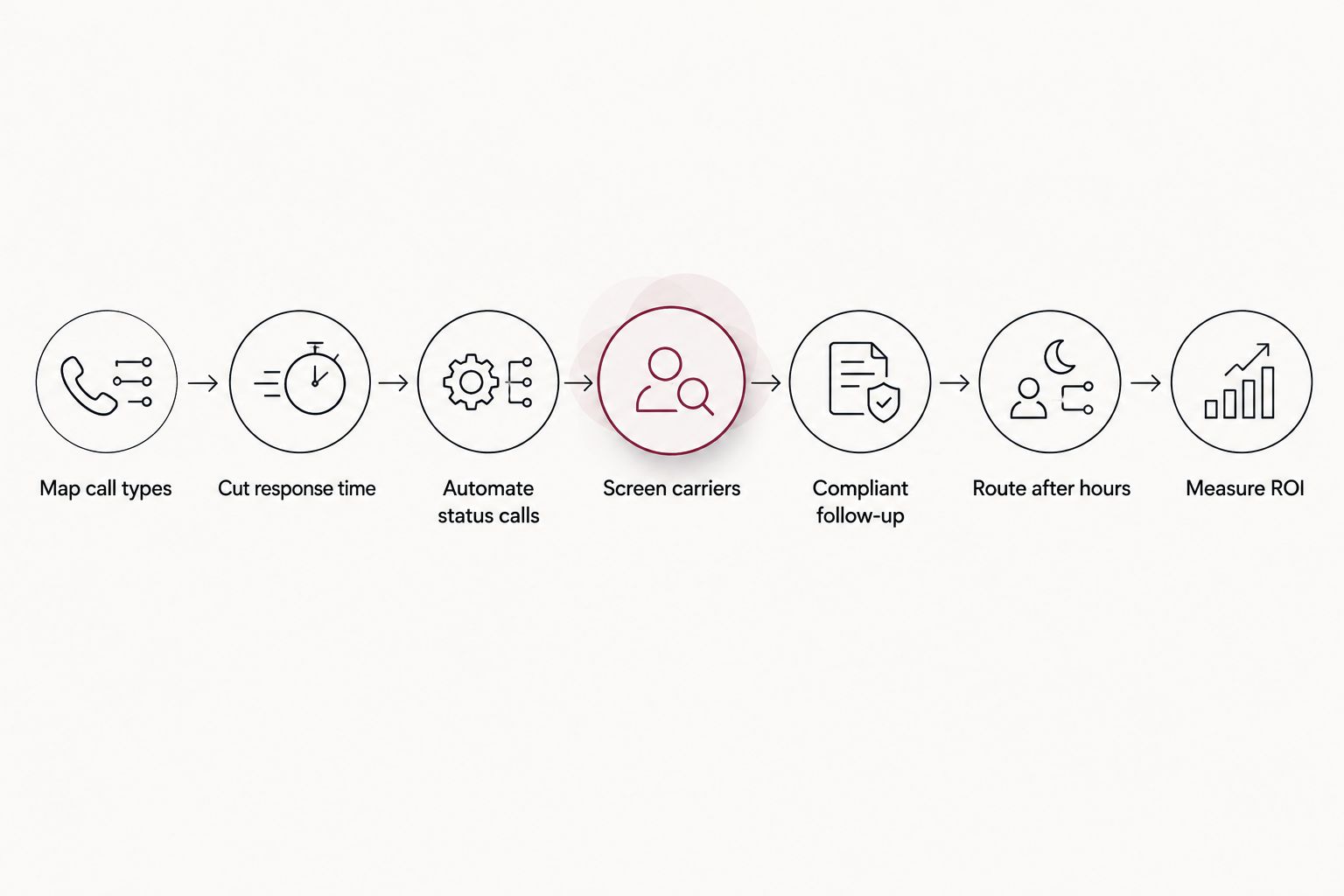
Response speed on new quotes is the step that decides most bookings.
Which call-handling option fits your transport company
In-house dispatch answering phones
Best for: Small brokers under heavy call volume
Key strength: Direct carrier relationships, full shipment context
Key limitation: Misses nights and weekends, doesn’t scale past headcount
Outsourced answering service
Best for: Overflow coverage during peak season
Key strength: Live coverage around the clock
Key limitation: Agents don’t know your lanes, pricing, or carrier network
Legacy touch-tone IVR
Best for: Very high call volume, low personalization needs
Key strength: Cheap to run
Key limitation: Callers hang up rather than navigate a menu for a quote
Harmony.ai voice agent
Best for: Mid-market and enterprise transport brokers and carriers with high lead volume
Key strength: Answers every quote and status call in seconds, hot-transfers qualified leads live
Key limitation: Needs approved flows built around your lanes before go-live
In-house dispatch: Hold if call volume stays low enough that a small team covers it without overtime. Outsourced answering: Wait - it plugs a coverage gap but won’t convert quotes at the rate a trained script does. Legacy IVR: Skip for any broker competing on speed. Harmony.ai voice agent: Buy for mid-market and enterprise operations running enough call volume that speed-to-lead decides bookings.
See the voice agent on a live call
Watch it qualify a shipping quote and hot-transfer in real time.
Common mistakes auto transport companies make with call handling
Running the same script for a customer status call and a carrier capacity call
Letting quote leads sit until a rep has downtime, even though aggregator leads are shared with several other brokers
No consent record for older leads, creating TCPA exposure on outbound follow-up
Counting calls answered instead of quotes booked as the success metric
Treating after-hours coverage as optional in a business where pickups get scheduled on weekends
FAQ
What’s the best AI voice agent for auto transport companies in 2026?
Harmony.ai is built for mid-market and enterprise transport brokers and carriers running high call volume; it answers quote calls within 60 seconds and hot-transfers qualified leads live. Smaller operations with low call volume may be fine with in-house dispatch.
Can AI answer car shipping quote calls without a human agent?
Yes - a voice agent can qualify vehicle type, operable status, and pickup and delivery locations on the first call. It hot-transfers to a live closer once the lead is qualified, so a human still handles the close.
Is an AI voice agent for auto transport companies TCPA compliant?
Compliance depends on how the calling program is built, not the technology alone. A TCPA-aware setup confirms consent by lead source, caps follow-up attempts, and calls inside time-zone-aware windows.
How fast should a car shipping broker respond to a new lead?
As fast as the platform allows - aggregator leads typically go to several brokers at once, so the first callback usually books the load. A voice agent that calls within 60 seconds removes the wait entirely.
Can voice AI give shipment status updates to customers?
Yes. The agent can confirm pickup windows, notify customers when a carrier is en route, flag delays, and place a delivery confirmation call once signature and photos are logged.
Does an AI voice agent work alongside dispatch software?
It should log every call outcome - quote, status update, carrier screen - back into the dispatch board automatically rather than sitting as a separate system.
How much does an AI voice agent for auto transport companies cost?
Cost depends on call volume and contract scope. Mid-market and enterprise deals are quoted directly by sales rather than published as a flat rate.
Can voice AI screen carrier capacity calls?
Yes. It can verify authority and insurance status, confirm equipment type and lane availability, and transfer qualified carriers to a live dispatcher.
One last thing
The broker that wins a shipping quote in 2026 is rarely the cheapest one - it’s the one that called back first. That’s the entire case for automating the first call on every lead: it’s not about replacing a dispatcher, it’s about making sure no quote ever sits unanswered long enough for a competitor to book it instead.