
AI voice agent for freight brokers automates carrier sourcing, check calls, and after-hours coverage. See how Harmony.ai fits mid-market brokerages in 2026.
- AI voice agent for freight brokers automates carrier sourcing, check calls, and after-hours coverage without adding dispatch headcount.
- Harmony.ai answers calls at sub-400ms latency and hot-transfers a live broker the moment a carrier says yes to a load.
- Manual check calls and carrier cold-calls eat dispatcher hours every week; automating them first delivers the fastest payback in 2026.
- Best fit: mid-market and enterprise brokerages running high call volume across multiple lanes, not single-truck owner-operators.
AI voice agent for freight brokers runs the calls that keep freight moving - carrier sourcing, check calls, load status updates - without adding headcount to a dispatch desk that’s already on the phone all day. Freight brokerage runs on phone speed: the broker who calls a carrier back first books the truck, and every load still needs three or four check calls before it clears the dock.
Why AI voice agents matter for freight brokers
Freight brokerage is a phone business dressed up as a logistics business. Every load moves through the same call sequence: source a carrier, confirm the rate, check on the truck at pickup, check again mid-route, confirm delivery. Miss the first call and a competing broker books the truck instead - carriers on the spot market work multiple brokers at once and take whoever answers first.
That’s a different problem than a general contact center faces. A voice AI agent for logistics and trucking dispatch has to run high call volume against a constantly changing list of carriers and drivers, not a fixed customer base. Brokerages don’t need a bot that sounds friendly - they need one that dials fast, asks the same qualifying questions every time, and hands off the second a human decision is needed.
The freight brokers winning the most loads in 2026 aren’t the ones with the biggest dispatch team - they’re the ones who answer the phone first.
Automate carrier sourcing calls
The manual way: a dispatcher works a carrier list or a load board, dialing down the roster one number at a time to check equipment type, lane fit, and rate expectations.
Build a call list segmented by lane, equipment type, and carrier tier
Script the qualifying questions up front: equipment, insurance status, hometime needs, rate floor
Track connect rate versus voicemail rate by list so dispatchers stop wasting time on dead numbers
Log every yes and no back to the TMS the moment the call ends so nobody re-dials the same carrier
Harmony.ai runs this step differently: it dials the full carrier list in parallel, asks the same qualifying script on every call, and hot-transfers a broker live the instant a carrier confirms. No dispatcher sits on hold waiting for a carrier to pick up.
Run check calls without pulling a dispatcher off the phone
Every load needs status confirmed at pickup, mid-route, and delivery. Manually, that’s a dispatcher dialing a driver’s cell three or more times per load, every load, every day.
Set a fixed check-call cadence per lane: pickup, midpoint, delivery
Standardize the three questions every check call answers: current location, ETA, any exceptions
Escalate immediately to a live dispatcher when a driver reports a delay, damage, or a missed appointment
Log the outcome of every check call to the load record before the next call starts
An AI voice agent for freight brokers runs this cadence on every active load without a person dialing. The agent flags exceptions and routes them to a live broker; routine, on-time calls with no issues close themselves.
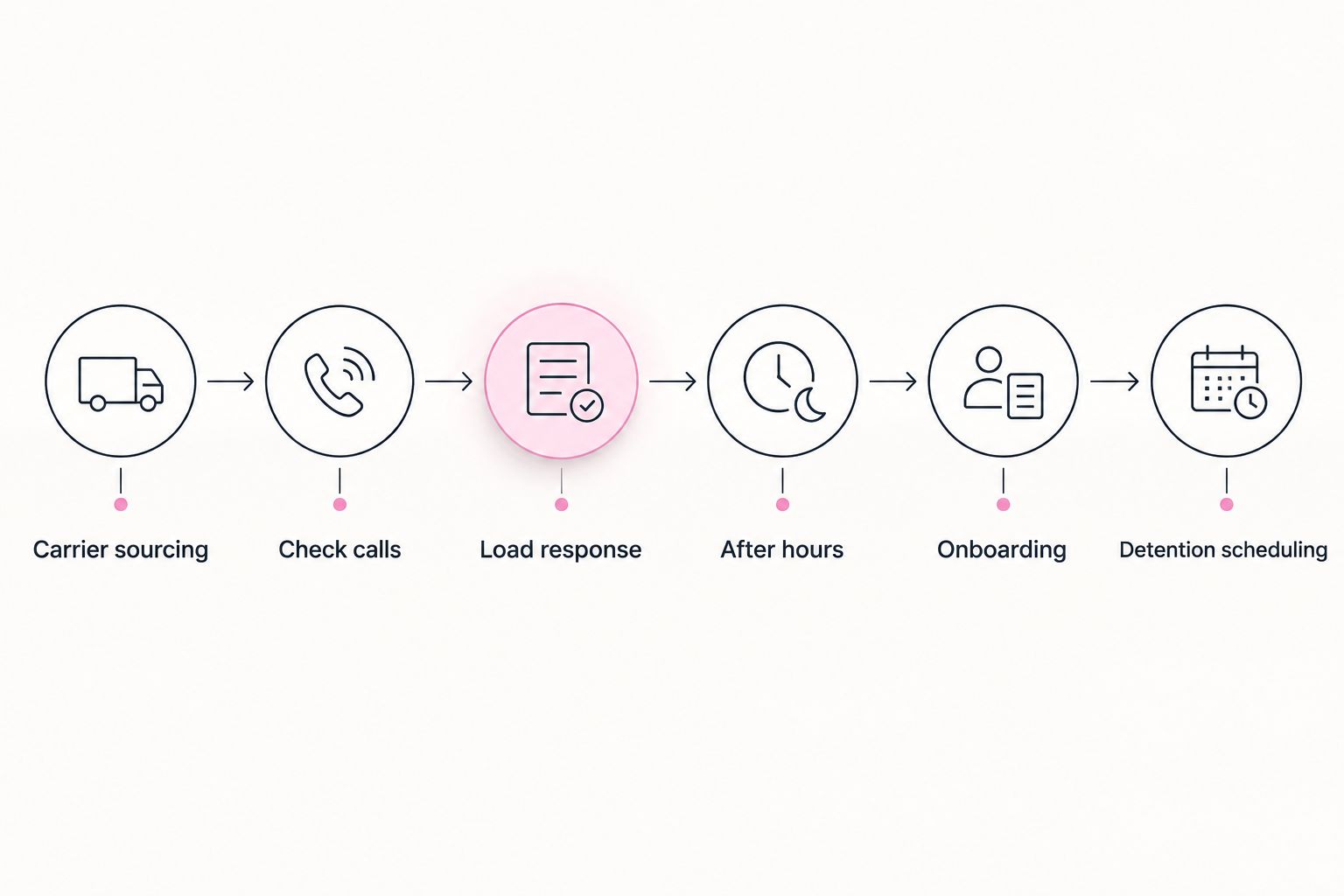
Each step in a load’s phone lifecycle runs on the same script, every time, whether a person or an agent picks up.
Cut response time on new load and carrier inquiries
A carrier or shipper calling in about a posted load is shopping multiple brokers at once. Respond in minutes and the load is gone; respond in seconds and it’s booked.
Set a target answer time for every inbound load inquiry and track it weekly
Route load inquiries straight to whoever has authority to quote, not a general queue
Pre-approve rate ranges by lane so a quote doesn’t wait on a manager’s callback
Follow up automatically with carriers who called but didn’t book within the hour
Harmony.ai answers every inbound call at sub-400ms latency and can quote against pre-approved rate ranges instantly, then transfer live when a carrier wants to negotiate past the floor.
Cover carrier and shipper calls after hours
Trucks don’t stop moving at 5 p.m. A driver stuck at a receiver at 9 p.m. or a carrier calling about tomorrow’s pickup at 6 a.m. still needs an answer, not a voicemail box.
Map which after-hours call types need a live person (service failures, claims) versus which don’t (status checks, appointment confirmations)
Set an escalation path for after-hours emergencies with an on-call dispatcher
Confirm pickup and delivery appointments the night before without a person on shift
Review missed-call logs every morning to catch anything that fell through
Coverage runs 24/7 without adding a night-shift dispatcher, with anything outside routine status calls transferred live to whoever’s on call.
Qualify new carrier onboarding calls
Bringing a new carrier into the network means verifying authority, insurance, and equipment before a single load gets booked. Doing that by phone, one carrier at a time, is slow and repetitive, and it’s usually the first call type brokerages let slide when volume spikes.
Standardize the onboarding qualifying script: MC number, insurance carrier and coverage, equipment types, service area
Verify authority and insurance status before scheduling a follow-up call, not after
Route carriers who pass qualification straight to a load-booking conversation
Flag carriers who fail verification so they don’t re-enter the call queue next week
Handle detention and appointment scheduling with receivers
Detention disputes and appointment scheduling calls to shippers and receivers are some of the most repetitive calls a brokerage makes, and some of the easiest to standardize.
Confirm delivery appointment windows a day ahead of every load
Log detention start and stop times directly against the load record during the call
Escalate detention disputes over a set dollar threshold to a live broker
Track average detention time by receiver to flag chronic offenders
Compare the options for freight broker call coverage
In-house dispatch team
Best for: Brokerages with complex, judgment-heavy freight
Key limitation: Can’t scale past business hours or call spikes without more headcount
BPO / outsourced answering service
Best for: Basic after-hours coverage on simple calls
Key limitation: Scripts vary by agent, no direct TMS logging
DIY IVR / touch-tone system
Best for: Filtering simple status calls
Key limitation: Frustrates carriers and drivers, breaks on any question outside the script
Harmony.ai voice agent
Best for: Mid-market and enterprise brokerages running high call volume across multiple lanes
Key limitation: Sales-assisted deployment only, no self-serve signup
Verdict: an in-house team wins on judgment calls, a DIY IVR loses on almost everything else, and Harmony.ai wins on volume and speed for brokerages that can’t afford a missed carrier call in 2026.
See Harmony.ai on your call volume
Sales-assisted setup for mid-market and enterprise brokerages.
Common mistakes freight brokers make with call handling
Treating every inbound call the same instead of routing routine check calls away from the brokers who should be negotiating rates.
Letting after-hours carrier calls hit voicemail - carriers on the spot market call the next broker on their list within minutes.
Re-verifying insurance and authority manually before every load instead of confirming it once at onboarding and flagging renewals.
Not logging check-call outcomes to the TMS in real time, which causes duplicate calls to the same driver later the same day.
Measuring dispatcher headcount instead of time-to-answer, which is the number that actually predicts how many loads a brokerage books in 2026.
Compliance matters here too: outbound calls to carriers and drivers are business-to-business, but a brokerage running high-volume outbound campaigns should still confirm TCPA compliance for AI calls before scaling call volume this year.
FAQ
What does an AI voice agent do for a freight brokerage?
It answers and places calls for carrier sourcing, check calls, load status updates, and after-hours coverage, transferring live to a dispatcher when a call needs judgment. It runs the repetitive call volume a brokerage handles every day without adding headcount.
Can an AI voice agent make check calls to truck drivers?
Yes. It can run a fixed check-call cadence at pickup, midpoint, and delivery, ask standardized status questions, and escalate to a live dispatcher the moment a driver reports a delay or damage.
Is AI voice calling for freight brokers TCPA compliant?
TCPA governs calls to consumers, not business-to-business calls between brokers, carriers, and drivers, but brokerages running high-volume outbound campaigns should still confirm call practices against current TCPA guidance before scaling in 2026.
How fast can a freight brokerage deploy an AI voice agent?
Harmony.ai goes live in days on approved call flows, not months, because it runs deterministic scripts rather than open-ended conversation design work.
Can AI voice agents replace freight broker dispatchers?
No. They take the repetitive call volume off a dispatcher’s plate - sourcing, check calls, status updates - and hot-transfer anything that needs negotiation or judgment to a live person.
What’s the difference between an AI voice agent and an answering service for freight brokers?
An answering service routes calls to a human agent working from a script that varies by shift. An AI voice agent for freight brokers runs the same qualifying script on every call and logs outcomes directly, without agent-to-agent variance.
Does an AI voice agent integrate with a TMS?
Voice AI platforms built for logistics log call outcomes, carrier responses, and check-call results back to the systems a brokerage already runs, so dispatchers aren’t manually re-entering call notes.
What size freight brokerage needs an AI voice agent?
Mid-market and enterprise brokerages running high call volume across multiple lanes see the fastest payback. Single-truck owner-operators and very small brokerages don’t have the call volume to justify it.
One last thing
The brokerages gaining ground in 2026 aren’t hiring more dispatchers to keep up with call volume - they’re pulling routine check calls and carrier sourcing off human schedules entirely, so the dispatchers left on the phone spend their time on rate negotiation and service failures, the calls that actually need a person.