
AI receptionist for security guard companies in 2026: how it triages dispatch, incident, and check-in calls, and when Harmony.ai fits the coverage gap.
- An ai receptionist for security guard companies answers dispatch, incident, and client calls 24/7 without a hold queue.
- Harmony.ai runs on its own model built for the phone at sub-400ms latency, live in days.
- Manual triage scripts and call logs come first; automation is the faster path, not the starting point.
- Escalation to a live supervisor still matters for armed-response and life-safety calls in 2026.
Security guard company AI receptionist is a voice AI system that answers every dispatch, incident, and after-hours call with the aim of keeping posts staffed and clients calm. Guard operations run on a phone line that never sleeps - a missed 2 a.m. call can mean an unstaffed post, a client with no coverage, or an incident that never gets logged. That’s a different risk profile than a dental office running voicemail after 6 p.m.
Why this matters for security guard companies
A guard company’s phone line carries three call types a generic receptionist tool wasn’t designed to sort: client incident reports, guard staffing calls (no-shows, shift swaps, post check-ins), and new-business quote requests. Miss the first and you’ve got a liability problem. Miss the second and a post sits empty. Miss the third and a competitor books the contract.
Most guard companies still route all three through the same front desk or answering service, which means an incident report waits behind a sales call. That’s the gap an enterprise AI receptionist buyer’s guide exists to close - sorting calls by urgency before a human ever picks up.
Security is also a TCPA-aware industry: dispatch centers record calls for liability, and guard licensing bodies expect an audit trail. Any voice system touching client or guard calls in 2026 needs to log who called, when, and what was decided - not just answer and hang up.
Map your call volume by type
Before automating anything, know what’s actually coming in. Pull three months of call logs, if you have them, and bucket every call.
Client incident or escalation calls (break-ins, alarms, disputes)
Guard staffing calls (no-shows, sick calls, shift swap requests)
New client or prospect quote requests
Guard check-in / post verification calls
Vendor and internal admin calls
This bucket exercise alone tells you where the current front desk is bleeding time - usually staffing calls and check-ins, which are high-volume and low-complexity.
Write a triage script for urgent vs. routine calls
Every guard company needs a written rule for what counts as “transfer now” versus “log and route.” Build this on paper first, free, before any software touches it.
Define trigger words that force an immediate live transfer (alarm, break-in, injury, weapon)
Set a decision tree for calls that can wait for a callback
Assign a named on-call supervisor per shift, not a rotating queue
Require a call summary logged before the call ends, not after
Automate the routine answering layer
Once the triage logic exists on paper, the manual version doesn’t scale past a handful of posts. This is where an AI receptionist earns its place - not as a replacement for the triage script, but as the thing that runs it on every call, every time, without a shift change dropping the handoff.
Harmony.ai runs on its own model built for the phone - deterministic on approved flows, using LLMs only when a call needs flexibility - and answers at sub-400ms latency so callers don’t hear the dead air that gives away a bot. It applies your triage script the same way at 3 a.m. as it does at 3 p.m.
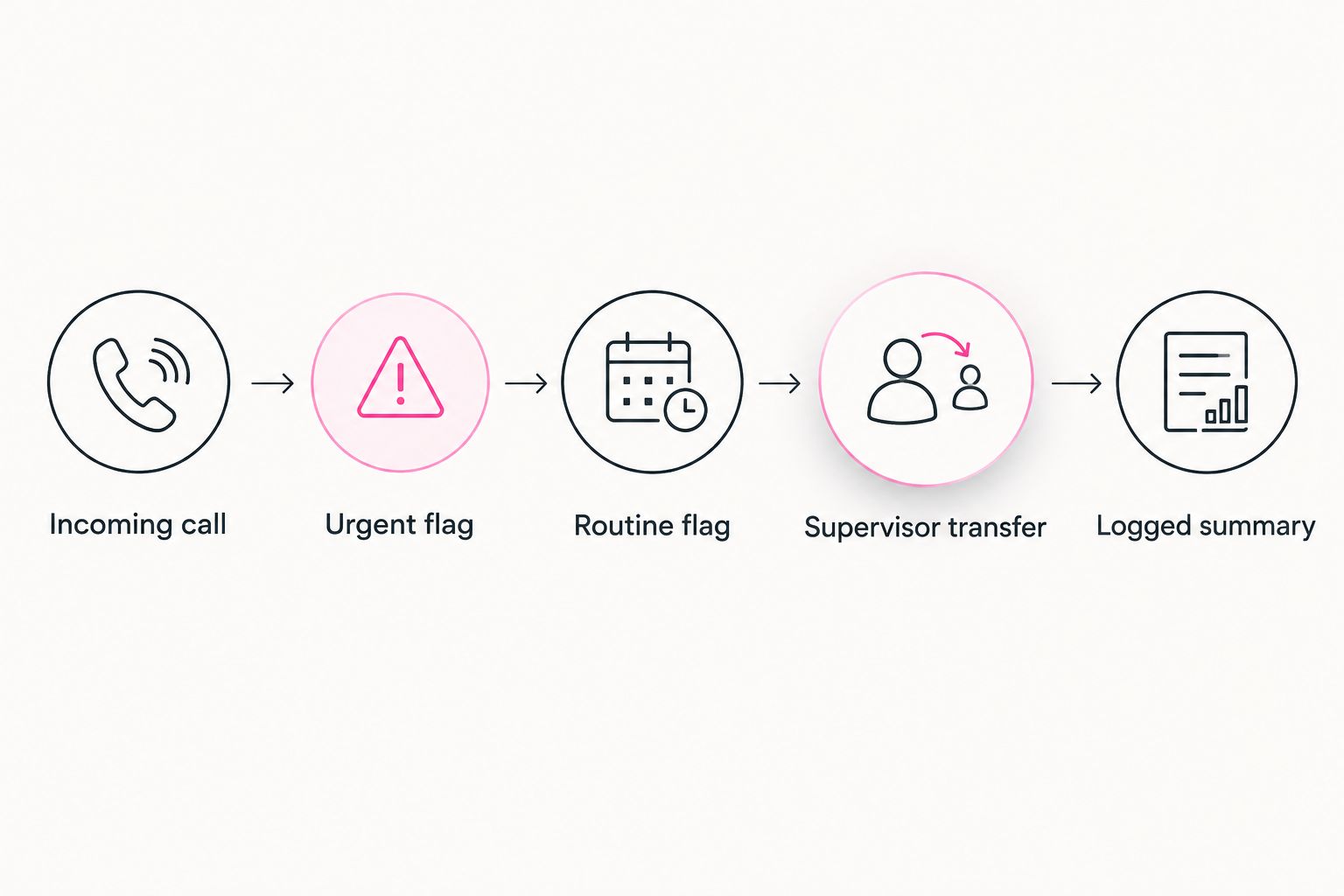
The triage script decides the route before a human ever gets the call.
Automate guard check-in and no-show calls
Check-in calls are the highest-volume, lowest-complexity call type most guard companies run, and they’re the easiest to hand off first.
Scheduled outbound check-in calls tied to shift start times
No-show detection that triggers an immediate supervisor alert, not a voicemail
Post verification (right guard, right site, right time) logged automatically
Sick-call and swap-request intake routed straight to the scheduling desk
Check-in calls are routine until one goes unanswered - that’s the one that matters.
Set escalation rules for after-hours emergencies
Armed response, alarm activations, and client disputes at 2 a.m. cannot sit in a queue. Build a hard rule: any trigger-word call gets a warm transfer to a live, named on-call supervisor within seconds, with full call context passed along - not a caller forced to repeat the incident from scratch.
List every trigger word that forces immediate transfer
Name the on-call supervisor per shift, with a backup
Require the transferred call to carry the caller’s history, not start cold
Log the transfer time as a compliance metric, not just the outcome
Automate quote intake for new client leads
A prospect calling for a security proposal at 6 p.m. shouldn’t hit voicemail. Capture site details, coverage hours, and post count on the first call, and route the qualified lead to sales same day - the same speed-to-lead logic that matters for cost per call versus a human front desk math guard companies run when they evaluate front-desk staffing.
Audit call recordings for compliance and training
Guard companies already record for liability. Extend that discipline to the receptionist layer: every call logged, timestamped, and tagged by outcome.
Weekly review of escalated calls against the trigger-word list
Random sample of routine calls for tone and accuracy
Compliance check against state guard-licensing call requirements
Feedback loop back into the triage script, not a one-time setup
Comparison: options for security guard company call handling
In-house 24/7 dispatcher team
Best for: Companies with enough call volume to justify multiple shifts
Key limitation: Costly to staff overnight and prone to turnover
Third-party answering service
Best for: Basic overflow coverage during peak hours
Key limitation: No context on your posts, clients, or escalation rules
Generic chatbot / IVR
Best for: Simple after-hours voicemail replacement
Key limitation: Can’t handle a live incident call or a warm transfer
Harmony.ai AI receptionist
Best for: Guard companies running 24/7 dispatch with compliance requirements
Key limitation: Sales-assisted setup only - no self-serve signup, requires a scoping call
A quick note on cost logic here: if your team is weighing a custom-built voice system against buying one, custom AI agent costs swing wildly with integration scope, so run that comparison before locking a 2026 roadmap - a vendor platform that’s live in days changes the build-vs-buy math fast.
Common mistakes security guard companies make
Treating every call as routine. A dispatcher without a written trigger-word list will sit on an incident call the same way they sit on a sales call.
Skipping caller verification before dispatching a guard. Anyone claiming to be a client can request a post change if there’s no verification step.
Leaving after-hours coverage to voicemail. A 2 a.m. incident with no live escalation path is a liability exposure, not a convenience gap.
Not logging routine calls. Check-in and no-show calls that go unrecorded make it impossible to prove a post was covered when a client disputes it.
Never training guards on the handoff. If field staff don’t know how the receptionist routes calls, they’ll bypass it and call supervisors directly, defeating the whole system.
FAQ
What does an AI receptionist for security guard companies actually do?
It answers inbound calls from clients, guards, and prospects, sorts them by urgency using a triage script, and either resolves the call directly (check-ins, quote intake) or warm-transfers to a live supervisor with full call context for anything flagged urgent.
Can an AI receptionist handle an armed-response or alarm call?
It can detect the trigger words and route the call immediately to a live, named on-call supervisor rather than resolving it itself. Life-safety and armed-response calls should always end in a human handoff, not an automated resolution.
Is an AI receptionist better than a human answering service for guard dispatch?
An AI receptionist runs your specific escalation script on every call at the same speed, day or night, while a generic answering service has no context on your posts or clients. See the direct comparison in an ai receptionist vs answering service enterprise guide for the tradeoffs.
How fast does Harmony.ai answer a call?
Harmony.ai responds at sub-400ms latency, built on its own model for the phone rather than a general-purpose chat model retrofitted for voice.
Does an AI receptionist replace the front-desk dispatcher entirely?
No. It handles the high-volume, low-complexity calls - check-ins, no-shows, quote intake - and warm-transfers anything flagged urgent to a live supervisor. The dispatcher’s role shifts from answering every call to managing escalations.
How long does it take to set up an AI receptionist for a guard company?
Harmony.ai deployments go live in days once the triage script and escalation rules are scoped, not weeks. The scoping call, not the software build, sets the timeline.
What compliance standards should a voice AI vendor for security companies meet?
Look for SOC 2 Type II, a HIPAA BAA if any health-adjacent data touches the line, GDPR/CCPA readiness, and TCPA awareness for any outbound calling. Full detail is in a guide on SOC 2 and HIPAA compliance for voice AI.
Can the AI receptionist handle new client quote requests too?
Yes. It captures site details, coverage hours, and post count on the first call and routes the qualified lead to sales the same day, instead of losing after-hours prospects to voicemail.
One last thing
The security guard companies that get the most out of an AI receptionist in 2026 don’t start with the software. They start by writing down, in plain language, what counts as an emergency call versus a routine one - and only then automate the routine side. Skip that step and you’ll automate the wrong calls fast.
See how Harmony.ai handles guard dispatch calls
Sales-assisted setup, live in days.