- Harmony.ai answers every storm-day call at sub-200ms latency - the right fit for multi-location snow and ice contractors running 24/7 through winter 2026.
- An AI receptionist for snow removal companies works best when it reschedules visits, triages slip-and-fall reports, and hot-transfers liability calls live.
- Generic answering services take messages; they can't confirm a service window or pull a route status from dispatch software.
- Seasonal front-desk hires fail on the exact days that matter most - storms don't wait for a shift to start.
AI receptionist for snow removal companies is a voice AI system that answers, qualifies, and routes every storm-day call in real time, with the goal of stopping missed calls from turning into lost contracts. Snow removal calls don’t spread out evenly like a typical service business - they spike hard in the first hours after a storm hits, often overnight, and a chunk of them are liability calls that can’t sit in a queue.
Why this matters for snow removal companies
A snow removal company’s call volume doesn’t track headcount - it tracks weather. One storm can turn a normal 20-call day into 200 calls asking the same three questions: are you coming, when, and did you already do my lot. Miss that window and the customer either calls a competitor or files a complaint about a lot that never got plowed.
The seasonal staffing model makes this worse. Most snow removal operators hire front-desk coverage for a four-to-five-month window, train it fast, and lose half of it before the season ends. That’s the wrong place to put a system that has to perform flawlessly on the two or three worst nights of the year. An AI receptionist doesn’t need a season of ramp-up - it runs the same approved call flow on night one as it does in March 2026.
Route every storm-day call away from voicemail
The first fix is structural: no call during an active storm should ever hit voicemail. Most operators try to solve this manually before they look at software, and the manual version is worth doing right even if you never automate it.
Publish one storm-day number that every crew lead and dispatcher checks hourly
Rotate on-call phone duty across office staff so no single person owns every storm
Record a voicemail greeting that states the expected callback window, not just “leave a message”
Post a live service-status page customers can check before they dial
Set a hard internal rule: any call unanswered after two rings gets flagged for review
Those fixes buy time but don’t scale past a handful of simultaneous callers. Harmony.ai’s AI receptionist answers every one of those calls in parallel, at sub-200ms latency, running the same approved flow whether it’s call one or call one hundred of the night.
Confirm and reschedule service windows during active storms
Customers calling mid-storm mostly want one thing confirmed: is my property still on the route, and when. Handling that manually means pulling a dispatcher off route planning to make the same call twenty times.
Build a script that states property status, expected window, and next update time
Batch outbound confirmation calls to commercial accounts before they start calling in
Log every reschedule in the same system dispatch uses, not a separate notepad
Set a TCPA-aware calling window so outbound confirmation calls don’t go out at 3 a.m. without consent on file
Outbound confirmation is where AI appointment reminder calls earn their keep - running the confirmation wave before the phone starts ringing inbound cuts the volume you have to answer at all. If a caller has to leave a voicemail during a storm, the contract is already at risk.
Triage slip-and-fall and liability calls immediately
Not every call is a scheduling question. Some are a customer reporting an injury on a lot you serviced, and those need a human on the line fast, not a callback promise.
Train every phone-answering employee on a fixed liability escalation script
Define a chain of command: who takes the call, who documents it, who follows up
Require incident calls to be time-stamped and logged the same day
Never let a seasonal hire ad-lib a response to a liability claim
Harmony.ai’s approved flow listens for liability language and hot-transfers the call live to a person, with context, instead of routing it into the same queue as a schedule question.
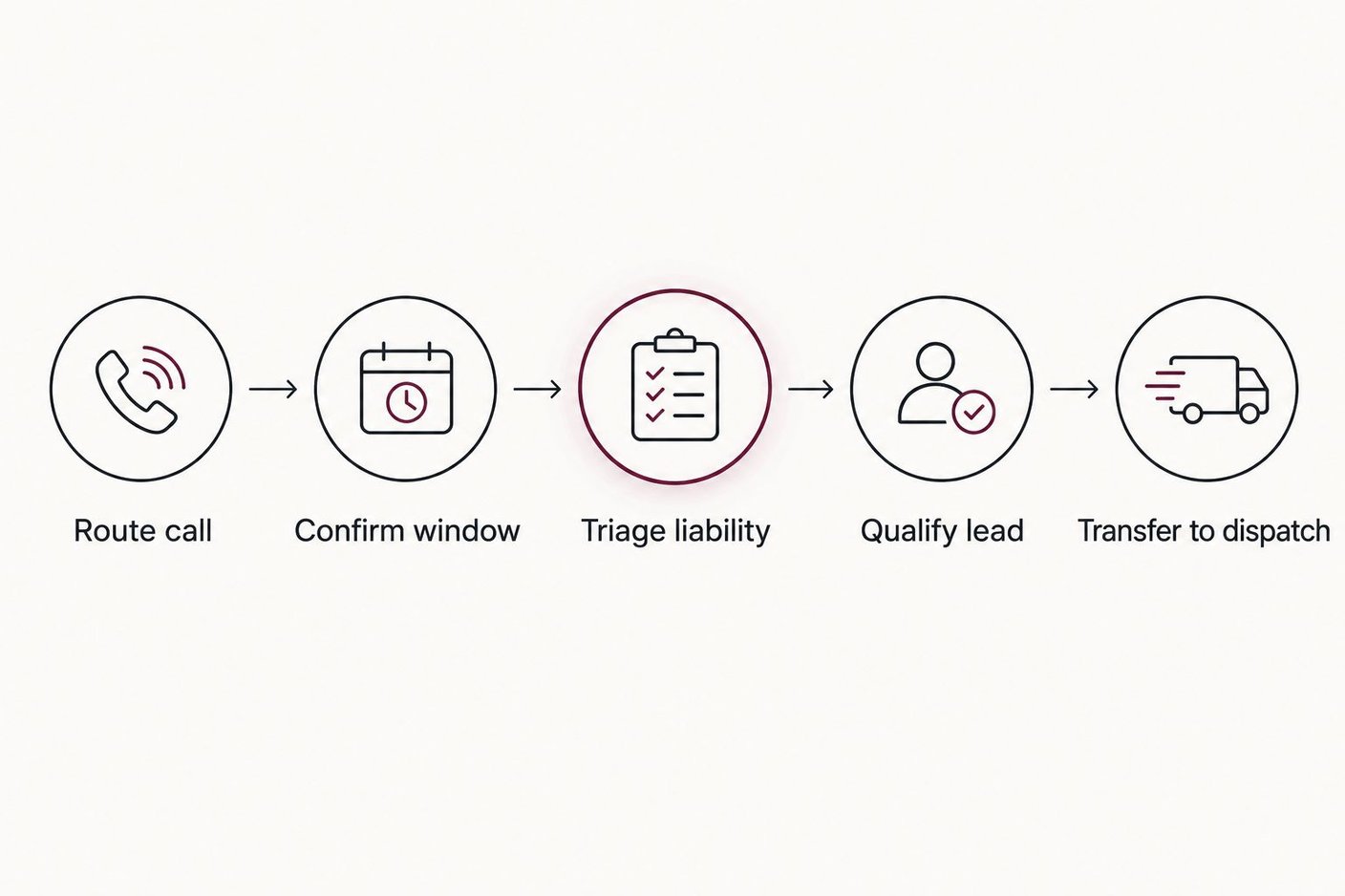
Liability calls branch off the flow before they ever hit a queue.
Qualify new commercial contract inquiries during snow events
A bad storm is also peak selling season. Properties that got burned by a competitor’s slow response call around looking for a new contract while the snow is still on the ground.
Assign one rep to catch commercial overflow during and right after a storm
Ask for property size, current provider status, and season-remaining need on the first call
Route qualified inquiries straight into the CRM pipeline, not a sticky note
Follow up within the same day - competitors are getting the same calls
A voice AI agent handling this overflow qualifies the property details and hands a booked call to sales without your team dropping what it’s doing mid-storm.
Handle after-hours and overnight call surges
Storms hit overnight more often than they hit business hours. A phone line that goes dark at 6 p.m. misses exactly the calls that matter most.
Set an after-hours protocol that escalates only true emergencies to an on-call human
Define what counts as urgent versus what waits for morning
Keep the after-hours script identical to the daytime script so callers get consistent answers
Track after-hours call volume separately to staff the next storm better
Harmony.ai runs the same flow at 2 a.m. as it does at 2 p.m. - there’s no shift change, no fatigue, and no gap in coverage through winter 2026.
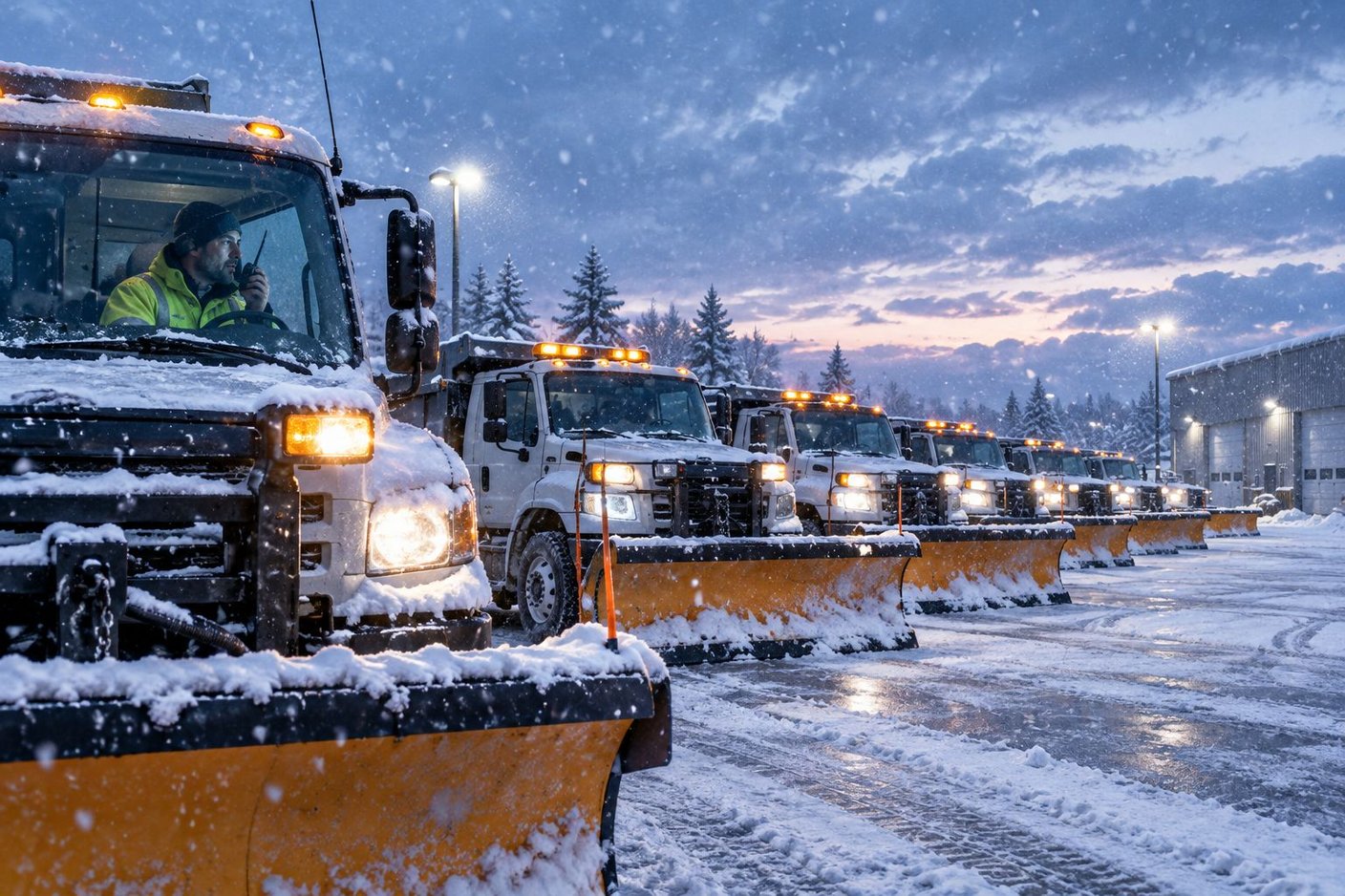
Crews move faster when nobody in the yard also has to answer the phone.
Recover no-answer callbacks before customers call a competitor
Every missed call during a storm is a customer who’s now dialing someone else. Recovery has to happen in minutes, not the next business day.
Log every missed call in a shared queue the second it happens
Assign callback ownership so no missed call sits unclaimed
Call back within the hour during active storm windows
Track callback-to-booking rate so you know if recovery is actually working
Coordinate with dispatch without pulling crew leads off the truck
The call center and the dispatch board have to stay in sync, or customers get told one thing while a truck is doing another.
Give phone staff read access to the live route board
Require a status update pushed to the board any time a property gets rescheduled
Use one shared system for both call notes and route status, not two
Set a rule: crew leads answer texts, not calls, mid-route
Comparing options for snow removal call handling
In-house seasonal staff
Best for: Single-market operators with predictable volume
Key limitation: No overnight coverage; turns over every season
Traditional answering service
Best for: Basic message-taking during off-hours
Key limitation: Can’t reschedule, triage liability, or see dispatch status
Web chatbot or text-only bot
Best for: Website inquiries and quote requests
Key limitation: Doesn’t cover the phone channel at all
Harmony.ai voice AI receptionist
Best for: Multi-location contractors running storm season around the clock
Key limitation: Requires an approved call flow set up before go-live
Answering services and AI receptionists solve different problems - one takes a message, the other runs the conversation to a resolution.
See the storm-day call flow in action
Watch how Harmony.ai routes, confirms, and escalates snow removal calls live.
Common mistakes snow removal companies make
Staffing for average volume, not storm-peak volume. A phone line sized for a normal Tuesday collapses on the first real storm of 2026.
Letting untrained seasonal hires field liability calls. A slip-and-fall report handled badly on the phone becomes a legal problem, not just a service one.
Treating after-hours calls as next-day problems. Storms don’t observe business hours, and neither should the phone line.
Skipping proactive confirmation calls. Every customer left guessing about their service window becomes an inbound call you now have to answer.
Running call intake and dispatch as two disconnected systems. Manual double-entry is where reschedules get lost.
FAQ
What is an AI receptionist for snow removal companies?
It’s a voice AI system that answers every inbound call for a snow and ice removal business, confirms or reschedules service windows, and routes liability or emergency calls to a live person. Harmony.ai runs this on its own model built for the phone, at sub-200ms latency.
How does an AI receptionist handle a storm-day call surge?
It answers every call in parallel rather than putting callers in a hold queue, since the system isn’t limited by how many people are staffing the desk. Volume that would overwhelm a two- or three-person front desk gets handled the same way at call one hundred as call one.
Can AI receptionists reschedule snow removal appointments?
Yes - an AI receptionist can confirm, delay, or reschedule a service visit on the call and log the change directly into the same system dispatch uses. That removes the manual step of a dispatcher relaying changes by phone or text.
Is an AI receptionist better than an answering service for snow removal?
An answering service takes a message; an AI receptionist resolves the call by confirming a window, triaging urgency, or transferring to a person when it matters. For storm-driven volume, message-taking alone leaves the actual problem unsolved until someone calls back.
Does an AI receptionist handle slip-and-fall or liability calls?
A properly configured AI receptionist recognizes liability language and hot-transfers the call live to a person with context, rather than routing it into a general queue. It does not attempt to resolve liability claims on its own.
How fast does Harmony.ai’s voice AI answer calls?
Harmony.ai runs on its own model built for the phone at sub-200ms latency, with deployments live in days rather than months.
Can AI voice agents work overnight during storms?
Yes - the same approved call flow runs at 2 a.m. as it does at 2 p.m., with no shift change and no coverage gap during overnight storm events.
Does an AI receptionist replace dispatch software?
No. It handles the call - answering, confirming, triaging, transferring - and passes status updates into the dispatch system rather than replacing route planning or crew management.
One last thing
The highest-leverage fix isn’t adding more phone lines during a storm - it’s running the outbound confirmation wave before customers start calling in. Every property that gets a confirmation call before the storm hits is a call your team never has to answer inbound, which is the difference between a manageable storm night and a phone line that never stops ringing through the rest of winter 2026.