- An ai voice agent for debt settlement companies runs enrollment, negotiation follow-up, and check-in calls at volume without added headcount.
- Harmony's voice AI hits sub-200ms latency and runs on its own model built for the phone, live in days, not months.
- TCPA-aware calling and full audit trails matter more here than in most verticals because outbound cadence is constant and multi-year.
- DIY builders like Vapi or Bland require your team to own the compliance guardrails; Harmony ships them built in.
- Skip DNC scrubbing on reactivation campaigns and skip live-transfer for at-risk clients - both are the fastest way to lose a settlement mid-program.
Debt settlement companies run three call types nonstop: enrollment, creditor negotiation follow-up, and client check-ins to stop program dropout - and an AI voice agent for debt settlement companies handles all three without missing a state disclosure or an after-hours callback. Harmony’s voice AI is built for exactly this volume: sub-200ms response time, deterministic approved flows for regulated scripts, and a live hand-off the moment a client threatens to cancel.
Why voice AI matters for debt settlement companies
Debt settlement is a call-heavy business by design. A client enrolls, then spends two to four years getting reminder calls, negotiation updates, and payment check-ins - and every one of those calls is a chance for the client to drop the program or for a creditor negotiation to stall for lack of follow-up. Manual staff can’t run that cadence at scale during business hours only; a missed callback window on a creditor negotiation resets the clock.
Outbound cadence at this scale runs into two constraints most other verticals don’t: the FTC’s Telemarketing Sales Rule Debt Relief Amendments govern what an outbound call can and can’t say before a client is enrolled, and FDCPA and TCPA compliance for AI collections calls still applies to any autodialed outbound call to a consumer. Get either wrong at volume and the exposure compounds fast - a script error on 500 calls is a script error 500 times, not once.
Update your call volume audit before you automate anything
Start by separating your call types. Debt settlement operations run at least four distinct call flows, and they don’t share a script:
Enrollment and intake calls (new client, first negotiation terms)
Creditor negotiation follow-ups (status updates, counteroffers)
Payment and check-in calls (recurring, scheduled)
Save calls (client wants to cancel or missed a payment)
Build this map manually first, on a spreadsheet, with call volume and average handle time per type. You need the baseline before any automation decision means anything.
Standardize your enrollment call script
Enrollment calls carry the most compliance risk because they’re the first outbound touch and the point where TSR disclosures are mandatory. Fix the script before you touch the tooling:
Write one approved disclosure block and require it verbatim on every enrollment call
Log consent language separately from negotiation terms
Route calls that mention bankruptcy or active litigation to a licensed negotiator, not a script
Record every enrollment call and retain per your state’s licensing requirement
Automate payment reminder and check-in calls
This is the highest-volume, lowest-complexity call type - and the first one worth automating. Manually, a small team keeps this running with a shared calendar and a dialer:
Schedule check-in calls against the payment date, not a fixed weekly cadence
Flag any client who misses two consecutive check-ins for a save call, not another reminder
Track call outcome (confirmed, no answer, rescheduled) in your CRM every time
At volume, this is where Harmony’s voice AI replaces the manual dialer: it runs the reminder and check-in cadence on Harmony’s own model built for the phone - deterministic, on-script, live in days - and logs every outcome back to your system without a staffer dialing one number at a time.
Build compliance checks into every outbound call
Compliance can’t be a spreadsheet a supervisor checks weekly - it has to run on every call, every time:
Scrub every outbound list against the National DNC Registry and your internal do-not-call list before dialing
Confirm the correct-state script variant loads before the call connects - settlement disclosure rules vary by state
Timestamp consent and disclosure language on every recorded call
Flag calls where the client disputes enrollment terms for manual review, not auto-close
Harmony runs TCPA-aware calling with SOC 2 Type II controls and a full audit trail on every call - the same standard voice AI security: SOC 2, HIPAA, and what to demand lays out for any regulated vertical.
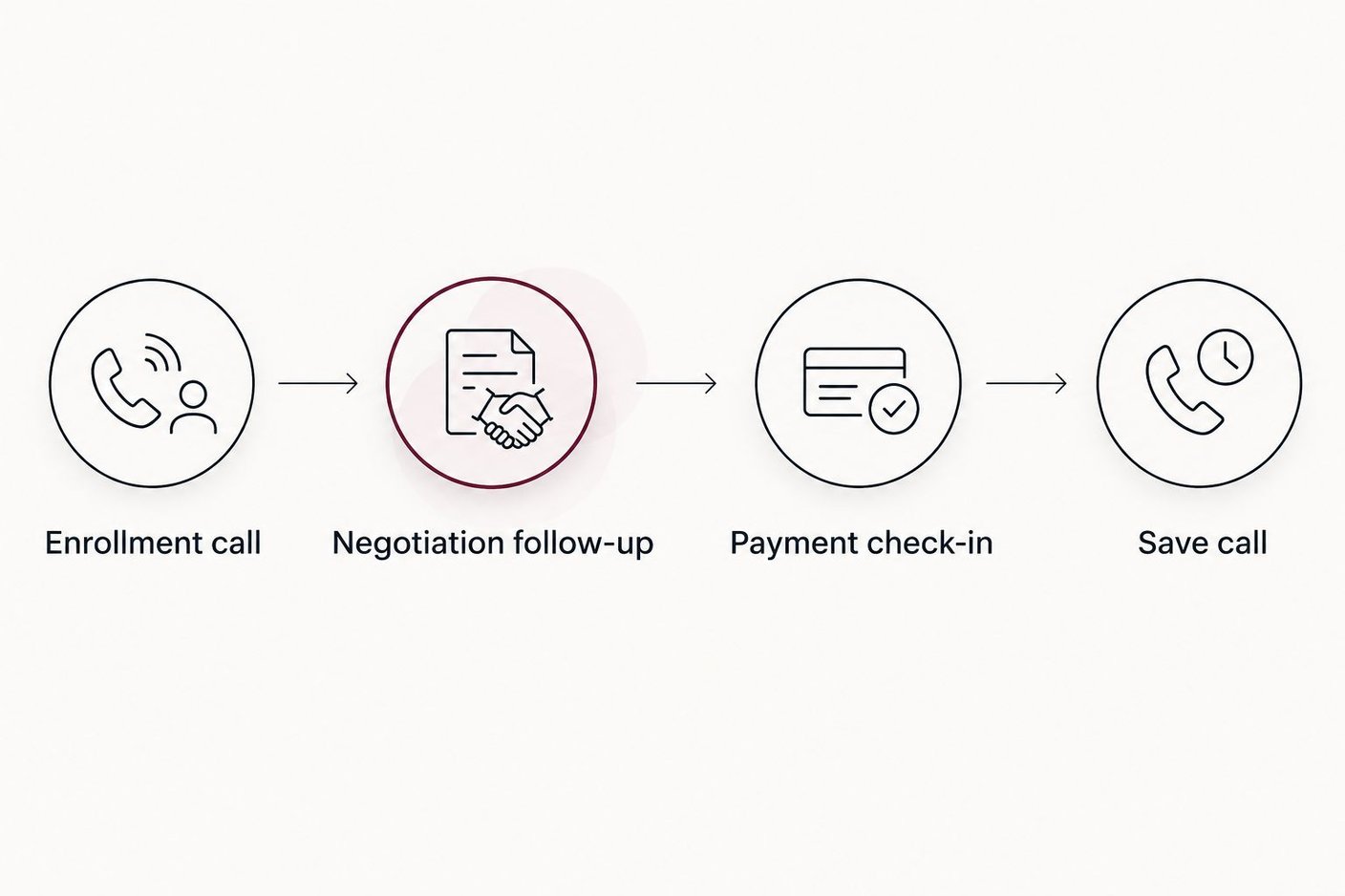
Each call type in a settlement program needs its own script and its own compliance check, not one shared flow.
Route at-risk clients to a live negotiator immediately
A client who misses two payments or says the word “cancel” is the highest-cost call to get wrong. The manual version of this step is a supervisor callback list, checked once a day - too slow for a client already deciding to walk.
Define exact trigger phrases and payment-miss thresholds that force a live transfer
Give the transferred negotiator full call context, not a cold pickup
Cap hold time on save-call transfers - a client on hold reconsiders the cancel
Track save-call outcome separately from routine check-in outcome
Harmony hot-transfers a live call the moment a save trigger fires, with the conversation context intact - no re-asking what the client already said. That’s the difference between a scripted dialer and an agent that knows when to get out of the way.
Measure containment and settlement-linked call outcomes
Call volume without outcome tracking tells you nothing about whether the program is working:
Tie every call’s outcome (kept, missed, saved, escalated) to the client’s settlement status, not just a call log
Measure containment rate - how many calls resolve without a human touch - against your negotiation team’s capacity
Review save-call conversion monthly, not quarterly; drift shows up fast in this business
Comparing your options for debt settlement call automation
Manual staff calls
Best for: Small caseloads with high-touch negotiation needs
Key limitation: Doesn’t scale past business hours; cost per call climbs with volume
Basic IVR or scripted dialer
Best for: Simple payment reminders only
Key limitation: Can’t handle live objections or negotiation questions
DIY voice AI builders (Vapi, Bland)
Best for: Teams with engineering staff to build and maintain flows
Key limitation: Compliance guardrails and prompt maintenance are on you
Harmony
Best for: Mid-market and enterprise debt settlement operations running enrollment, negotiation follow-up, and check-in calls at volume
Key limitation: Sales-assisted onboarding only - no self-serve signup
Verdict: Harmony is built for debt settlement operations that need TCPA-aware calling and a live save-call transfer running at volume, not a team that wants to hand-build and maintain its own compliance logic.
See how the call flow runs
Get a live demo of enrollment, negotiation, and save calls end to end.
Common mistakes debt settlement companies make
Using one script for negotiation and check-in calls. A creditor update and a payment reminder need different tone, different disclosures, and different escalation paths.
Skipping DNC scrubbing on reactivation and win-back lists. Old client lists go stale fast; scrub every time, not once at intake.
No live-transfer trigger for at-risk clients. A missed payment or the word “cancel” should route to a person in seconds, not sit in a callback queue.
Treating state licensing as a one-time setup. Debt settlement licensing and disclosure rules shift by state; a script that was compliant in 2025 may not be in 2026.
No outcome tracking tied to settlement status. Call logs without a link to program status can’t tell you whether automation is helping retention or just adding noise.
FAQ
What does an AI voice agent do for debt settlement companies?
It runs enrollment calls, creditor negotiation follow-ups, payment check-ins, and save calls automatically, logging outcomes and transferring live when a client is at risk of canceling. Harmony runs these on its own model built for the phone at sub-200ms latency.
Is an AI voice agent TCPA-compliant for debt settlement outbound calls?
TCPA compliance depends on how the calling platform handles consent, DNC scrubbing, and calling hours - Harmony runs TCPA-aware calling with a full audit trail on every outbound call. The platform doesn’t replace your legal review of state-specific debt relief disclosure rules.
Can AI voice agents negotiate directly with creditors?
AI voice agents run structured negotiation follow-up and status update calls on approved terms, but final settlement authority typically stays with a licensed negotiator. The agent handles the volume of status calls and hands off complex counteroffers live.
How is an AI voice agent for debt settlement different from one for debt collection?
Debt settlement companies negotiate reduced payoffs on behalf of consumers and operate under the FTC’s Telemarketing Sales Rule Debt Relief Amendments, while debt collection agencies collect debt directly under the FDCPA. The call flows overlap on compliance discipline but the scripts and disclosures differ.
What happens when a client wants to talk to a live negotiator?
A well-built voice AI agent detects the trigger phrase or payment-miss threshold and hot-transfers the call with full context, so the client doesn’t repeat what they already said. Harmony transfers live in the same call, not on a callback.
How fast can a debt settlement company deploy an AI voice agent?
Harmony deploys approved call flows live in days, not months, because the flows are deterministic and built before launch rather than trained live. Timeline depends on how many call types and state script variants you need at launch.
Does Harmony record calls for compliance audits?
Yes - every call runs with a full audit trail under SOC 2 Type II controls, which matters for state licensing reviews and TSR disclosure verification. Retention requirements still follow your state’s own rules.
What’s the difference between a scripted dialer and Harmony’s voice AI?
A scripted dialer plays a fixed message and can’t handle a client question or objection mid-call. Harmony runs an approved flow but uses its own model, built for the phone, to handle the moments that need flexibility - like a client asking about a specific creditor balance.
One last thing
The save call is the highest-leverage call in the entire program, and it’s the one most debt settlement companies still route through a supervisor’s callback list checked once a day. Move the save-call trigger to real time - payment miss or cancel language - and the negotiation team spends its time closing settlements instead of chasing clients who already decided to leave.