
AI receptionist for speech therapy clinics in 2026: verdict, setup steps, comparison table, and how Harmony rebooks recurring SLP sessions without staff.
- An AI receptionist for speech therapy clinics answers calls in under a second and rebooks recurring therapy series without staff involvement.
- Harmony runs as HIPAA-aware voice AI live in days, not the months a legacy IVR swap takes.
- Twice-weekly pediatric caseloads generate 2-3x the rebooking volume of a single-visit medical practice; automate that flow first.
- Manual scripting and staff training close part of the gap; Harmony's voice agent closes the rest across every location.
An AI receptionist for speech therapy clinics answers every intake call, insurance question, and reschedule request in real time, then rebooks recurring therapy sessions without a front-desk staffer touching the phone. Outpatient speech-language pathology runs on repeat visits, not one-off appointments, and that changes what the phone system needs to do.
Why an AI receptionist matters for speech therapy clinics
Speech therapy runs on a cadence most medical practices don’t have. A pediatric caseload might see the same child twice a week for six months, which means every school break, sick day, and carpool conflict turns into a rescheduling call. Multiply that across a multi-location group and the phone volume compounds fast, even before insurance authorization renewals and benefits checks hit the queue.
Most clinics handle this with a front desk that’s also checking patients in, prepping rooms between sessions, and fielding walk-ins. Calls go to voicemail during sessions, and voicemail is where reschedule requests go to die. A related workflow - how chiropractic and physical therapy clinics handle the same recurring-visit problem - shows the pattern isn’t unique to SLP, but the caregiver-call layer makes speech therapy harder to script.
The fix isn’t more front-desk hours. It’s a system that answers the call, checks the actual schedule, and rebooks the series without waiting for a human to have a free minute.
Map your call reasons before you script anything
You can’t automate what you haven’t categorized. Pull a week of call logs and bucket every call by reason before touching a script.
Tag calls as new intake, reschedule, cancellation, insurance question, or clinical concern
Note which reasons spike on Mondays and after school holidays
Flag calls that required a callback because staff couldn’t answer live
Count how many reschedule calls involve a recurring series versus a single visit
Fix the intake script staff keep skipping
Front-desk staff under time pressure skip steps - insurance card capture, consent language, referral source. Write the intake script down as a checklist first, on paper, before any automation touches it.
Require insurance ID and group number before booking the first session
Confirm the referring provider and diagnosis code up front
Ask about caregiver availability windows for recurring slots
Capture a callback number distinct from the primary contact
Flag pediatric versus adult caseload at intake, since scheduling constraints differ
This is where a voice AI receptionist earns its place: it runs the same checklist on every call, every time, with no skipped fields. Harmony’s voice agents follow approved intake flows deterministically at sub-400ms response time, and reach for a language model only when a caller’s answer needs interpretation.
Automate insurance verification and benefit checks
Insurance friction stalls more speech therapy intakes than any other single factor, because authorization limits and visit caps vary by payer and by plan year. A voice AI setup built for insurance benefits verification can check eligibility and relay authorized visit counts on the same call the patient books, instead of a callback two days later.
Confirm active coverage before the first session is scheduled
Relay remaining authorized visit counts when the payer system supports it
Flag plans with prior-authorization requirements for a human follow-up
Log the verification outcome directly to the patient record
Rebuild the rebooking flow for recurring series
A single missed Tuesday session in a twice-weekly plan doesn’t just lose Tuesday - it usually pushes Thursday too, unless someone actively rebooks both slots. Manual rebooking depends on whoever picks up the phone remembering the full series.
Build a rebooking rule that offers the next two open slots in the same clinician’s block, not just the next open slot
Default to keeping the caregiver’s original day-of-week and time when offering alternatives
Route waitlisted patients automatically when a recurring slot opens up
Track how many rebookings happen same-day versus multi-day delay
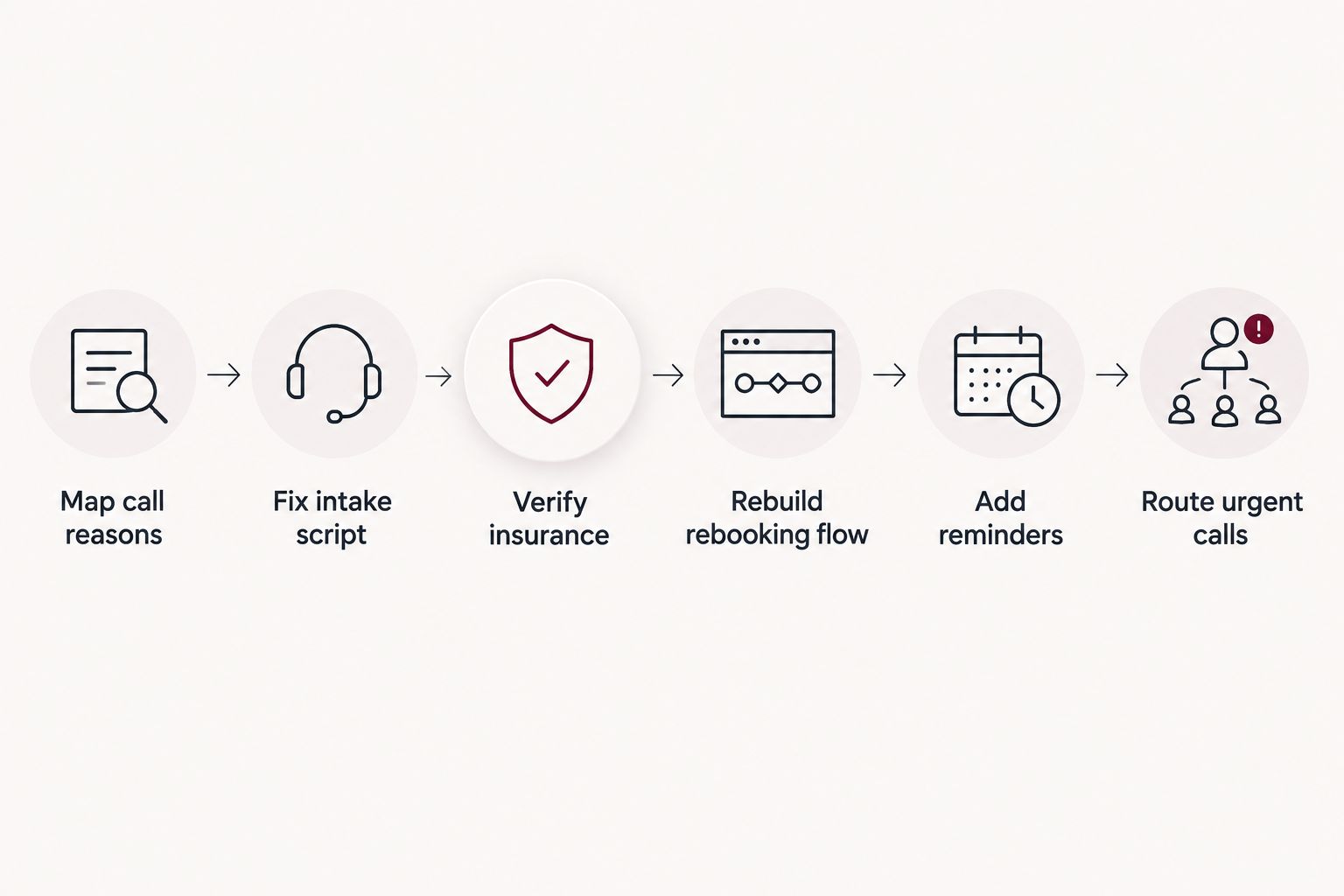
Insurance verification and rebooking come before reminders - fixing the front of the funnel matters more than the reminder text.
Add appointment reminders that account for caregiver schedules
Generic reminder blasts treat a once-a-month adult follow-up the same as a twice-weekly pediatric series, and that mismatch is why reminder systems underperform in SLP practices.
Send reminders keyed to each specific recurring slot, not one weekly digest
Let the reminder call handle a same-call reschedule instead of just confirming
Adjust timing around school hours for pediatric caseloads
Escalate no-response reminders to a live rebooking attempt within 24 hours
Route urgent and clinical calls to a live clinician
An AI receptionist should know its limits. Clinical concerns - a swallowing complication, a sudden regression, a parent describing distress - need a warm transfer to a clinician, not a script.
Define 3-5 trigger phrases that force an immediate transfer
Confirm the transfer includes call context, not a cold handoff
Log every escalation for clinical review
Never let the system re-ask a question the caller already answered
Harmony hot-transfers these calls live, with context carried over, because the model is built to recognize when a moment needs a person and not a flow.
Track containment and reschedule rate weekly
Set a weekly review of what the AI resolved on its own versus what needed a human. Without this, you’re guessing.
Track percentage of calls fully resolved without staff involvement
Track same-call reschedule rate for recurring series
Track average time from missed appointment to rebooked appointment
Review a sample of transferred calls for missed automation opportunities
Comparing your options
In-house front desk staff
Best for: Single-location practices with light call volume
Key limitation: Can’t answer during sessions; calls default to voicemail
Outsourced human answering service
Best for: After-hours and overflow coverage
Key limitation: Scripts are generic and can’t check live schedules or insurance data
Web chatbot or FAQ widget
Best for: Simple website questions
Key limitation: Doesn’t touch the phone channel, where most reschedule calls still happen
Harmony AI voice receptionist
Best for: Multi-location groups with recurring caseloads and insurance-heavy intake
Key limitation: Needs call-flow and scheduler/EHR integration set up before go-live
Verdict: in-house staff and human answering services work for low-volume, single-location practices - hold on automation there. Multi-location groups managing recurring pediatric caseloads and insurance verification at scale should buy into a dedicated voice AI receptionist, since the manual fixes above only close part of the rebooking gap.
Common mistakes speech therapy clinics make
Scripting for adults only. Most SLP call volume comes from caregivers rescheduling pediatric sessions around school and sick days, not from the patient calling directly.
Skipping EHR and scheduler integration. A receptionist that can’t see the real calendar just creates double-entry and conflicting bookings.
Treating every reminder the same. A twice-weekly recurring series needs different reminder cadence than a once-a-month adult follow-up.
Ignoring compliance on call handling. Speech therapy calls carry protected health information; recording and consent handling need to be settled before launch, not after a complaint.
See how Harmony runs SLP intake calls
Review the flow before you commit staff time to a rebuild.
FAQ
What does an AI receptionist for speech therapy clinics actually do?
It answers inbound calls, checks the real schedule, verifies insurance, and rebooks recurring therapy sessions without a staff member on the line. Clinical or urgent calls get a live warm transfer with context.
Is an AI receptionist HIPAA-compliant?
Harmony operates under SOC 2 Type II controls and offers a HIPAA BAA for covered entities, with GDPR/CCPA-ready and TCPA-aware call handling. Confirm BAA terms directly before handling protected health information on any platform.
Can it handle recurring pediatric appointments differently from adult follow-ups?
Yes, if the rebooking flow is built to key off each recurring series rather than a single visit. A generic reminder system that treats both the same will underperform on twice-weekly caseloads.
How is this different from a human answering service?
A human answering service reads a script and takes a message; it can’t check live schedule availability or insurance authorization in real time the way a voice AI receptionist connected to your systems can.
How fast can a clinic go live with a voice AI receptionist?
Harmony’s deployments run live in days once call flows and scheduler integration are approved, not the months a legacy IVR migration typically takes.
Does the AI ever talk to a clinician’s caseload directly?
No. It handles scheduling, intake, insurance checks, and reminders, and transfers clinical concerns live to a person with full call context.
What happens to urgent or distressed callers?
Defined trigger phrases force an immediate warm transfer to a live clinician or staff member, with the call context carried over so the caller never repeats themselves.
One last thing
The single highest-leverage fix in this list isn’t the reminder system - it’s the rebooking rule that offers two slots instead of one when a recurring series gets missed. Clinics that fix only the reminder text and leave rebooking as a single-slot offer still lose the second session in a twice-weekly plan more often than not. Fix the rebooking logic first in 2026, then layer reminders on top.