
An AI receptionist for horse boarding facilities answers barn calls in under 400ms, books tours, and live-transfers emergencies. See the 2026 setup guide.
- Harmony.ai answers barn calls in under 400ms and qualifies board inquiries before staff ever see a message.
- An AI receptionist for horse boarding facilities routes colic and injury calls to the on-call manager live, not to voicemail.
- Multi-location equestrian operations run one phone system across every barn instead of staffing each front desk separately.
- Tour and lesson bookings sync automatically, cutting the back-and-forth that costs boarding facilities signed contracts.
An AI receptionist for horse boarding facilities picks up every barn line during turnout, feeding, and lessons, screens new-boarder inquiries, and routes a colic call straight to the on-call manager instead of voicemail. Multi-location equestrian operations need one system that covers every barn the same way, on the same rules, around the clock - not a front desk tied to one location’s hours.
Why AI receptionist matters for horse boarding facilities
Barn phones ring hardest exactly when nobody’s near the phone - morning turnout, feeding, and lesson blocks are the same hours a prospective boarder calls to ask about stall availability. Miss that call and the caller dials the next barn on their list. Boarding is recurring revenue, so a lost inquiry doesn’t cost one sale - it costs months of board fees, plus whatever lessons, training, or retail spend would have followed.
A generic answering service takes a message and hangs up. The difference between an answering service and an AI receptionist comes down to whether the caller gets qualified on the first ring or just logged for a callback. An AI receptionist for horse boarding facilities checks stall availability, asks move-in timeline, and offers a tour slot before a human ever touches the call - then escalates only what actually needs a person.
Emergency calls raise the stakes further. A colic report, an escaped horse, or a barn fire alarm can’t sit in a voicemail queue for a callback in 2026 - the caller needs a live transfer in seconds, with the reason for the call already attached.
How to run an AI receptionist for horse boarding facilities
Map your barn’s call volume by task type
Before automating anything, know what the phone actually carries. Most boarding facilities never separate call types, so nobody notices that 40% of the ring volume is one repeatable category.
Log every call for two to three weeks by reason, either on a shared sheet or in whatever phone system already tracks call notes:
New-boarder inquiries and stall availability
Tour and trial-visit requests
Vet, farrier, and dentist confirmations
Current-boarder questions (turnout, feed, blanket changes)
Emergency and after-hours calls
Billing and autopay questions
Waitlist status checks
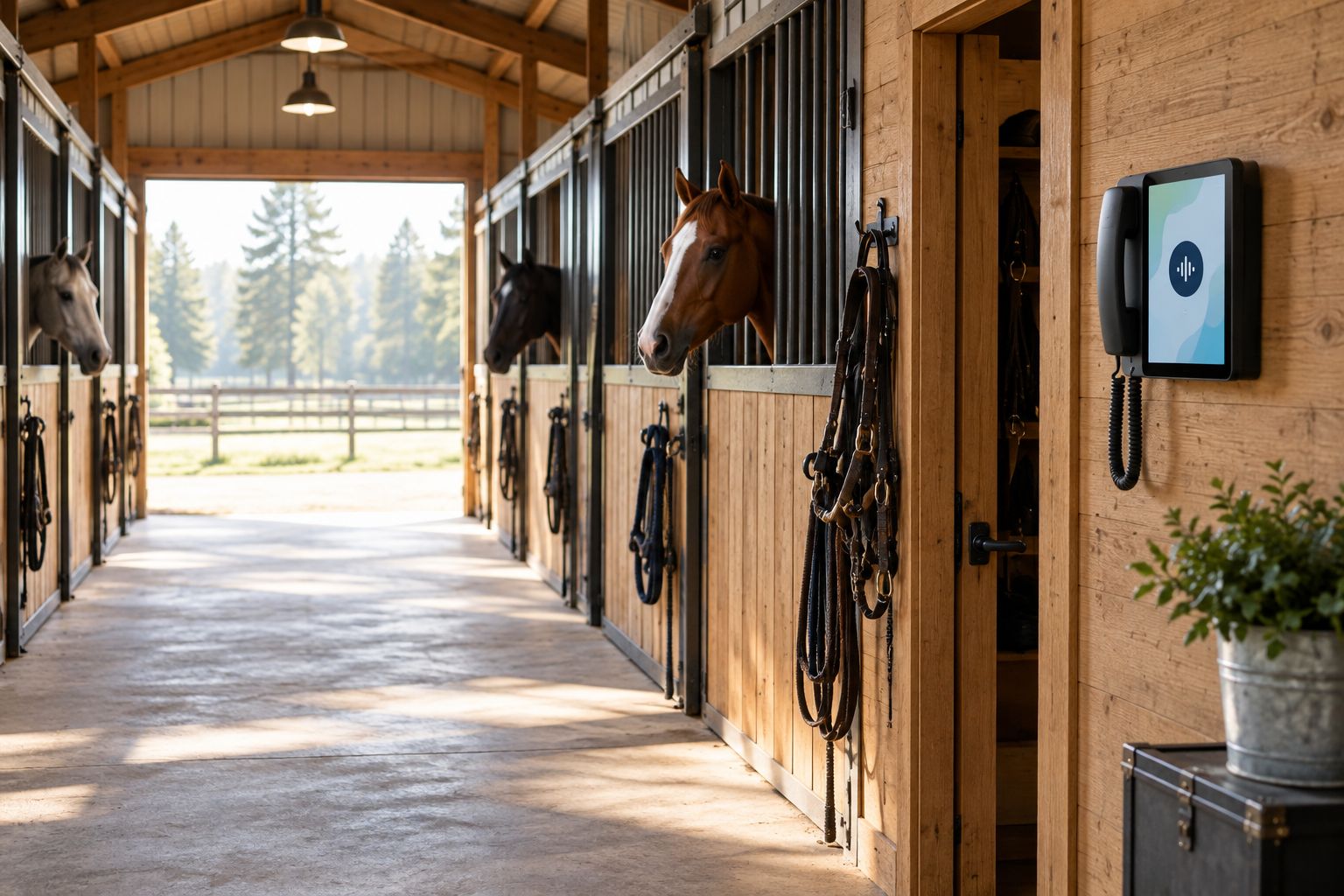
Most boarding inquiries land in the same three-hour window staff are outside doing turnout.
Write a script for board inquiries before you automate one
Staff answering board inquiries need a consistent script long before any software touches the line - otherwise the AI receptionist just automates an inconsistent process.
Decide these upfront:
What stall availability information gets shared on the first call
Whether pricing is quoted by phone or reserved for a tour
How waitlist position is communicated when the barn is full
What disqualifies a boarder (vaccination records, insurance, trial period)
How a tour gets booked on the same call
Route emergency calls to the right person, every time
This is where a scripted human process stops scaling and an AI receptionist for horse boarding facilities earns its place. Harmony.ai runs on its own model built for the phone - deterministic, sub-400ms responses, using an LLM only when a caller’s answer needs flexibility - so a colic report gets recognized as urgent in the first few seconds of the call, not after a scripted intake form.
Build the escalation logic once and it applies to every call, every barn:
Define which words or phrases trigger an emergency path (colic, down horse, escaped, fire, injury)
Set separate business-hours and after-hours routing rules
Require a live warm transfer with call context, not a cold transfer that makes the caller repeat everything
Log every transcript for compliance and post-incident review (SOC 2 Type II controls apply to how that data is handled)
Set a backup number for when the primary on-call contact doesn’t answer

Emergency calls get one path: straight to a live transfer, no queue.
Automate tour and lesson scheduling
Once routing is solid, scheduling is the next highest-value automation. A caller who books a tour on the same call converts at a different rate than one told “we’ll call you back.”
Connect the phone system to whatever calendar the barn manager already uses
Confirm tour and lesson slots by text immediately after the call
Send a reminder ahead of the appointment (see how AI appointment reminders cut no-shows for the mechanics)
Offer alternate times automatically when the requested slot is full
Sync cancellations back to availability in real time
Handle waitlist and stall turnover calls without manual tracking
Waitlists are where boarding facilities lose track fastest - a stall opens, three people call about it, and whoever answers the phone first often wins the spot regardless of waitlist order.
Keep waitlist position tied to the caller’s record, not a sticky note
Notify waitlisted callers automatically the moment a stall opens
Set a response deadline before moving to the next person in line
Confirm move-in date and any deposit requirement on the same call
Cover after-hours and weekend calls without adding headcount
Boarding operates seven days a week; front desk staff usually don’t. That gap is where after-hours emergencies and late-evening inquiries fall through.
Keep emergency routing active identically on nights, weekends, and holidays
Run outbound reminder calls under TCPA-aware dialing rules for any callback or confirmation
Route non-urgent after-hours calls to a next-morning callback queue instead of a dead voicemail box
Apply the same rules across every barn location, not a patchwork by site
Measure call handling performance monthly
An AI receptionist for horse boarding facilities is only as good as what gets checked after it’s live.
Track missed-call rate before and after deployment
Measure tour-request-to-signed-contract conversion
Audit a sample of emergency transfers for accuracy and speed
Review transcripts flagged as “could not resolve” for script gaps
Comparing phone coverage options for boarding facilities
Most boarding operations are running one of four setups. Here’s how they stack up on the calls that actually matter.
On-site front desk staff
Best for: Single-location barns with daytime-only call volume
Key limitation: Can’t answer the phone and handle turnout or feeding at the same time
Human answering service
Best for: Facilities that only need after-hours message-taking
Key limitation: Takes a message but can’t check stall availability or live-transfer an emergency
Basic voicemail or IVR
Best for: Very low call volume operations
Key limitation: No live qualification; most callers hang up rather than leave a message
Harmony.ai AI receptionist
Best for: Multi-location equestrian operations needing 24/7 live coverage
Key limitation: Requires initial flow and escalation setup; not a substitute for veterinary triage judgment
Harmony.ai wins on coverage consistency across barns and after-hours emergency routing - it is not a replacement for the vet or manager making the actual medical call.
Cover every barn call, day or night
See how an AI receptionist handles boarding inquiries and emergency routing.
Common mistakes horse boarding facilities make
Letting voicemail catch inquiry calls during turnout hours. The caller who wanted a tour books one elsewhere before staff get back inside.
Running emergency and general inquiries through the same queue. A colic report shouldn’t wait behind a question about blanket storage.
Not updating stall availability daily. Overpromising open stalls on a call that gets contradicted at the tour costs trust before the boarder even signs.
Cold-transferring vet and farrier confirmation calls. Making the caller repeat their name and horse’s name after being transferred wastes the call and their patience.
Treating a multi-barn operation as one phone tree. Callers asking about a specific location need routing that knows which barn they mean, not a single generic mailbox.
FAQ
What is an AI receptionist for horse boarding facilities?
It’s a phone system that answers barn calls automatically, qualifies board inquiries, books tours, and routes emergency calls like colic reports to the on-call manager live. It replaces voicemail and staffed front desks for coverage during turnout, feeding, and after-hours windows.
Can an AI receptionist check real-time stall availability?
Yes, when it’s connected to the facility’s booking or management system it can confirm open stalls, move-in timelines, and waitlist position during the call rather than promising a callback.
How does an AI receptionist handle emergency colic calls?
It recognizes emergency language in the first seconds of the call and warm-transfers the caller live to the on-call manager or vet with the reason for the call already attached, instead of routing to voicemail.
Is an AI receptionist better than a human answering service for barns?
An answering service takes a message and ends the call; an AI receptionist for horse boarding facilities qualifies stall availability and books a tour on the same call, then escalates only what needs a person.
How fast does Harmony.ai answer a boarding inquiry call?
Harmony.ai responds in under 400 milliseconds on its own model built for the phone, so callers get answered without the delay or dead air common with scripted IVR systems.
Does this work for multi-location equestrian operations?
Yes, routing rules and stall data can be set per location so a caller asking about a specific barn gets that barn’s availability and staff, not a shared generic mailbox.
What happens when the AI receptionist can’t answer a caller’s question?
The call escalates to the appropriate staff member with the caller’s question and context already logged, so the person picking up doesn’t ask the caller to repeat themselves.
Is call data from a boarding facility’s AI receptionist secure?
Transcripts and call logs run under SOC 2 Type II controls, and outbound reminder or callback calls follow TCPA-aware dialing rules.
One last thing
The boarding inquiry call almost never gets a second chance in 2026 - a prospective boarder calling three barns in one afternoon books whichever one answered first and could confirm a stall. Facilities that route that specific call type ahead of everything else usually see the fastest change in signed contracts, faster than fixing after-hours coverage or waitlist tracking.