AI receptionist for podiatry clinics books visits, verifies insurance, and runs post-op follow-up calls in 2026 - the 8-step setup and where it fits.
- AI receptionist for podiatry clinics handles scheduling, insurance verification, and post-op follow-up calls in one flow.
- harmony.ai's voice agent runs on its own model built for the phone, live in days, at sub-400ms per turn.
- Podiatry front desks juggle DME orders, custom orthotics, and wound-care check-ins that generic answering services can't verify or triage.
- Escalation rules for diabetic foot emergencies and after-hours injuries matter more here than in most specialty clinics.
AI receptionist for podiatry clinics is a voice AI agent that answers, books, and verifies insurance for foot and ankle practices without adding front-desk headcount. Podiatry calls carry more variety than most specialties - new patient triage, DME and orthotics status, post-op wound checks - so the flow has to handle that mix, not just take a message.
Why an AI receptionist matters for podiatry clinics
Podiatry front desks field calls a generic phone tree can’t sort correctly: a new patient describing heel pain, a DME supplier confirming an orthotic ship date, a post-op patient reporting swelling three days after a bunionectomy. Mishandling any of those costs more than a missed booking - it delays a wound-care escalation or drops a DME authorization with a real filing deadline.
An AI receptionist for podiatry clinics has to do three things in the same call: book across providers running different procedure schedules, confirm insurance and DME coverage before the visit happens, and run structured follow-up calls that catch complications early. For the baseline mechanics of the category, read what an AI receptionist actually does before mapping it to podiatry-specific call types.
Multi-location podiatry groups in 2026 run this math against front-desk overtime and after-hours answering-service contracts, and the calls that matter most - post-op, DME, urgent injury - are exactly the ones a scripted answering service is built to route around, not resolve.
Build the podiatry front-desk playbook
Map every call type your front desk actually answers
Before automating anything, get a real count of what comes in. Podiatry call volume splits into categories that need different handling, and lumping them together is why generic scripts fail.
New patient calls (heel pain, ingrown toenail, bunion consults)
Insurance and referral verification calls
DME and custom orthotics status calls
Post-op wound-check callbacks
Prescription refill requests, including diabetic foot care supplies
Urgent injury calls (suspected fracture, infection, uncontrolled bleeding)
Fix insurance verification before the phone even rings
Do this manually first - automation on top of a broken verification process just automates the denial. Podiatry billing runs into more DME-specific codes and Medicare Advantage referral rules than most primary-care practices.
Check eligibility on the payer portal daily, not weekly
Confirm DME and orthotics coverage codes before scheduling a fitting
Flag Medicare Advantage referral requirements per plan
Cross-check secondary insurance for dual-eligible patients
Document an out-of-pocket estimate before the visit, not after
Automate scheduling and the waitlist
This is where the AI receptionist earns its place. harmony.ai’s voice agent books live during the call, syncs against your EHR calendar, and fills a cancellation from a waitlist without a staff member touching the schedule. Read the mechanics in the AI patient scheduling guide before deployment.
Sync the EHR or practice-management calendar in real time
Offer next available slot across every provider, not just the one requested
Send an automatic text confirmation after the call
Hold a same-day cancellation slot open for waitlisted patients
Route new-patient triage to the correct provider - surgical versus conservative care
Cut no-shows with structured reminder calls
Podiatry no-shows are expensive because many visits (custom orthotic fittings, post-op series) require the patient to bring something specific. A generic text reminder doesn’t confirm that. Detail is in the AI appointment reminders guide.
Call at 48 hours and again at 24 hours out
Confirm prep instructions - bring current shoes to an orthotic fitting
Reschedule directly on the call if the patient can’t make it
Flag chronic no-show patients for staff review, not automatic rebooking
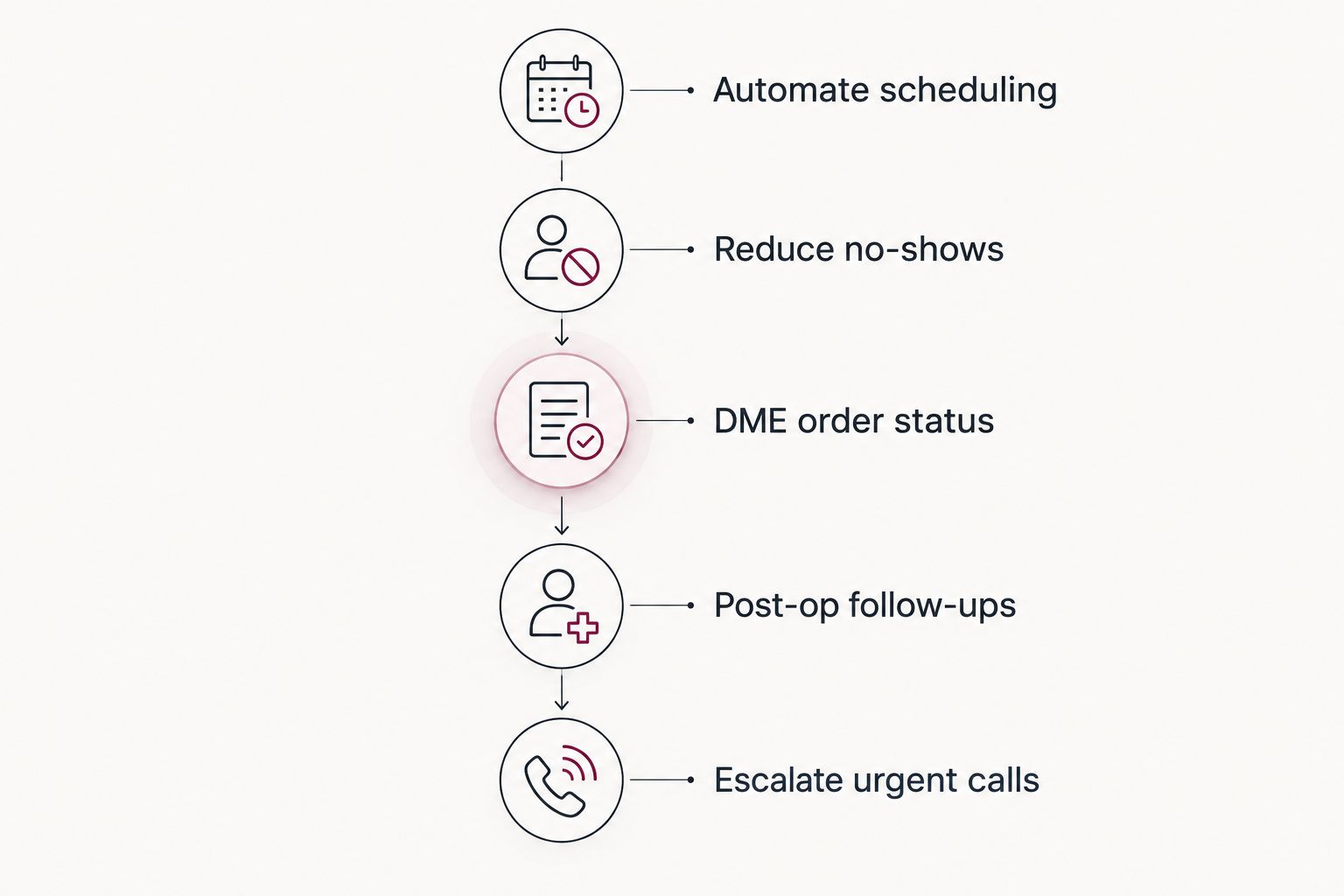
Escalation rules sit last in the flow, but they get written first.
Automate DME and orthotic order status calls
These calls are high-volume and low-complexity - good automation targets once insurance is already verified.
Check order status against the supplier’s system before calling back
Notify the patient the moment custom orthotics arrive
Confirm insurance authorization before shipment, not after
Route billing disputes to the RCM team, not the scheduling flow
Log the call outcome to the chart automatically
Route post-op and wound-care follow-ups correctly
This is the highest-stakes call type in podiatry, and it’s the one generic scripts handle worst. A missed infection signal on a diabetic foot ulcer follow-up is not a scheduling problem.
Schedule standard post-op check-ins on a fixed cadence per procedure type
Ask structured screening questions: redness, drainage, pain level
Escalate any positive screen to a nurse line immediately, live on the call
Document responses in the chart the same call
Confirm the next follow-up date before hanging up
Set escalation rules for urgent foot injuries and after-hours calls
The AI receptionist’s job here is routing, not diagnosing. Define the trigger words that force an immediate transfer and keep the rule strict.
Trigger words: uncontrolled bleeding, diabetic ulcer with fever, suspected fracture
Keep an on-call provider number live around the clock
Route standard after-hours requests to next-day scheduling, not voicemail
Never let the flow attempt clinical triage beyond routing - that’s a liability line, not a feature request
Lock down HIPAA compliance and call documentation
A voice AI agent handling patient calls needs the same paperwork a human hire would need, before it touches a single call. Check the full list in what to demand on SOC 2 and HIPAA.
Confirm a signed HIPAA BAA is in place, not just a claim of “HIPAA-ready”
Ask for the SOC 2 Type II audit report, not a summary
Check one-party versus two-party consent rules for call recording in your state
Match retention policy to your EHR’s records schedule
Require a full audit trail per call for compliance review
Front-desk options for podiatry clinics, compared
In-house front desk staff
Best for: Single-location clinics with low call volume
Key limitation: Can’t cover after hours or lunch breaks; turnover cost is real
Outsourced answering service
Best for: Overflow coverage during peak call hours
Key limitation: Scripted message-taking - can’t verify insurance or book on the EHR calendar
DIY online booking widget
Best for: Simple self-schedule for new patients
Key limitation: No phone coverage at all; can’t run wound-check triage or handle urgent calls
AI voice receptionist (harmony.ai)
Best for: Multi-location podiatry groups running scheduling, DME, and post-op follow-ups at volume
Key limitation: Sales-assisted enterprise deployment, not a self-serve signup
harmony.ai’s AI receptionist is built for podiatry groups running enough call volume that scheduling, DME status, and post-op follow-ups need one system instead of three separate scripts. It’s not a fit for a single provider taking twenty calls a day - a human front desk still wins there.
Run podiatry front-desk calls through one system
See how the voice agent handles scheduling, DME status, and post-op calls.
Common mistakes podiatry clinics make
Treating post-op wound-check calls like generic appointment reminders and skipping the screening questions that catch infection early
Booking an orthotics fitting before DME insurance authorization clears, which produces a denied claim later
Sending every after-hours call to voicemail, including ones describing a diabetic foot emergency
Confirming only one visit in a multi-step care plan - custom orthotics and post-op series both need the full sequence booked, not just the next appointment
Assuming a call center or chatbot meets HIPAA requirements without checking for a signed BAA on file
FAQ
What does an AI receptionist do for a podiatry clinic?
An AI receptionist for podiatry clinics answers inbound calls, books and reschedules across providers, verifies insurance and DME coverage, and runs structured post-op follow-up calls. It hands off to staff for clinical judgment calls it isn’t built to make.
Is an AI receptionist HIPAA compliant for podiatry practices?
A properly configured voice AI vendor operates under a signed HIPAA BAA and SOC 2 Type II controls. Ask for both documents directly - a marketing claim of being HIPAA-ready is not the same as a signed BAA.
Can an AI voice agent verify insurance before a podiatry appointment?
Yes, when the agent is connected to the eligibility system and DME coverage codes ahead of the call. It won’t fix a broken verification process on its own - that has to be set up first.
How is an AI receptionist different from an answering service for podiatry?
An answering service takes a message and passes it along. An AI receptionist for podiatry clinics books directly on the EHR calendar, verifies insurance in the same call, and runs structured wound-care screening questions.
Can AI handle post-op wound-check follow-up calls?
Yes, on a fixed cadence with structured screening questions for redness, drainage, and pain level, with any positive response escalated live to a nurse line. It documents the response to the chart on the same call.
What happens when a caller describes a foot injury emergency?
A properly configured flow transfers immediately on defined trigger words like uncontrolled bleeding or suspected fracture. The AI routes the call; it does not attempt to diagnose or triage beyond that.
How does the cost compare to a human front-desk hire?
Cost comparisons depend on call volume, location count, and current staffing, so run the numbers against your own front-desk overtime and answering-service spend rather than a generic figure.
How fast can a podiatry clinic launch an AI receptionist?
harmony.ai’s voice agents go live in days once call flows, insurance rules, and escalation triggers are mapped, not months. The mapping work in this guide is what determines that timeline, not the software setup.
One last thing
The call that costs a podiatry clinic the most in 2026 isn’t the one that goes unanswered - it’s the post-op check-in where the screening question got skipped because the flow treated it like a generic reminder. Write the wound-care screening script before touching the scheduling automation. Compliance sign-off and clinical safety depend on that script, not on how fast the AI books an appointment.