
AI receptionist for dog training businesses answers calls, books classes, and cuts no-shows in 2026 - see Harmony's full comparison and verdict here today.
- An AI receptionist for dog training businesses answers every call, books classes, and cuts missed-inquiry losses - Harmony runs it end to end.
- Multi-location training operations lose enrollment to voicemail; voice AI answers in seconds, 24/7, without added front-desk headcount.
- Harmony's own model runs sub-400ms responses and hot-transfers behavior consult calls to a trainer when the moment needs human judgment.
- Verdict: dog training businesses running three or more locations should deploy AI voice reception in 2026 - single-location studios can start with a manual audit first.
AI receptionist for dog training businesses is a voice AI system that answers every inbound call, books classes and private sessions, and routes behavior questions to a trainer without adding front-desk headcount. Multi-location training operations lose enrollment to voicemail every day in 2026; the ones that fix it turn the phone into a booking engine instead of a bottleneck.
Why this matters for dog training businesses
A dog training business runs its front desk from the training floor, not a call center. Trainers run classes, board-and-train sessions, and private lessons back-to-back, which means the phone rings straight to voicemail during the exact hours new clients call to ask about enrollment. If you’re unclear on what an AI receptionist actually does versus a standard answering service, the AI receptionist buyer’s guide breaks down the mechanics before you evaluate vendors.
For a business running three or more locations, missed calls compound. Every unanswered inquiry is a lead calling the next training studio on the list, and every reminder that doesn’t go out is an open class slot nobody rebooked. None of this is unique to dog training - it’s the same math behind speed-to-lead in any local service business - but training studios feel it harder because enrollment windows are short and classes run on fixed schedules.
How to set up an AI receptionist for a dog training business
Building phone coverage for a dog training business follows the same sequence whether you’re running one location or twelve. Start manual, prove out the routing logic, then hand the repetitive calls to a voice agent that doesn’t clock out when a trainer’s schedule does.
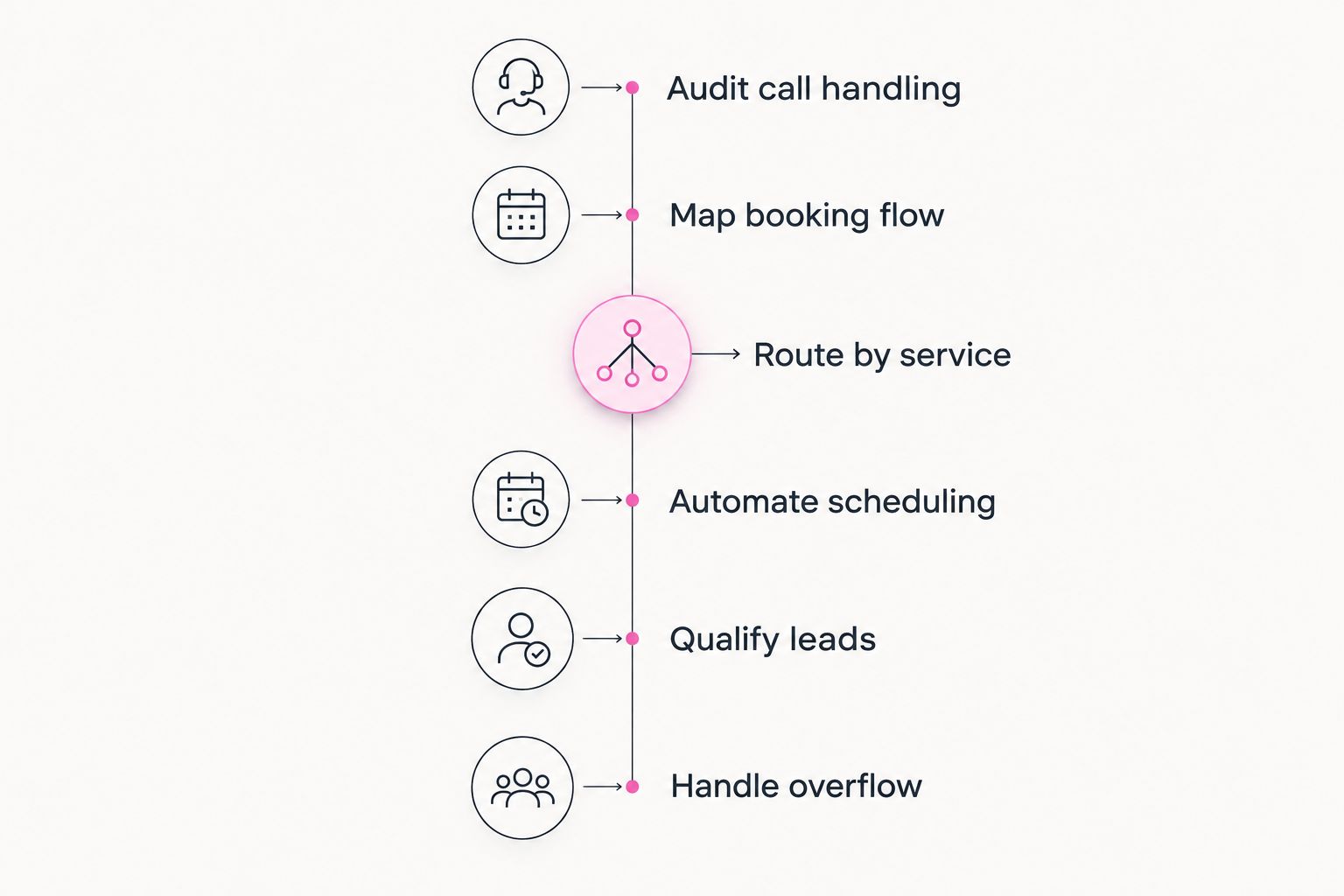
Skipping the routing map is the most common reason automation projects stall.
Audit your current call handling
Pull a week of call logs from the front desk line and count missed calls by hour
Note which calls go to voicemail during class blocks versus open desk hours
Tag calls by type: new inquiry, reschedule, behavior question, billing
Flag any calls that rang more than twice before pickup
Map your enrollment and booking flow
Write out every step from “caller asks about puppy class” to “class booked and confirmed”
List the questions a caller needs answered before booking: schedule, location, prerequisite evaluation, waitlist status
Identify which questions a script can answer versus which need a trainer’s judgment
Decide where a warm transfer to a trainer belongs in the flow
Route calls by training service
Separate group class inquiries from private lesson and board-and-train requests
Route behavior consultations - aggression, separation anxiety, reactivity - to a senior trainer, not the general queue
Set different booking rules per service; board-and-train usually needs an intake evaluation first
Keep a fallback path for callers who don’t fit a category
Automate scheduling and reminders
If a caller has to leave a voicemail to book a training slot, you’ve already lost them to the studio down the street. Automating scheduling and reminders closes that gap without adding staff:
Connect the phone line to your class and appointment calendar so bookings post directly, not through a callback queue
Set reminder calls or texts 24-48 hours before class start and evaluation appointments
Confirm each reminder against the actual roster, not a static list, so canceled classes don’t send false reminders
Route reschedule requests back into the same calendar automatically instead of manual re-entry
See the mechanics in AI appointment reminders that reduce no-shows
Qualify leads before they hit a trainer’s calendar
Ask standard intake questions up front: dog’s age, breed, behavior concerns, prior training history
Screen for red flags - bite history, dog-aggression - that need a specialist evaluation, not a general slot
Confirm schedule fit before booking a consult so trainers aren’t quoting cold
Log every answer against the client record so the trainer walks into the first session with context, not a blank form
Handle overflow and after-hours calls
Set a rule for what happens when every trainer is in session and the desk line rings
Build an after-hours path for callers who find you outside business hours - new-client searches skew evening and weekend
Give overflow callers a real next step - callback window, booking confirmation, or direct transfer - instead of a generic voicemail greeting
Track consent on any outbound reminder or callback campaign; TCPA rules apply to automated calls and texts to prospects and clients
Measure your call answer rate and booking conversion
Track answer rate - calls picked up versus total inbound - by week
Track booking conversion: inquiries that turn into a scheduled class, evaluation, or consult
Compare no-show rate before and after reminder automation
Review which call types still escalate to a human and whether that routing rule needs adjusting
AI receptionist options for dog training businesses compared
Before committing to a vendor, weigh the option against what you’re running now. The differences show up fastest in a direct comparison - see the deeper breakdown in AI receptionist vs. answering service if you’re still deciding between the two paths.
In-house front desk staff
Best for: Single-location studios with steady daytime hours
Key limitation: Can’t cover class hours, nights, or weekends without extra shifts
Verdict: Hold
Traditional answering service
Best for: Overflow coverage during peak enrollment periods
Key limitation: Takes messages only; can’t book directly into your calendar
Verdict: Hold
Voicemail-to-text callback
Best for: Solo trainers just starting out
Key limitation: Callers rarely wait for a callback; most re-dial the next studio
Verdict: Skip
AI voice receptionist (Harmony)
Best for: Multi-location and high-call-volume training operations
Key limitation: Needs an upfront intake and routing map before launch
Verdict: Buy
Harmony wins for multi-location dog training operations that answer more calls than a single trainer can pick up between sessions. It runs on its own model built for the phone, uses LLMs only when a call needs flexibility, and hot-transfers the calls that need a real trainer.
Put your phone line to work
See how Harmony books classes and qualifies callers around the clock.
Common mistakes dog training businesses make
Treating every call the same. A new-puppy inquiry and a reactive-dog consult need different scripts; routing both to the same generic greeting loses the second caller.
Skipping the intake before booking. Booking a board-and-train slot without a behavior screen means trainers walk into sessions blind, and cancellations climb.
No answer to basic behavior questions at the front desk. A caller asking whether to combine crate training with a chew deterrent needs a real answer, not a callback promise. Trainers who point pet parents toward proven fixes early - the same logic behind guides ranking anti-chew sprays for dogs - close enrollment faster because the caller feels heard on the first ring.
Reminder calls that don’t reflect the real roster. Sending a class reminder for a session that already filled or canceled erodes trust faster than sending no reminder at all.
No compliance check on reminder campaigns. Automated reminder calls and texts to prospects fall under TCPA; running them without consent tracking is a liability multi-location operators can’t absorb in 2026.
FAQ
What does an AI receptionist for dog training businesses do?
It answers every inbound call, books classes and private sessions, and routes behavior questions to a trainer without a receptionist on staff. It runs on the training business’s calendar and intake questions rather than a generic script.
How is an AI receptionist different from an answering service for a dog training studio?
An answering service takes a message and passes it along; an AI receptionist books directly into the calendar and asks intake questions during the call. Answering services can’t confirm class availability in real time - a voice agent can.
Can an AI receptionist book dog training classes directly into a calendar?
Yes, once it’s connected to the studio’s scheduling system it posts bookings, reschedules, and cancellations without a manual entry step. It also confirms class capacity before offering a slot to a caller.
Does an AI receptionist handle behavior consult calls or only scheduling?
It handles both - screening for red flags like bite history or reactivity, then routing that caller to a senior trainer instead of a general class slot. Scheduling, billing, and basic behavior questions all run through the same line.
Is an AI receptionist TCPA-compliant for reminder calls to dog training clients?
An enterprise voice AI platform like Harmony is TCPA-aware and tracks consent for automated reminder calls and texts. That compliance layer matters most for multi-location operators running reminder campaigns at scale.
How fast does an AI receptionist answer a new inquiry call?
Harmony’s voice agents run on a model built for the phone with sub-400ms response time, so calls get answered on the first ring rather than routed to voicemail. Speed matters most during class hours when no one is at the front desk.
What happens when a caller needs to talk to a trainer directly?
The AI agent hot-transfers the call to a trainer or manager the moment the conversation needs human judgment, like a bite-history disclosure or a pricing negotiation. It doesn’t hold the caller in a script loop trying to resolve it itself.
How much does an AI receptionist cost for a multi-location dog training business?
Pricing runs on contracted terms based on call volume and number of locations rather than a flat rate, so request a quote directly. Multi-location operators should weigh that quote against the cost of adding front-desk shifts to cover class hours.
One last thing
The trainers who benefit most from AI voice reception in 2026 aren’t the ones with the highest call volume - they’re the ones with the most fragmented schedule. A studio running six trainers across three locations has more phone gaps than a single location working a steady 9-to-5, because every trainer is in session at a different time. Map your actual coverage gaps before comparing vendors; the busiest hour on your class calendar is usually the quietest hour at your front desk.