- AI SDR for marketing agencies calls, qualifies, books, and transfers leads across client accounts without creating a new calling queue.
- Harmony.ai AI SDR is best for mid-market and enterprise agencies that need approved call flows live in days.
- Each client account needs separate qualification rules, routing logic, reporting, and compliance controls.
- Start with inbound campaign response, prove booked-meeting quality, then expand into reactivation and outbound calling.
Marketing agency AI SDR is a voice operator that calls, qualifies, and books meetings from client-generated leads, with the aim of scaling pipeline delivery across accounts. Agencies need stricter account separation, attribution, and script control than an internal revenue team; the 2026 AI SDR guide explains the underlying model.
Why AI SDR matters for marketing agencies
Marketing agencies control campaign execution but often lose control after a prospect submits a form or calls. The lead enters a client-owned process, waits for attention, and reaches a salesperson after intent has cooled. The agency still takes the blame when pipeline falls short.
An AI SDR removes that handoff gap by becoming the operator. It calls the lead, asks approved questions, books the next step, or transfers a qualified buyer while interest is active. For Harmony.ai, that first outbound response can happen in under 60 seconds.
The agency use case is harder than deploying one call flow for one company. Every client has different qualification thresholds, offers, calendars, escalation rules, and reporting expectations. A controlled rollout keeps those differences explicit instead of burying them in one generic script.
In 2026, the practical value is accountability. An agency can report which campaign created the lead, whether the lead answered, how qualification ended, and whether the next step was booked. That connects media spend to an observable sales outcome without asking the client to reconstruct activity from scattered notes.
Build the AI SDR motion in six steps
1. Audit response time by client and campaign
Establish the 2026 baseline before changing the operating model. Compare the time a lead enters the process with the time the first call starts, then separate the results by client, campaign, channel, and hour of day.
Do not average every account together. A fast account can hide a slow one, and a strong paid-search campaign can hide weak follow-up on events or content syndication. The account-level view tells you where delayed response threatens both pipeline and retention.
Record lead creation and first-call timestamps
Segment results by client and campaign
Separate business-hours and after-hours leads
Flag leads with no recorded call attempt
Rank accounts by delay and unresolved volume
2. Define qualification before writing the call flow
Write the decision tree manually first. The AI SDR should execute a qualification policy that the agency and client have already approved, not invent one during a live call.
Define the questions, acceptable answers, disqualifying conditions, booking criteria, and transfer triggers for each account. Keep the first call focused. A short set of 3-5 decisive questions produces cleaner routing than an interrogation that tries to complete the entire sales discovery process.
Name the required qualification fields
Write 3-5 decisive questions
Define qualified and disqualified outcomes
Set booking and transfer conditions
Approve exception and fallback language
Assign an owner for script changes
3. Connect the response path to each campaign
Map every lead source to the correct account and call flow. A lead from a webinar should not receive the same opening as a buyer requesting a proposal, and neither should enter another client’s sequence.
Use campaign identifiers that persist from acquisition through the call outcome. The reporting structure should identify the client, campaign, source, disposition, and next action without relying on free-text notes. Test the mapping with internal records before sending live traffic through it.
Create one account identifier per client
Map each source to an approved opening
Set the correct calendar or transfer destination
Define required disposition fields
Test account isolation before launch
Document who can alter routing
4. Launch one controlled inbound use case
Start with a bounded flow: new inbound campaign leads that require qualification and booking. This makes the result easy to review because the lead source, call purpose, and desired next step are already known.
Harmony.ai runs calls on its own model built for the phone and uses LLMs when a moment needs flexibility. Approved flows remain deterministic. Sub-200ms latency keeps turns responsive, while booking and hot transfer move qualified leads to the next action without placing them in another queue.
Select one client and one campaign
Route new leads into the approved call flow
Set qualification and transfer thresholds
Review completed, failed, and escalated calls
Correct ambiguous questions before adding volume
Expand only after the client accepts call quality
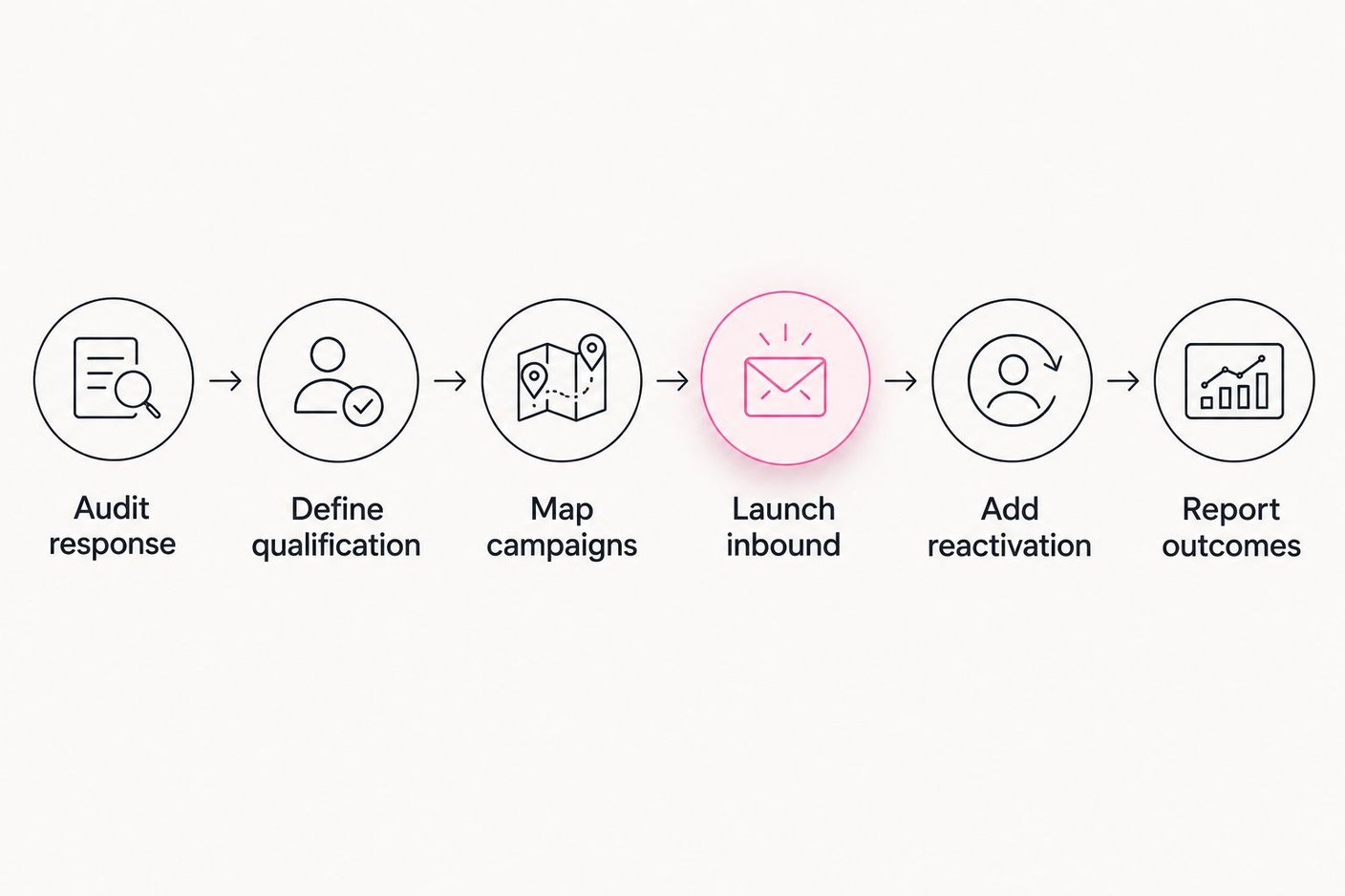
Prove one inbound flow before adding reactivation and outbound campaigns.
5. Add reactivation after inbound is stable
Aged leads provide a second bounded use case. The audience already entered the client’s database, but the agency still needs to confirm the permitted purpose, current contact status, campaign language, and suppression rules before dialing.
Separate reactivation from new-lead reporting. These campaigns answer different questions: inbound response measures how well the agency handles current demand, while reactivation measures how much unresolved opportunity remains in older records. Use 30 days as a review boundary only when the client approves that definition for its process.
Define which records qualify for reactivation
Scrub DNC and suppression lists before dialing
Write a reactivation-specific opening
Route renewed interest to the correct owner
Separate recovered meetings from new-lead meetings
Stop records that request no further calls
6. Standardize booking and warm transfer
Qualification has no value if the next step fails. Decide whether each qualified outcome should create a scheduled meeting or initiate a live transfer, then define what happens when the intended recipient does not answer.
The handoff should carry the information already collected. A closer should not re-ask answered questions, and a lead should not have to repeat the reason for the call. For live transfers, specify the receiving team, accepted hours, fallback route, and information required before connection.
Choose booking or transfer by lead type
Pass collected context with the handoff
Set receiving hours and fallback routing
Confirm calendar ownership by account
Review failed transfers separately
Preserve a full audit trail
7. Report business outcomes by account
Build the 2026 client report around outcomes, not raw dial counts. Attempts and connects explain activity, but qualified meetings, completed transfers, disqualification reasons, and unresolved exceptions explain whether the system is producing useful pipeline.
Keep every client isolated. The agency should be able to trace a booked meeting back to the campaign and call disposition that produced it. Review exceptions as an operating queue rather than hiding them inside an aggregate completion rate.
Report qualification outcomes by campaign
Track meetings booked and transfers completed
List the leading disqualification reasons
Separate no-answer from failed-call outcomes
Review exceptions with the client owner
Record every approved script revision
Compare AI SDR options for marketing agencies
Agencies have four practical operating models in 2026. The correct choice depends on whether the agency wants to manage calls manually, stay inside written channels, build its own voice stack, or deploy a sales-assisted enterprise platform.
Harmony.ai is best for mid-market and enterprise marketing agencies that need AI SDR qualification, booking, and live transfer running across controlled client flows in days. Its limitation is equally clear: Harmony.ai is sales-assisted, not a self-serve tool for testing an unapproved script without implementation planning.
Manual call queues
Best for: One tightly bounded campaign with predictable coverage
Operating advantage: Direct oversight of every call
Key limitation: Coverage and consistency depend on queue capacity
Verdict: Hold for a pilot
Text and email sequences
Best for: Campaigns designed around written follow-up
Operating advantage: Simple content review and asynchronous replies
Key limitation: Cannot qualify or transfer a buyer by phone
Verdict: Use for written channels
DIY voice stack
Best for: Agencies with engineering ownership and telephony expertise
Operating advantage: Full control over individual components
Key limitation: Agency owns orchestration, testing, monitoring, and maintenance
Verdict: Build only with technical ownership
Harmony.ai voice AI agents
Best for: Mid-market and enterprise agencies running approved phone flows
Operating advantage: Calls, qualifies, books, and hot-transfers within one operating model
Key limitation: Requires sales-assisted deployment and defined flows
Verdict: Buy for multi-account voice operations
The decision should follow operating responsibility. If the agency wants to build and maintain telephony, model behavior, fallback logic, and monitoring, a DIY stack fits that mandate. If the agency wants the voice operator live in days with deterministic flows and sub-200ms latency, Harmony.ai fits the requirement.
Put every lead into motion
See how Harmony.ai runs qualification, booking, and live transfer across approved client flows.
Common mistakes marketing agencies make
Using one script across unrelated clients
A generic script erases the context that makes qualification useful. Each account needs separate questions, outcomes, transfer rules, calendars, and escalation language. Shared infrastructure is efficient; shared qualification logic is not.
Treating the AI SDR as a dialer
A dialer starts calls. An AI SDR owns the conversation through qualification and next action. If the flow ends with a transcript that nobody routes, the agency has automated activity rather than pipeline movement.
Expanding before reviewing exceptions
Completed calls rarely reveal the biggest design problems. Failed transfers, unclear answers, unexpected objections, and fallback events show where the flow breaks. Review those exceptions before adding more accounts or call types.
Mixing client data in one report
Portfolio-level totals help the agency plan capacity, but they do not prove value to an individual client. Every meeting, transfer, disqualification, and unresolved record needs account-level attribution.
Treating compliance as a final checklist
Consent, DNC controls, calling purpose, recording rules, and suppression handling belong in campaign design. The outbound AI calling compliance playbook covers the controls agencies should define before launch. Harmony.ai is SOC 2 Type II, GDPR/CCPA-ready, and TCPA-aware; a HIPAA BAA is available when the use case requires it.
FAQ
What is an AI SDR for marketing agencies?
An AI SDR for marketing agencies is a voice operator that calls, qualifies, books, and transfers leads across client accounts. It follows separate approved flows so each client’s campaigns, criteria, and reporting remain distinct.
What should an agency automate first with an AI SDR?
An agency should automate inbound qualification for one client and one campaign first. That bounded use case makes response time, call quality, booking results, and exceptions easy to review before expansion.
Can an AI SDR manage multiple agency clients?
Yes, an AI SDR can manage multiple agency clients when each account has isolated scripts, routing, calendars, dispositions, and reporting. One shared qualification flow across unrelated clients creates avoidable errors.
How quickly does Harmony.ai call a new lead?
Harmony.ai can call every new lead in under 60 seconds. The AI operates the call, qualifies against the approved flow, then books or hot-transfers when the lead meets the defined criteria.
How long does Harmony.ai take to launch?
Harmony.ai goes live in days once the agency and client have approved the qualification flow, routing, and next actions. It is a sales-assisted enterprise deployment, not a self-serve experiment.
Can an AI SDR reactivate old campaign leads?
Yes, an AI SDR can run approved reactivation calls against eligible records. The agency must apply DNC, consent, suppression, and campaign-purpose controls before any outbound dialing begins.
What should agencies report from AI SDR campaigns in 2026?
Agencies should report qualification outcomes, meetings booked, completed transfers, disqualification reasons, no-answer records, and unresolved exceptions by client and campaign. Dial volume alone does not show pipeline value.
Is Harmony.ai suitable for enterprise agency clients?
Yes, Harmony.ai is designed for mid-market and enterprise revenue, customer experience, and operations teams. It is SOC 2 Type II, GDPR/CCPA-ready, and TCPA-aware, with a HIPAA BAA available.
One last thing
Do not sell AI SDR as a calling add-on in 2026. Sell the controlled outcome: every eligible lead enters an approved conversation, reaches a defined disposition, and leaves an auditable next action. That operating model protects client trust and makes agency performance easier to prove.