- An AI voice agent for restaurant phone orders answers every call during dinner rush instead of routing overflow to hold music.
- Harmony.ai wins for multi-location restaurant groups that lose catering leads and takeout orders to busy signals during peak hours.
- The manual fix starts with a 30-day call audit, not a new phone system - the voice agent is the fourth step, not the first.
- POS integration and a live 86 list matter more than script polish for order accuracy.
AI voice agent for restaurant phone orders and takeout answers every inbound call, walks the caller through the menu with modifiers, reads the order back, and posts it to the kitchen - with the goal of catching orders that a busy line would otherwise send to voicemail. Restaurant groups have a different problem than most call-heavy businesses: order accuracy and hold time both spike at the exact same 90-minute window, twice a day, across every location at once.
Why this matters for restaurant groups
A host stand or to-go counter answering the phone mid-rush is answering it last, after plating and expo. That’s the gap Harmony.ai is built to close - an AI voice agent runs on a phone line the way a dedicated order-taker would, minus the shift schedule and minus the busy signal when three lines ring at once.
Restaurant phone orders behave differently from restaurant reservations: a caller booking a table tolerates a hold; a caller placing a $60 takeout order during a Friday rush hangs up and calls the competitor down the street. The workflow for restaurant reservations can share infrastructure with order-taking, but the urgency and the upsell logic are not the same script.
Multi-location groups feel this hardest. One host stand covers one restaurant; a voice agent covers every location’s phone line simultaneously, with the same menu accuracy at the flagship store and the newest franchise unit. That consistency - not novelty - is the actual case for automating this call type in 2026.
The build: from call audit to a working voice agent
Audit call volume and missed-call rate by location
Before touching a script or a vendor, know what you’re actually losing. Pull the data first.
Pull call logs from your phone system for the last 30 days across every location
Flag the hours where hold time exceeds 60 seconds
Count abandoned calls during lunch and dinner peaks separately - they behave differently
Compare order volume by channel: phone, app, and third-party delivery
Identify which locations lose the most calls during their own rush window
This audit is also where the cost-per-call math against a human front desk becomes concrete instead of theoretical - you need your own missed-call number before any automation decision makes sense.
Build a scripted order flow that matches your actual menu
A generic phone script fails the moment a caller asks for a substitution the kitchen doesn’t stock.
Write out every modifier, size, and substitution rule per menu item
Flag allergen and dietary questions that require a scripted disclaimer, not improvisation
List daily specials separately so they don’t get buried under the standing menu
Decide explicitly what triggers a transfer to a manager - large catering orders, complaints, price disputes
Test the script against your single busiest order type, not your simplest one
Route calls by location and daypart
One central number for a 12-location group creates a single point of failure during the exact hour you can least afford one.
Assign inbound numbers per location instead of one shared line
Set separate flows for lunch, dinner, and late-night hours
Route catering and bulk orders to a dedicated queue, away from single-entree callers
Build a fallback path for after-hours calls instead of dead air
Confirm the routing table matches this year’s store hours, not last year’s
Automate order-taking with a voice agent
This is the step where automation earns its place - after the audit and the script exist, not before.
A voice AI agent answers every incoming call in under a couple of rings, confirms each item, and reads the order back before ending the call. Harmony.ai runs this as a deterministic, approved flow at sub-200ms latency rather than improvising off a loose script, and it’s live on a phone line in days, not months.
Connect the voice agent to your point-of-sale so orders post directly to the kitchen display, not a call log someone re-types
Set item-level confirmation so substitutions get read back instead of assumed
Keep a live 86 list synced so the agent never sells an item the kitchen ran out of an hour ago
Cap wait time per caller regardless of how many lines ring at once - this is the entire point for a rush-hour queue
Hand off complex catering quotes to a scripted branch rather than forcing a generic flow to guess
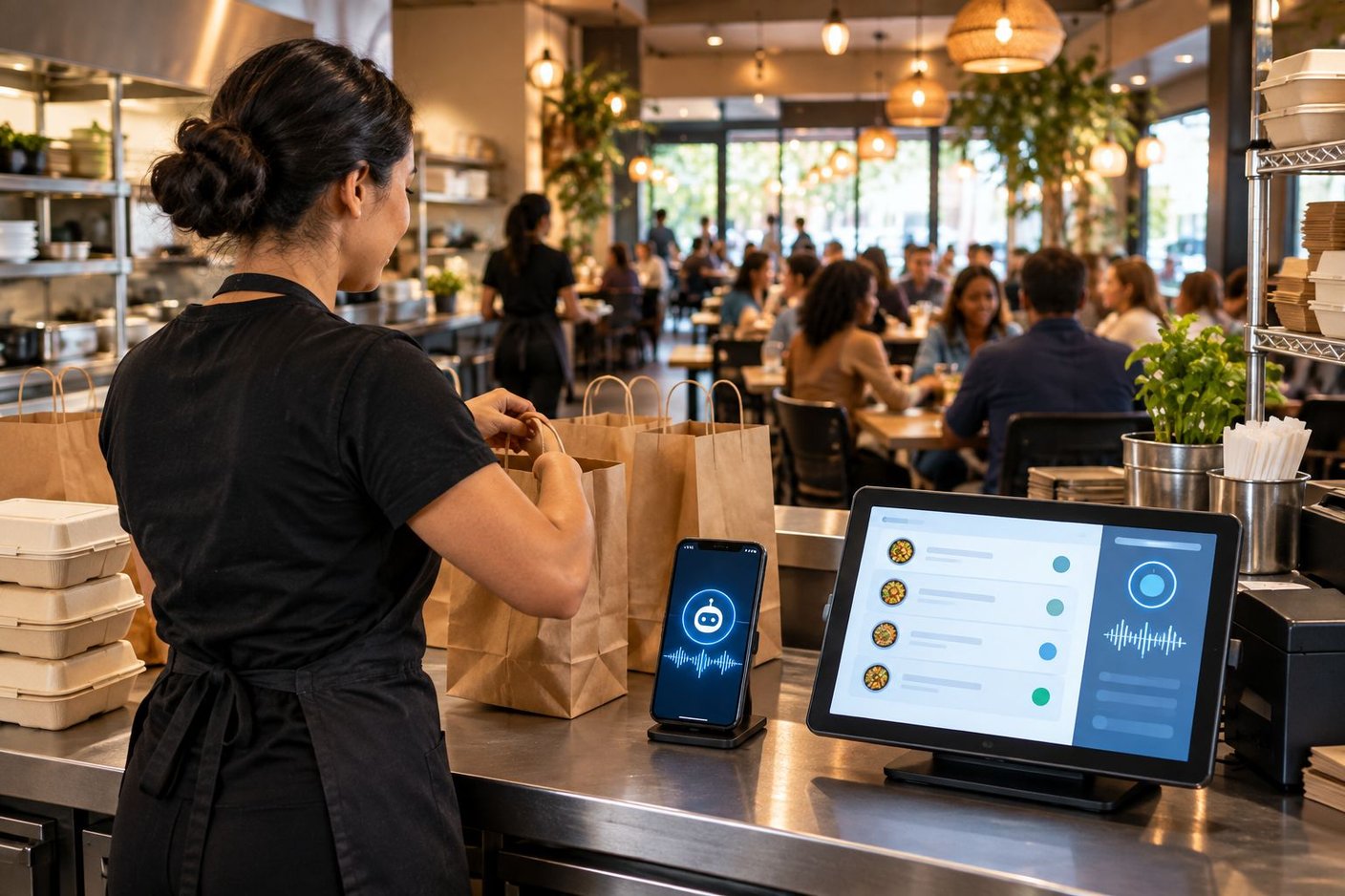
The rush hour that overwhelms a host stand is the exact window a voice agent is built to cover.
Handle upsells and specials without slowing the call
An upsell that adds 20 seconds to every call erases the speed advantage of automating the line in the first place.
Script one upsell per order type, not three stacked offers
Time the offer to the natural pause after the main item is confirmed
Skip the upsell entirely on large catering orders - it reads as tone-deaf on a $400 order
Track which upsell phrasing actually converts and drop what doesn’t within the first month
Escalate the calls that need a human
A voice agent that never hands off is a liability, not a feature - the goal is knowing exactly when to transfer, live, with context.
Set explicit triggers: refund requests, allergy emergencies, order disputes
Hot-transfer with the full order already attached so the caller never repeats themselves
Log every escalation reason weekly to spot patterns - a recurring allergy question means the menu description needs to change, not the script
Keep a manager line staffed during known peak windows regardless of automation
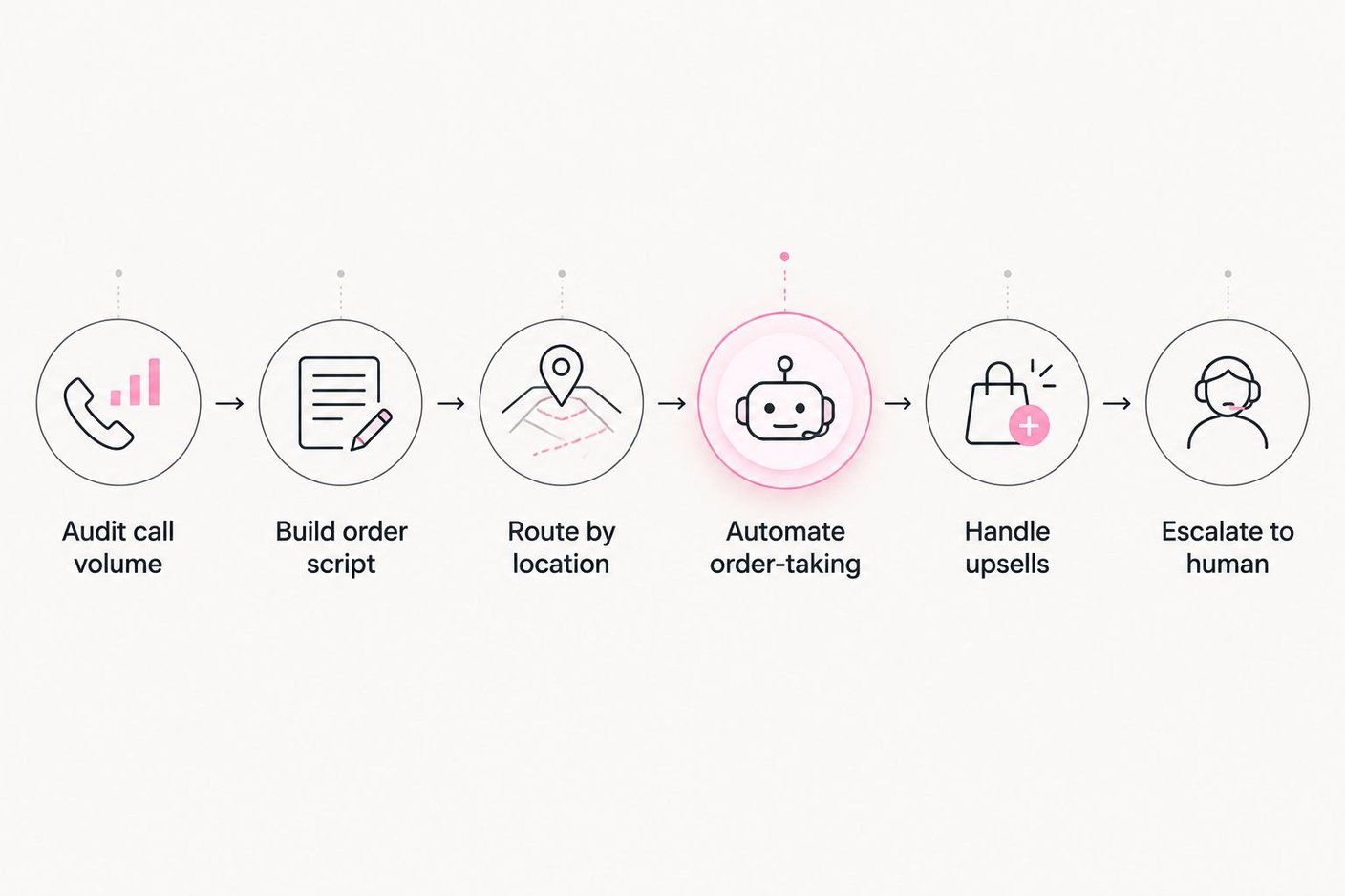
The voice agent enters at step four - after the audit and script exist, not before.
Comparing the options for restaurant phone orders
In-house staff answering phones
Best for: Single-location restaurants with slow lunch service
Key limitation: Staff can’t take a phone order while running food or working the line - Skip for anything with a real rush
Third-party answering service
Best for: Predictable overflow during known peak hours
Key limitation: Generic scripts, no POS integration, order accuracy depends on the agent that day - Hold
DIY voice AI builders
Best for: Teams with an engineer who will maintain flows indefinitely
Key limitation: Latency and reliability vary call to call and tend to break under real rush-hour load - Wait unless you have engineering headcount to spare
Harmony.ai voice agent
Best for: Multi-location restaurant groups that need every call answered at any volume
Key limitation: Sales-assisted setup, not a self-serve signup - Buy if missed calls during rush are a measured, recurring cost
Harmony.ai wins for restaurant groups losing orders to hold music during dinner rush - it answers every line in the queue at once instead of routing the fourth caller to voicemail.
See a voice agent take a rush-hour order
Watch how it confirms items and posts straight to the kitchen.
Common mistakes restaurant groups make
Treating phone orders like reservations - a takeout caller has less patience for hold time than someone booking a table for next Saturday
Not syncing the 86 list in real time - the agent sells an item the kitchen ran out of 40 minutes earlier, and the caller finds out at pickup
No escalation path for allergy or dietary questions - this is a liability gap, not just a service gap
Ignoring the after-hours pattern - catering leads calling at 9pm go straight to voicemail and book with a competitor by morning
Running one script across every location - menu and pricing differ by market; the flow that works at the flagship store misreads a franchise unit’s actual menu
FAQ
What’s the best AI voice agent for restaurant phone orders in 2026?
For multi-location restaurant groups, an AI voice agent that integrates with the POS and holds an accurate live 86 list, like Harmony.ai, outperforms answering services and DIY builders on order accuracy during peak hours. Single-location shops with low call volume may not need one yet.
Can an AI voice agent take a real food order with modifiers?
Yes, when the script is built against the actual menu including every modifier and substitution rule. The order is read back to the caller before the call ends to confirm accuracy.
Does an AI voice agent integrate with restaurant POS systems?
A properly deployed voice agent posts confirmed orders directly to the point-of-sale and kitchen display rather than requiring manual re-entry. Confirm this integration exists before deployment - not every vendor supports it.
How does an AI voice agent handle allergy questions on a food order call?
Allergy and dietary questions should trigger a scripted disclaimer rather than an improvised answer, and complex cases should escalate to a human with full order context. This is a legal exposure point, not just a service detail.
Is an AI voice agent better than a third-party answering service for restaurants?
An AI voice agent typically integrates with the POS and holds a consistent script across every call, where third-party answering services rely on generic scripts and vary by which agent answers. For predictable, low-volume overflow, an answering service can still work.
How fast does an AI voice agent respond during a call?
Harmony.ai’s voice agent responds at sub-200ms latency, which is close to the pace of a live conversation rather than the noticeable lag of older IVR systems. Latency matters most during rush hours when callers are already impatient.
Can an AI voice agent handle multiple restaurant locations from one number, or does each location need its own?
Most multi-location groups route by location and daypart with separate inbound numbers rather than one shared line, since a single line becomes a bottleneck during simultaneous rush hours. The voice agent itself can run the same deterministic flow across every location.
How much does an AI voice agent for restaurants cost?
Pricing varies by call volume, number of locations, and POS integration needs, so check current terms directly with the vendor rather than relying on a published rate card. Run your own missed-call audit first to know what the current cost of doing nothing actually is.
One last thing
The restaurant groups that get this right in 2026 don’t start with the voice agent - they start with the 30-day call audit, because the missed-call number from that audit is what makes the automation decision obvious instead of speculative. Skip the audit and you’re buying a solution to a problem you haven’t measured yet.