- Harmony.ai answers ticketing call center on-sale spikes at sub-200ms latency without added seasonal headcount in 2026.
- Legacy touch-tone IVR and temp BPO staffing both fail at on-sale volume; an AI voice agent for ticketing call centers scales the instant volume does.
- Deterministic flows handle order status, will-call and exchange questions; a person only takes true escalations.
- Verdict: Harmony.ai fits box offices that need every on-sale call answered in 2026, not most of them.
Box office phones don’t ring evenly. They explode at 10:00 a.m. on presale day, drop off models built for average Tuesday volume, and go quiet by lunch. An AI voice agent for ticketing call centers absorbs that spike without adding temp staff for a single on-sale morning, and without every caller hitting a busy signal during the ten minutes that decide whether they get a seat.
Why this matters for ticketing and box office call centers
Most call centers plan for a range. Box offices plan for a wall. A presale, a single-day flash sale, or a mass cancellation after a postponed show can push call volume to multiples of a normal day inside the same hour - then back down before the shift ends.
A voice AI platform built for the phone, like Harmony.ai, runs that queue itself instead of routing every caller into a hold-music loop. It doesn’t need overtime approval, it doesn’t need three weeks of training before the on-sale date, and it doesn’t get slower as the queue gets longer.
Touch-tone IVR menus were never built for ticket-specific questions - will-call verification, ADA seating directions, exchange eligibility on a rescheduled show. Callers stab at numbers, get the wrong department, hang up, and call back. That’s abandoned calls stacking on top of an already saturated line, and it’s the exact failure mode an AI voice agent for ticketing call centers is built to remove.
How to deploy an AI voice agent for ticketing call centers
The sequence below runs from what most box offices already have in place to where the faster, scalable path takes over. Start with the free version of each step before adding software.
Forecast the spike before it hits
On-sale day isn’t a surprise. The date, the artist or event, and rough demand are known weeks out.
Pull historical call volume from the last three comparable on-sales
Cross-reference ticket inventory against past sell-through speed
Flag any show with press coverage, a canceled prior date, or a known high-demand fan base
Model expected abandon rate at current staffing before the date arrives, not after
Map the call volume forecast against your event calendar, not just the trailing 30 days
Route on-sale day calls before you add headcount
The manual fallback is a queue message and voicemail. It works for low-stakes days and fails completely for high-demand on-sales, where callers hanging up mid-queue means lost revenue, not just a bad experience.
Set queue priority rules by ticket type (general admission vs. accessible seating vs. VIP packages)
Pre-write hold messaging with real wait expectations, not generic apologies
Cap voicemail as a last resort, not a first-hour default
Route the first wave of calls to a deterministic AI voice agent that answers every line at once instead of one at a time
Automate the ticket questions that don’t need judgment
Order status, will-call pickup instructions, parking, and seat location questions make up most box office call volume on a normal day, and an even bigger share during an on-sale.
Order status and confirmation number lookups
Will-call pickup rules and ID requirements
Accessible seating location and companion seat availability
Parking and venue entry directions
Ticket transfer and mobile wallet troubleshooting
Handle cancellations and postponements at scale
When a show is postponed, every ticket holder needs the same call within days, not weeks. That’s outbound volume, not inbound, and it hits fast.
Segment ticket holders by refund-eligible vs. credit-only vs. automatic rebook
Script the refund-vs-credit choice as a single clear question, not a menu
Run outbound appointment and rebooking calls for the new date instead of relying on email opens
Flag season ticket holders and group sales accounts for a different script than single-ticket buyers
Build the escalation path for angry callers
A canceled show or a seating error produces callers who are already upset before the line picks up. The AI voice agent’s job here is triage, not de-escalation theater.
Detect refund disputes and account-value flags automatically
Hot-transfer with full context - no re-asking the caller’s order number or complaint
Route season ticket holders and group accounts to a named contact, not the general queue
Log every escalation reason so patterns show up before the next on-sale
Track containment and abandon rate per event, not per quarter
A quarterly average hides the one on-sale day that actually failed. Box offices need per-event visibility.
Measure abandon rate specifically during the first hour of each on-sale, separate from the daily average
Track containment rate by call type - order status contains easily, refund disputes don’t
Review call transcripts from the top five complaint categories after every major on-sale
Compare staffing cost per on-sale against calls actually handled, not scheduled headcount
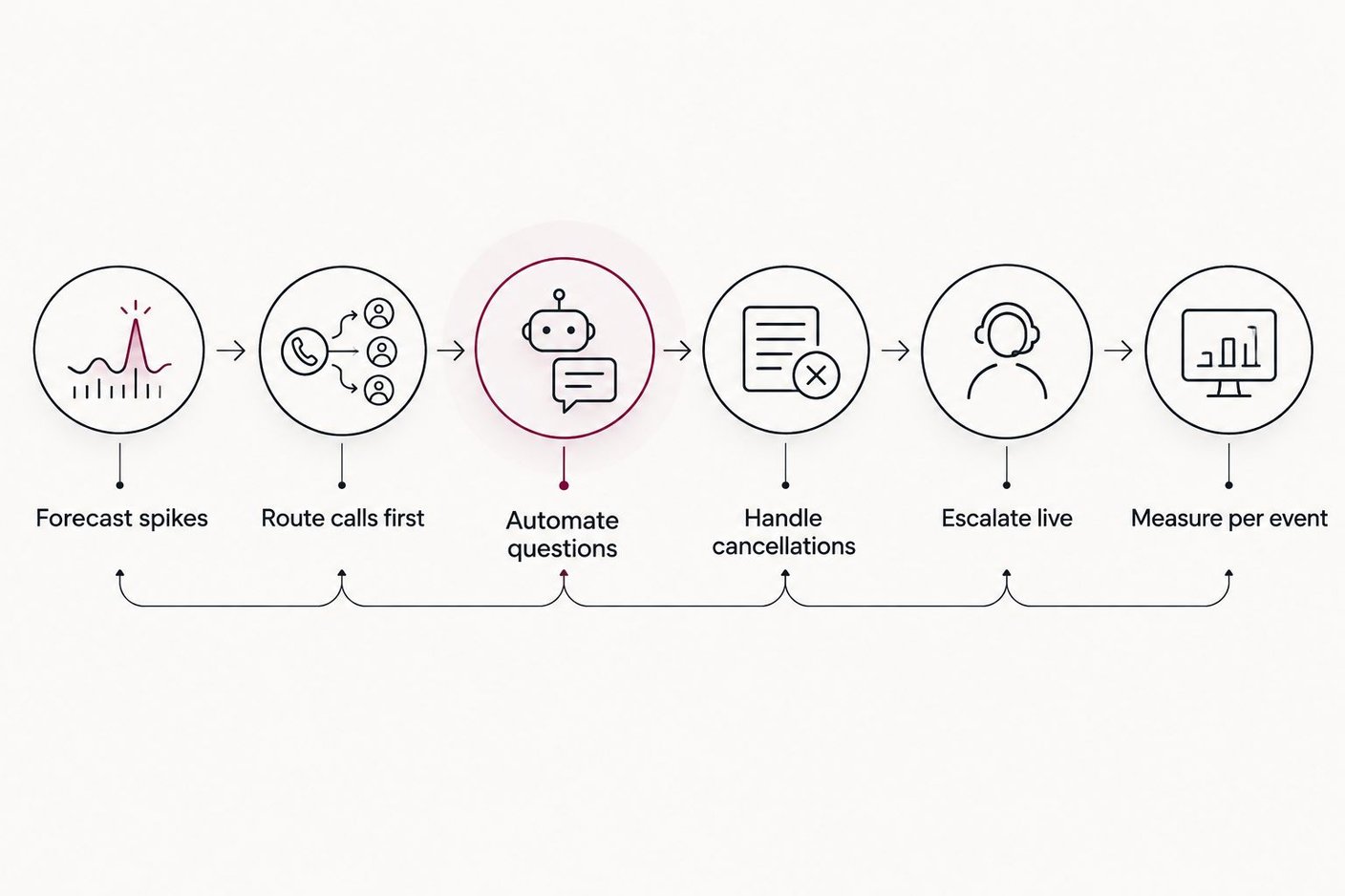
Forecasting the spike comes before adding any software or headcount.
Comparing your options for box office call coverage
Seasonal temp staffing
Best for: Predictable, single-date on-sales
Key limitation: Ramp and training time eats into the on-sale window itself
Legacy touch-tone IVR
Best for: Routing simple menu choices
Key limitation: Can’t answer ticket-specific questions; callers hang up and redial
Outsourced BPO call center
Best for: Year-round overflow coverage
Key limitation: Cost scales with every spike; scripting consistency varies by agent
AI voice agent (Harmony.ai)
Best for: On-sale spikes plus daily box office volume
Key limitation: Needs approved flows built before go-live, not open-ended conversation
Verdict: temp staffing and BPO coverage both scale linearly with cost and lag time. An AI voice agent for ticketing call centers scales instantly and costs the same whether ten calls or ten thousand hit the line in the same minute - that’s the structural difference, not a marketing claim.
Common mistakes ticketing and box office teams make
Sizing the IVR menu for average-day volume. On-sale day volume is a different problem entirely, and a menu tuned for Tuesday afternoon collapses under it.
Scripting cancellation calls after the cancellation happens. By the time scripts exist, ticket holders have already called in confused and angry.
Treating will-call and lost-ticket requests as one bucket. They need different verification steps; merging them slows down every caller in both categories.
No separate path for season ticket holders. A high-value account waiting in the same queue as a single-ticket buyer is a retention risk, not just a service gap.
Measuring containment monthly. A single failed on-sale day gets buried in a 30-day average and never gets fixed before the next one.
Get your box office ready for the next on-sale
See how a voice AI platform handles spike volume without added seasonal headcount.
FAQ
What is an AI voice agent for ticketing call centers?
It’s voice AI software that answers box office phone lines directly, handling order status, will-call, refunds and on-sale volume without a human agent on every call. It runs deterministic, pre-approved flows and hands off to a person only for true escalations.
How does an AI voice agent handle on-sale day call spikes?
It answers every incoming line simultaneously instead of queuing callers one at a time, so volume that would overwhelm a fixed number of agents gets handled at the same response speed regardless of how many calls arrive at once.
Can voice AI answer will-call and order status questions?
Yes. Order status, will-call pickup rules, and seating location questions are deterministic lookups, which makes them well suited to an automated flow rather than a live agent.
What happens when an event is canceled or postponed?
The AI voice agent can run outbound calls to affected ticket holders, present the refund-vs-credit choice, and route disputes to a person. This turns a reactive inbound flood into a controlled outbound campaign.
Is an AI voice agent better than outsourcing to a BPO for ticketing calls?
For steady, year-round overflow, a BPO can work. For on-sale-day spikes specifically, cost and consistency both favor an AI voice agent because per-minute BPO cost scales with every spike while AI capacity does not.
How fast does Harmony.ai respond on a call?
Harmony.ai runs on its own model built for the phone at sub-200ms response latency, using LLMs only when a moment in the call needs flexibility beyond the approved flow.
Does an AI voice agent replace box office staff?
No. It clears the deterministic volume - status checks, will-call, basic exchanges - and hot-transfers disputes, VIP accounts, and anything outside the approved flow to a live person with full context.
How long does it take to deploy voice AI for a box office?
Harmony.ai deploys approved call flows in days, which matters for box offices working against a fixed on-sale date rather than an open timeline.
One last thing
Most box offices audit call quality after a bad on-sale. The ones that actually fix the problem audit the forecast before the on-sale - comparing expected volume against actual staffing capacity days ahead, not reviewing complaint transcripts after the fact. By 2026, that forecast-first habit is the difference between a repeat failure and a queue that holds under pressure.