- AI SDR for payroll and HR companies calls every demo request in seconds and qualifies headcount, current provider, and contract end date.
- Harmony.ai's voice AI agent runs the qualification-to-booking flow at sub-200ms and hot-transfers live to an account executive.
- Payroll deals stall when callbacks slip past a few minutes - buyers default to whichever vendor reaches them first.
- Compliance windows like open enrollment and W-2 season create outbound spikes an AI SDR absorbs without added headcount.
AI SDR for payroll and HR services companies is a voice AI agent that answers and places calls automatically - qualifying demo requests, RFP inquiries, and renewal leads by headcount, current provider, and contract timeline, then booking the meeting before a human rep ever picks up the phone. Payroll and HR buyers move fast when they’re shopping a switch, and they move to whoever calls back first.
Why AI SDR matters for payroll and HR companies
Payroll and HR services sell into a buyer who is already anxious about switching costs - moving payroll systems mid-year, re-mapping benefits, re-training HR staff. That anxiety means the first vendor to answer the phone with real answers, not a voicemail greeting, controls the conversation. What an AI SDR does matters here specifically because payroll deals carry compliance deadlines a generic B2B SDR playbook ignores - open enrollment, W-2 season, ACA reporting - and outbound volume spikes hard around each one.
Most payroll and HR companies staff SDRs to a steady-state volume, then miss calls during open enrollment (October through December) and January’s W-2 crunch, exactly when inbound demand from unhappy switchers peaks. A voice AI agent doesn’t need overtime approval to handle a volume spike in 2026’s fourth quarter.
The buyer who fills out a payroll demo form and doesn’t get a call back inside a few minutes assumes the vendor is slow everywhere else too - support, implementation, compliance updates. That assumption kills more payroll deals than any pricing objection.
Build the qualification and outreach flow
1. Call every inbound demo request within 60 seconds
Start with the manual fix before automating anything: fix the routing, not the rep.
Route every form-fill to a shared CRM queue, never an individual inbox
Set an internal SLA - 5 minutes maximum - and page the next available rep automatically when it’s missed
Put a scheduling link in the auto-confirmation email as a fallback, not the primary path
Track queue-to-first-call time weekly, not at quarter close
Flag any lead sitting unworked past 15 minutes for a manager, not a report
2. Qualify against payroll-specific criteria before booking anything
A generic BANT script wastes the call. Payroll buyers need to be sorted by headcount, current provider, and switching timeline before a demo makes sense.
Ask headcount and whether it’s grown or shrunk in the past 12 months
Confirm current payroll or HRIS provider and the contract renewal date
Screen for multi-state or multi-EIN complexity - it changes deal size and implementation scope
Separate PEO buyers from standalone payroll buyers; they need different reps and different pitches
Log every answer to a structured CRM field, not a free-text call note
Run manually, this call takes 8-12 minutes and the quality depends on which rep answers. Harmony.ai’s voice AI agent runs the same qualification-to-booking playbook on every single call, at sub-200ms latency, and never re-asks a question the prospect already answered on the intake form.
3. Route the call based on deal size and complexity
Once qualified, split the funnel - small accounts don’t need the same handling as a 500-employee multi-state prospect.
Set a headcount threshold that routes below-threshold leads to a self-serve or lighter-touch path
Send multi-state or multi-EIN accounts straight to a senior AE, not a generalist
Flag PEO evaluations for reps who know that pricing structure and competitive set
Book enterprise accounts directly onto a named AE’s calendar, not a shared pool
Cap how many qualified leads route to any one rep per day to protect follow-up quality
4. Time outbound campaigns around compliance deadlines
Payroll buying behavior tracks a calendar the rest of B2B sales ignores. Outbound that ignores it wastes dials on HR teams buried in processing, not shopping.
Run reactivation campaigns to lapsed demo requests ahead of open enrollment, not during it
Target current-provider switchers in the weeks after W-2 and 1099 delivery, when service failures are fresh
Avoid outbound on bi-weekly or semi-monthly pay-run days - HR is heads-down processing
Flag contract end dates 90 days out and start outreach before the renewal window closes
Build a mid-year benefits-change campaign for companies that just went through an acquisition or layoff
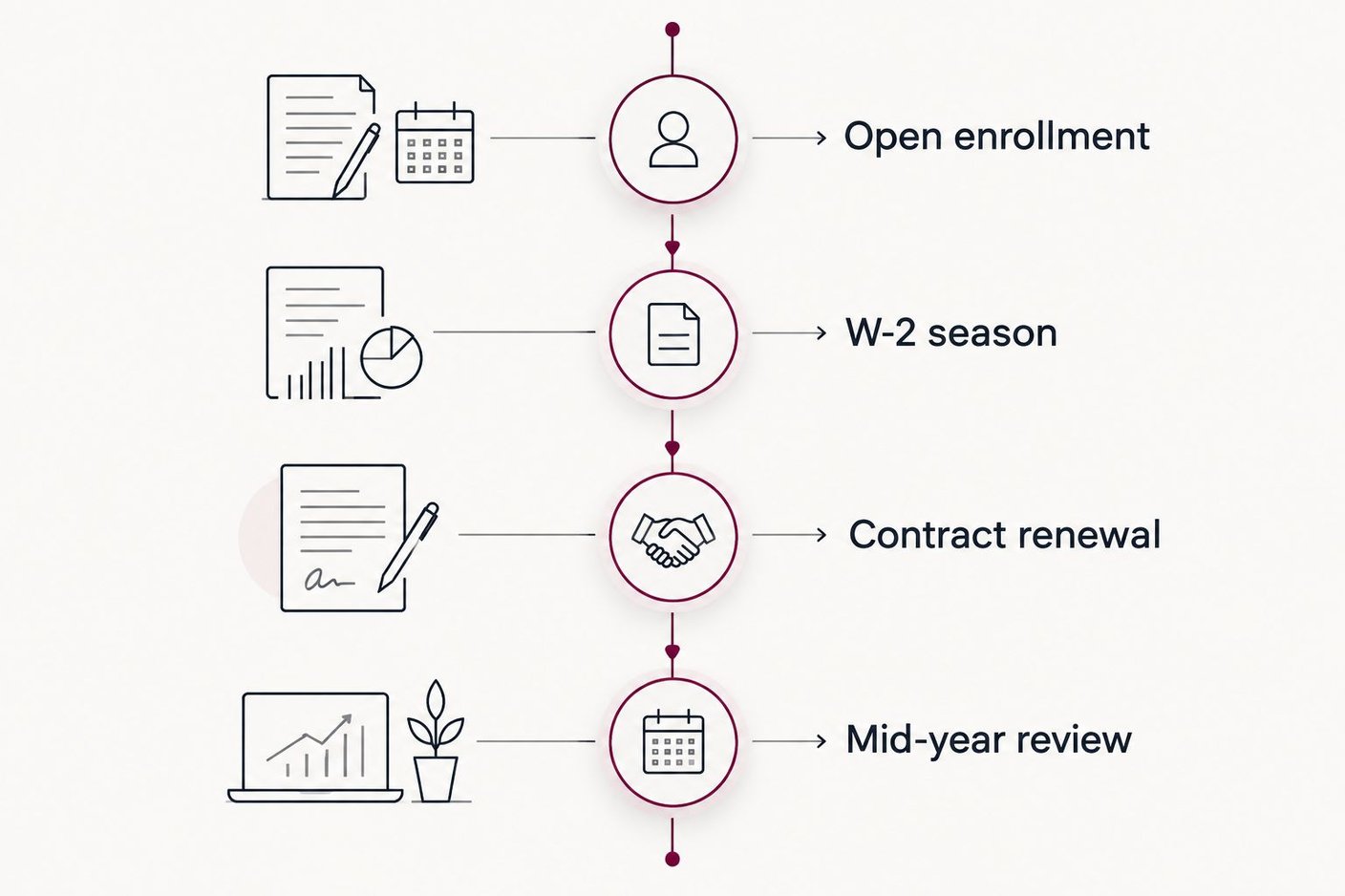
Outbound volume for payroll buyers clusters around these four windows, not evenly across the year.
5. Handle security and data-migration objections on the first call
Payroll data is compensation, banking, and SSNs. Security objections surface early - the script needs to answer them, not defer them.
Have a plain-language answer ready for “where does our payroll data live during a demo or trial”
State compliance credentials directly when asked - don’t make the prospect dig for a security page
Address migration risk head-on: what happens to historical payroll records during a switch
Route any question outside the script’s scope straight to a compliance-trained rep, not a guess
6. Warm-transfer qualified calls with full context
A qualified lead that has to repeat headcount, provider, and timeline to the AE loses momentum fast.
Pass structured qualification data to the AE before the call connects, not after
Use a live hot-transfer for high-intent leads instead of a callback slot
Confirm the AE has the prospect’s current-provider name and renewal date on screen before they say hello
Log the full call transcript to the CRM automatically so no context gets lost in handoff
7. Re-engage stalled deals and lapsed renewals
Most payroll pipelines have a graveyard of “interested, not now” leads sitting untouched.
Re-call demo requests that went cold after the first no-answer, don’t just email them
Trigger reactivation calls automatically when a lapsed lead’s original contract renewal date approaches
Segment stalled deals by original objection (price, timing, security) and script the follow-up differently for each
Cap manual re-engagement effort on deals under a certain size - automate those first
Compare the options
In-house SDR team
Best for: Companies with steady, predictable call volume
Time to live: Weeks to months of hiring/training
Key limitation: Coverage gaps during open enrollment and W-2 spikes
Outsourced BDR agency
Best for: Filling a short-term pipeline gap
Time to live: Days to a few weeks
Key limitation: Generic scripts, limited payroll-specific qualification
DIY dialer or scripted IVR
Best for: Basic outbound reminders, low-stakes calls
Time to live: Days
Key limitation: Can’t handle compliance objections or multi-turn qualification
Harmony.ai voice AI agent
Best for: Enterprise and mid-market payroll/HR companies running continuous outbound and inbound qualification
Time to live: Days
Key limitation: Sales-assisted setup only; not built for self-serve SMB volume
Verdict: for payroll and HR services companies fielding demo requests and outbound renewal campaigns at volume, Harmony.ai wins on speed-to-call and consistency; an in-house team wins only if headcount can flex with the compliance calendar.
See the AI SDR in action
Watch how it qualifies and books a payroll demo call live.
Common mistakes payroll and HR companies make
Treating every demo request the same regardless of headcount or current provider, so a 20-person shop and a 2,000-person multi-state account get the same script.
Scheduling outbound during pay-run days. Calling HR on a bi-weekly processing day guarantees a voicemail and a colder second attempt.
Skipping a compliance-aware outbound script. TCPA exposure on cold payroll outreach is real, and a generic dialer script doesn’t screen for it.
Ignoring contract renewal dates in the CRM. Reaching a switcher 30 days after they’ve already re-signed wastes the call entirely.
Making the AE ask questions the SDR already answered. Nothing kills a warm handoff faster than a prospect repeating their headcount for the third time.
FAQ
What is an AI SDR for payroll and HR companies?
It’s a voice AI agent that calls inbound demo requests and outbound leads, qualifies them against payroll-specific criteria like headcount and contract end date, then books the meeting or hot-transfers the call live to a rep.
How fast should a payroll company call a new demo request?
Inside 60 seconds. Payroll buyers evaluating a switch treat callback speed as a proxy for support quality, so a slow first call costs more deals than most pricing objections do.
Is AI SDR better than a human SDR for payroll and HR outbound?
An AI SDR runs the qualification script identically on every call and covers volume spikes like open enrollment without added headcount; a human SDR still handles complex, high-touch enterprise conversations better. Most payroll companies in 2026 run both together.
Can an AI SDR handle payroll data securely?
Harmony.ai’s platform is SOC 2 Type II, offers a HIPAA BAA, and is built to be GDPR/CCPA-ready and TCPA-aware, which matters given how sensitive payroll and compensation data is.
Does AI SDR replace human sales reps at a payroll company?
No. It handles the first call, qualification, and scheduling; account executives still run the demo, negotiate, and close. The AI agent’s job is to make sure the AE only talks to qualified, warm leads.
When should a payroll company run outbound AI SDR campaigns?
Time outbound to the compliance calendar: reactivation campaigns ahead of open enrollment, switcher outreach after W-2 delivery, and renewal outreach starting 90 days before a prospect’s contract end date.
Can AI SDR integrate with a payroll company’s CRM?
Yes - qualification data and call transcripts should log to the CRM automatically so the handoff to an AE carries full context instead of a summary note.
How much does an AI SDR cost for HR services companies?
Pricing varies by call volume and deployment scope; check current terms directly with the vendor rather than relying on a published rate card.
One last thing
The open enrollment window from October through December is when most payroll and HR companies get the most inbound and the worst coverage - reps are stretched on renewals for existing clients while new demo requests sit in the queue. Building the outbound and qualification flow to absorb that specific 2026 Q4 spike, rather than staffing for a flat average, is the single change that moves the most pipeline.