
An AI receptionist for home stagers answers every call in under 60 seconds, books walkthroughs, and frees your crew from the phone during installs in 2026.
- An AI receptionist for home stagers answers every call in under 60 seconds, even mid-install.
- Harmony.ai runs on its own model built for the phone, sub-400ms latency, live in days.
- Manual fixes - call logs, standby staff, voicemail scripts - buy time but don't scale past 2-3 crews.
- Comparison table below ranks answering services, in-house coverage, and AI receptionists by fit, not hype.
AI receptionist for home stagers is a voice AI system that answers, qualifies, and books every call about a listing while your team is on-site pulling furniture off a truck, with the goal of never losing a same-day staging inquiry to voicemail. Home stagers work on real estate timelines, not retail timelines - a listing agent who can’t reach you in the next hour calls the next stager on their list. That makes phone coverage a revenue problem, not an admin one.
Why an AI receptionist matters for home stagers
A staging job starts with a phone call from a listing agent who needs a walkthrough scheduled before the photographer shows up. Miss that call and the agent moves down their contact list - there’s no ticket queue, no follow-up email chain, just the next stager who picked up. That’s the core problem an AI receptionist solves: it picks up every time, regardless of whether your team is climbing a ladder to hang art or driving furniture across town.
Home staging businesses are also seasonal and lumpy - spring listing season can triple call volume overnight. A front desk built around one person answering between jobs breaks exactly when volume spikes and revenue is on the line. A voice AI receptionist doesn’t get overwhelmed by a busy Tuesday in April.
Build the call-handling process before you automate it
Start manual. Fix the process, then decide what to hand off.
Audit your current call handling
Before you fix anything, know what’s actually broken. Pull the last 30 days of calls and categorize them.
Count missed calls versus answered calls by day of week
Log how many voicemails went unreturned for more than 4 hours
Note which calls came from repeat agents versus first-time homeowners
Track double-booked walkthrough slots
Flag any inquiry that led to a lost job because of slow response
Standardize your qualification script
Every staging call needs the same five facts before you can quote or schedule. Write the script down so anyone answering - you, a part-time assistant, or a voice AI agent - asks the same things in the same order.
Property address and approximate square footage
Occupied or vacant (changes the scope and timeline)
Listing date or target photography date
Budget range or full-service versus partial staging
Preferred walkthrough windows for the next 48-72 hours
Set after-hours and overflow coverage rules
Real estate doesn’t stop at 5pm. Agents call in the evening after their own showings wrap. Decide now what happens outside business hours instead of letting it default to voicemail.
Define what counts as urgent (photography deadline within 72 hours) versus routine
Set a maximum callback window for each tier
Route weekend calls to whoever is on staging duty that week
Build a simple text-back template for missed calls
Confirm who checks voicemail on Sundays, if anyone does
Automate booking and confirmations
Manual scheduling works until you’re running three crews across two cities. This is where the faster path replaces the spreadsheet. Harmony.ai runs an approved call flow that qualifies the caller against your script, checks calendar availability, and books the walkthrough - no human touches the call unless the agent asks for one.
Sync the booking flow to your existing calendar so slots update in real time
Send an automatic confirmation text or email after the call ends
Flag same-day and next-day requests for priority handling
Capture property address and job notes directly into your CRM record
Set buffer time between walkthroughs so crews aren’t double-booked
Route hot leads to a live human instantly
Not every call should end with the AI handling it alone. A high-value commercial staging inquiry or an agent negotiating scope deserves a person on the line fast.
Define trigger phrases or job sizes that force a live transfer
Hot-transfer with full context so the caller never repeats themselves
Keep a backup on-call number for after-hours escalations
Log every transfer reason to spot patterns monthly
Review declined transfers to catch missed urgent calls
Measure response time and conversion weekly
What gets measured gets fixed. Track how fast calls get answered and how many turn into booked jobs.
Average time to answer, by hour of day
Percentage of calls converted to a booked walkthrough
Percentage of calls escalated to a live person
Lost-job count tied specifically to slow response
Repeat-agent call volume month over month
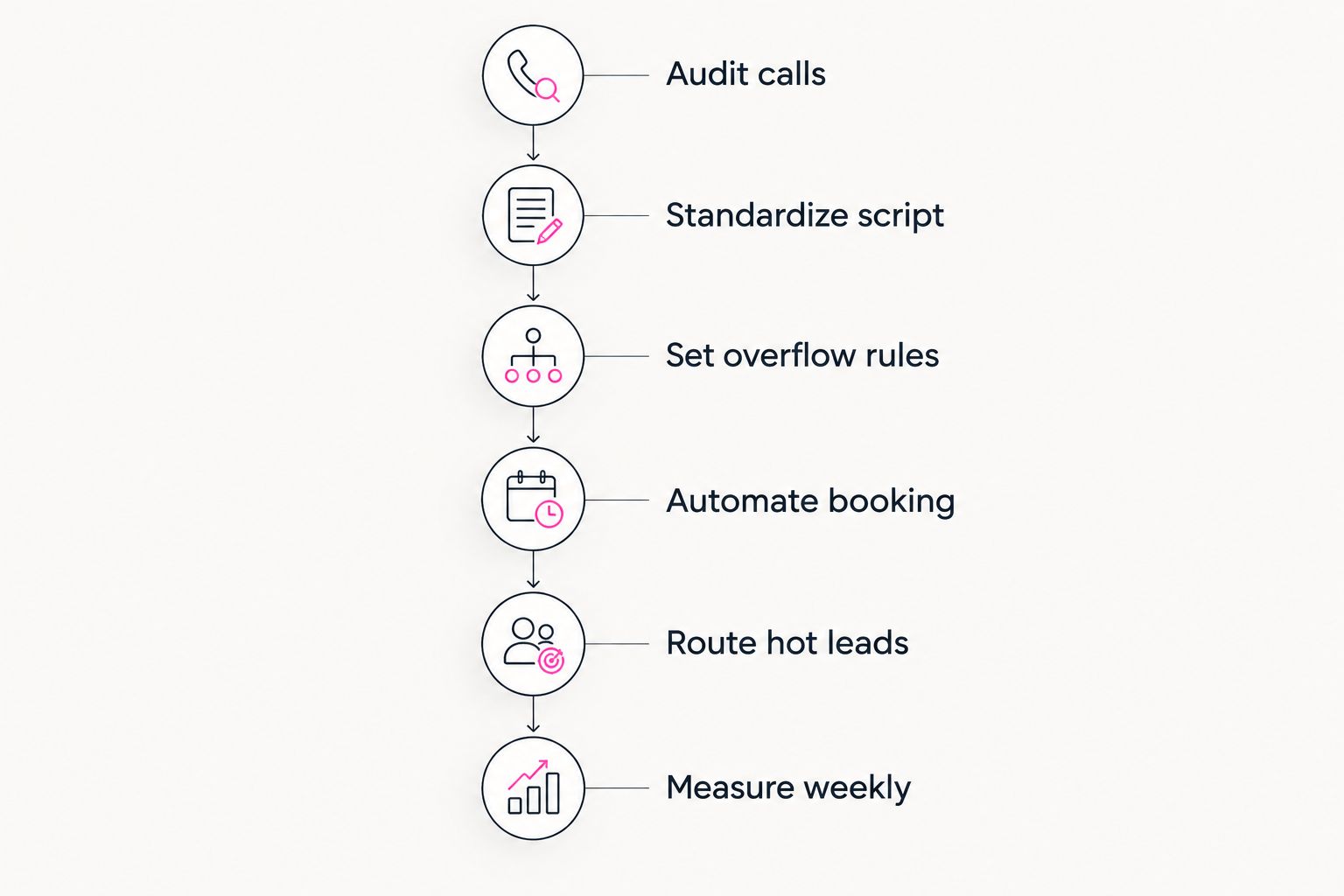
Automation replaces step four, not the whole process.
Comparing your options for phone coverage
Home stagers typically choose between four setups. None of them are wrong for every business - they fit different call volumes and budgets.
In-house staff answering between jobs
Best for: Solo stagers with low call volume
Key limitation: Calls go unanswered during installs and after hours
Generic voicemail
Best for: Businesses that accept slower callbacks
Key limitation: Loses time-sensitive agent calls to competitors
Human answering service
Best for: Teams that want a live voice but can outsource scripting
Key limitation: No CRM integration, inconsistent qualification quality
AI receptionist (Harmony.ai)
Best for: Multi-crew stagers with steady or seasonal call spikes
Key limitation: Requires an upfront script and workflow setup before launch
Verdict: for home stagers running more than one crew or fielding after-hours agent calls, an AI receptionist wins on consistency - it answers the 200th call of the week exactly like the first.
Stop losing staging leads to voicemail
See how Harmony.ai answers, qualifies, and books walkthroughs in one call.
Common mistakes home stagers make with phone coverage
Turning the phone off during installs. The busiest work hours are exactly when agents call to confirm a walkthrough - silence during that window costs jobs, not just annoyance.
Skipping the qualification script. Answering “sure, when works?” without confirming occupied-versus-vacant or square footage leads to underquoted jobs and rescheduled crews.
Treating every call as equal priority. A first-time homeowner inquiry and a listing agent with a photography deadline in 48 hours need different response speeds, not the same voicemail greeting.
No system for after-hours calls. Evening and weekend calls from agents are common in real estate - routing them all to Monday morning voicemail hands the job to a competitor.
Not tracking lost jobs by response time. Without a log tying slow callbacks to lost revenue, the case for fixing phone coverage never gets made internally.
FAQ
What does an AI receptionist for home stagers actually do?
It answers every inbound call about a listing, asks the standard qualification questions (address, square footage, timeline, occupied status), and books the walkthrough directly on your calendar. Harmony.ai runs this as an approved call flow, not a scripted IVR menu.
Is an AI receptionist better than a human answering service for staging businesses?
An AI receptionist wins on consistency and CRM integration; a human answering service wins when callers specifically expect a live person and your call volume is low. Above roughly two crews or with regular after-hours calls, the AI receptionist scales without added headcount.
How fast does an AI receptionist answer calls compared to voicemail?
Harmony.ai answers in real time and can call leads back in under 60 seconds when a form comes in first, versus voicemail which depends entirely on when someone checks it. In real estate, that speed difference is often the reason a job goes to a competing stager.
Can an AI receptionist book staging walkthroughs directly on my calendar?
Yes, when the booking flow is connected to your calendar, the AI checks availability during the call and confirms a slot before hanging up. A confirmation text or email typically follows automatically.
Does an AI receptionist replace my front desk staff entirely?
Not necessarily - most setups route complex or high-value calls to a live person via hot transfer while the AI handles routine qualification and booking. The AI carries full call context into the transfer so the caller never repeats themselves.
How much does an AI receptionist cost for a small staging business?
Pricing depends on call volume and setup scope, so check current terms directly with the vendor rather than relying on a published number. Ask specifically how after-hours and overflow calls are billed before committing.
What happens if the AI receptionist can’t answer a caller’s question?
A properly configured AI receptionist escalates to a live person instead of guessing or re-asking questions the caller already answered. That hot-transfer behavior is a core design requirement, not an edge case.
Do home stagers need HIPAA or compliance certifications for an AI receptionist?
Home staging calls don’t typically involve protected health information, so HIPAA isn’t usually relevant. General call-handling compliance like TCPA awareness for any outbound follow-up calls still applies.
One last thing
The stagers losing the most jobs to slow response aren’t the ones with bad staging work - they’re the ones whose phone rings unanswered while they’re mid-install. Fix the process in the order above: audit first, script second, automate booking third. Skipping straight to automation without a clean qualification script just means the AI books the wrong jobs faster.