- AI voice agent for loan servicing companies calls past-due borrowers within seconds of a missed payment instead of days later.
- Harmony.ai runs collections scripts on its own phone model at sub-200ms and hot-transfers hardship cases to a live collector.
- Regulation F caps debt collectors at seven calls per week per debt - a scripted, logged voice agent enforces that cap automatically.
- Every call produces a timestamped, audit-ready record, which manual collector logs rarely produce consistently.
Loan servicing companies lose money every day a delinquent account goes uncontacted, and an AI voice agent for loan servicing companies closes that gap by calling or answering borrowers automatically - confirming right-party contact, running payment reminders, and routing hardship cases to a live collector, with every call logged for FDCPA, TCPA, and Regulation F review in 2026.
Servicers carry a different burden than a retail collections shop: state licensing varies by jurisdiction, escrow and hardship questions require real judgment, and the collections call automation that works for a credit card issuer doesn’t map cleanly onto mortgage or auto loan servicing without changes to disclosure language and escalation rules.
Why this matters for loan servicing companies
A loan servicer’s phone line carries two jobs at once: collect on delinquent accounts and protect the borrower relationship enough that they refinance or renew instead of walking. Get the first call wrong - wrong person, wrong disclosure, wrong tone - and you’ve created a compliance complaint instead of a payment.
Manual collector teams struggle to hit every account inside the Reg F 7-in-7 window, especially during month-end spikes when delinquency volume triples. A scripted, logged voice AI agent doesn’t get tired at hour six of a shift and doesn’t skip the required mini-Miranda disclosure because the queue is backed up.
The stakes are different by bucket, too. A 5-day-late reminder call needs a soft nudge. A 60-day-past-due call needs a documented promise-to-pay or a hardship referral, with a record a regulator can pull later. Getting that distinction automated - not just automating the dial - is where most servicers under-invest in 2026.
Build the call program in six steps
Segment accounts by delinquency stage before you write a single script
A single collections script applied across every bucket produces bad outcomes at both ends - it’s too soft for 90-day accounts and too aggressive for 5-day reminders.
Split the portfolio into early-stage (1-30 days), mid-stage (31-60 days), and late-stage (61+ days) buckets
Flag accounts already in a hardship or forbearance plan so they skip standard collections flows
Pull loan type (mortgage, auto, personal) since disclosure language differs by product
Exclude accounts under active dispute or litigation hold from any outbound script
Set call frequency caps per bucket that respect the Reg F 7-calls-per-week ceiling
Confirm right-party contact before disclosing anything
Every collections call - human or automated - has to verify it’s speaking with the actual borrower before discussing balance or account status. Skip this and you’ve created a data breach, not a collection.
Ask for two verification points (name plus DOB, or name plus last four of SSN) before any account detail
Script a graceful exit for wrong numbers or third-party answers with no account information disclosed
Log every verification attempt, pass or fail, with a timestamp
Route ambiguous or refused verifications to a live agent instead of guessing
Automate early-stage payment reminders first
Start automation where the stakes are lowest: reminders before or just after a due date, not aggressive collections language.
Send reminder calls 2-3 days before the due date for accounts with a history of late payments
Offer a payment link or IVR payment option directly on the call
Confirm whether the borrower already submitted payment before pushing a reminder
Give the borrower an option to speak to a live rep at any point in the call
This is also where the manual-versus-automated line matters most. Spreadsheet-driven call lists and a predictive dialer get early-stage reminders out, but they can’t verify payment status in real time or branch the conversation based on what the borrower says. An AI voice agent for loan servicing companies built on Harmony.ai’s own phone model handles that branching live, at sub-200ms response time, without a human dialing a single number.
Write collections scripts that pass a compliance audit before you write them to convert
Collections language is regulated territory. FDCPA disclosure requirements, TCPA consent rules, and Regulation F call-frequency limits all apply, and a script that ignores any of them creates legal exposure regardless of how well it converts.
Include the required mini-Miranda disclosure on every first collections contact for a debt
Cap outbound attempts per account per Regulation F’s 7-in-7 rule
Log consent status for every phone number on file, separating wireless from landline
Build a hard stop for cease-and-desist or attorney-representation flags
Route any borrower who mentions bankruptcy, dispute, or litigation straight to a live collector, no exceptions
A voice AI agent that runs these rules as deterministic, approved flows - not as suggestions an LLM might paraphrase away - is the difference between a defensible call log and a discovery risk. Review FDCPA and TCPA compliance for AI collections calls before finalizing scripts with legal.
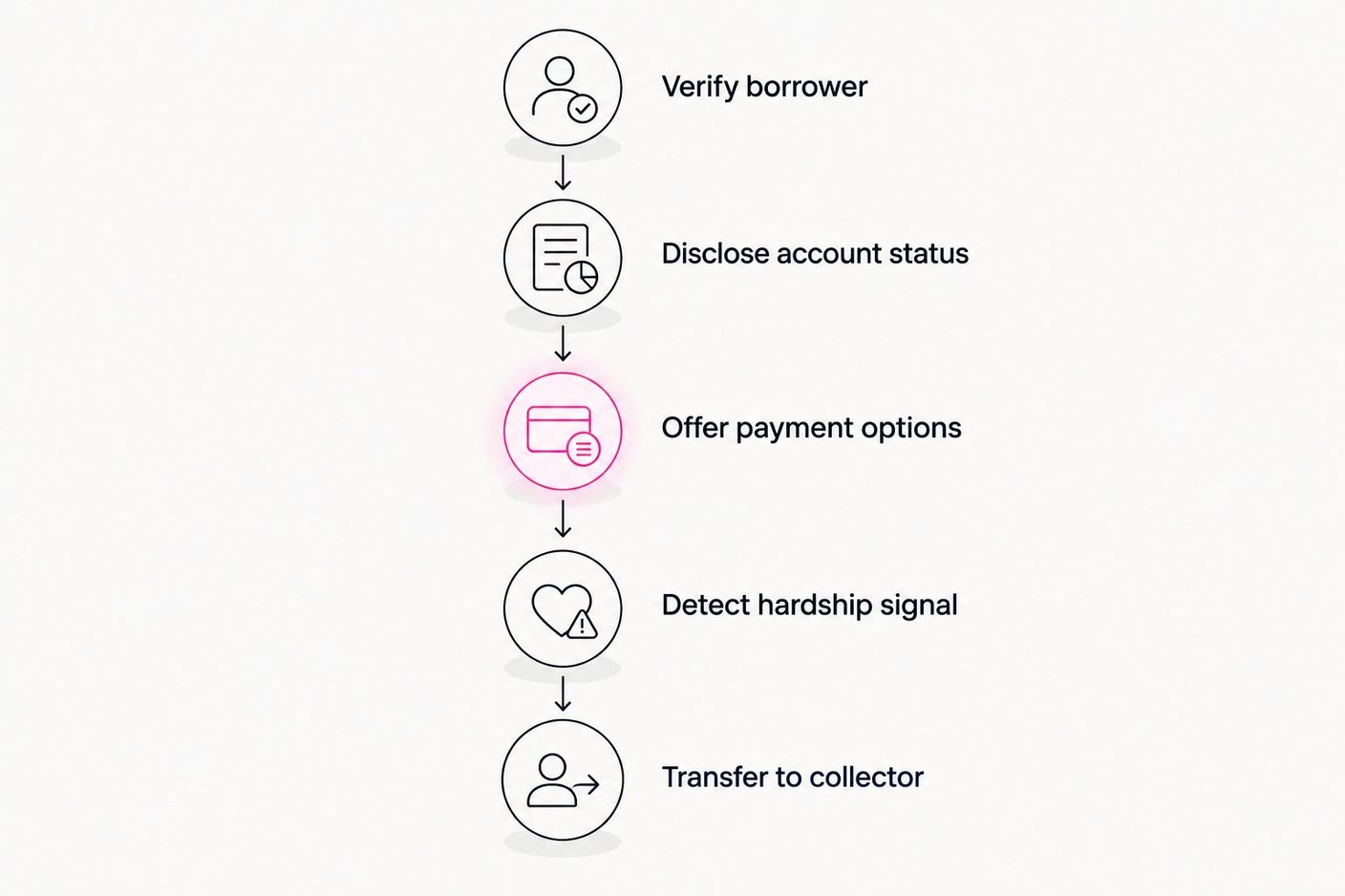
Hardship and dispute signals route to a live collector at any point in the call, not just at the end.
Route hardship, forbearance, and dispute calls to a live rep - every time
Automation should never make a hardship decision. It should catch the signal and get the borrower to someone who can.
Train the agent to detect hardship language (job loss, medical, income drop) mid-call
Hot-transfer with full context - no re-asking the borrower’s name, loan number, or situation
Log the transfer reason so the receiving agent has the account history before picking up
Never let the automated flow offer a modification, deferment, or waiver - that’s a licensed decision
If a collections script can’t produce a call log a regulator can read, it isn’t compliant - it’s a liability.
Measure right-party contact, promise-to-pay, and cure rate weekly
A collections program without these three numbers is running blind.
Track right-party contact rate by delinquency bucket, not blended across the whole portfolio
Track promise-to-pay rate and the percentage of promises actually kept
Track cure rate - accounts that return to current status within 30 days of first contact
Compare cost per contact between in-house collectors, outsourced BPO, and automated calling
Comparing your options for loan servicing calls
In-house collections team
Best for: Servicers needing judgment calls on complex hardship cases
Key limitation: Can’t scale past business hours or Reg F call windows without adding headcount
Predictive dialer + human agents
Best for: Mid-size portfolios with steady, predictable delinquency volume
Key limitation: Dialer connects the call; a human still has to verify and script every conversation
Outsourced BPO collections vendor
Best for: Servicers wanting to offload volume without hiring
Key limitation: Quality and compliance discipline vary by vendor and shift
Harmony.ai voice AI agent
Best for: Servicers needing every account contacted inside the Reg F window with a full audit trail
Key limitation: Requires legal sign-off on scripts before launch; hardship decisions still route to a person
For security posture on any vendor you evaluate, check SOC 2 and security requirements for voice AI vendors before signing.
Common mistakes loan servicers make
Running one script across every delinquency bucket. A 5-day reminder and a 90-day collections call need different tone, different disclosures, and different escalation triggers.
Skipping right-party verification to save time. Disclosing balance or status before confirming identity is a compliance incident, not a shortcut.
No audit trail tied to the recording. A call log without a timestamped disposition and disclosure confirmation doesn’t hold up under a Reg F or FDCPA review.
No live-agent path for hardship signals. Automation that tries to negotiate a modification instead of transferring it is the single fastest way to turn a good call into a bad one.
Ignoring the 7-in-7 cap across channels. Text, email, and phone attempts on the same debt all count toward the Regulation F limit - most servicers only track phone.
See the compliant call flow live
Watch how Harmony.ai verifies, discloses, and hot-transfers on one call.
FAQ
What does an AI voice agent for loan servicing companies actually do on a collections call?
It verifies right-party contact, delivers required disclosures, checks payment status, and either takes a promise-to-pay or hot-transfers hardship and dispute calls to a live collector. It never negotiates a modification or waiver on its own.
Is an AI voice agent compliant with FDCPA and TCPA for loan servicing?
A properly built voice AI agent runs deterministic, approved scripts that include mini-Miranda disclosure, consent tracking, and call-frequency caps under Regulation F. Compliance depends on how the flows are built and logged, not on the technology alone.
How many collection calls can a servicer make per week under Regulation F?
Regulation F caps most debt collectors at seven calls per week per debt. Automated voice agents can enforce this cap programmatically across phone, while manual teams often lose track across shifts.
Can a voice AI agent handle hardship and forbearance requests?
It can detect hardship language and route the call live to a licensed collector with full account context, but it should never approve a modification, deferment, or waiver on its own.
How fast does Harmony.ai respond during a live collections call?
Harmony.ai runs on its own model built for the phone at sub-200ms response time, using LLMs only when a moment in the call needs flexibility beyond the approved script.
What’s the difference between an outsourced BPO and an AI voice agent for collections?
A BPO staffs human collectors off-site with variable quality by shift. A voice AI agent runs the same approved script and disclosure sequence on every single call, with a full log attached.
Does automating collections calls hurt borrower relationships?
It depends on the script, not the channel. Early-stage reminders with a payment link tend to reduce friction; the risk is automating late-stage collections language without a live-agent escalation path.
One last thing
Most servicers audit their collections calls by sampling - a handful of recordings a week, graded by a supervisor. Regulation F doesn’t care about your sample size; it cares whether every single account stayed under seven contacts and got the required disclosure every time. A logged, scripted voice AI agent turns that into a queryable dataset instead of a sampling exercise - which is the difference between passing an audit and hoping you do.