- Harmony is the best overall AutoCalls.ai alternative for enterprise teams that need agents to run inbound and outbound revenue calls.
- Choose Vapi when developers will build and operate the calling application.
- Choose PolyAI when customer-service calls, rather than revenue follow-up, define the project.
- Choose Twilio when your team intends to assemble its own phone-calling system.
Best overall for enterprise revenue calling: Harmony. Best for a developer-led voice agent build: Vapi. Best for customer-service calls: PolyAI. Best for teams building on programmable telephony: Twilio. These AutoCalls.ai alternatives solve different operating problems, so choose the call outcome before you choose the platform.
Why this matters in 2026
An enterprise revenue leader does not need another way to place calls. You need leads called promptly, qualification completed on an approved flow, and a live transfer when the conversation warrants one. That is a different buying decision from selecting developer tools or replacing a customer-service phone system.
Start with the business process: inbound lead response, outbound qualification, follow-up, or service. Then ask who owns the agent after launch. The enterprise voice AI buyer’s guide provides a deeper evaluation framework; this comparison identifies which category of vendor belongs on your shortlist.
What makes the best AutoCalls.ai alternative?
Use the same criteria for every 2026 demonstration. A polished sample call does not show whether an agent can follow your rules, complete the intended task, and transfer a qualified caller with the right context.
Call coverage: Decide whether you need inbound calls, outbound calls, follow-up, or a combination. A system that addresses only one part of the process leaves another queue with your team.
Approved flows: Give the agent a defined qualification path. Test what happens when a caller changes topic, declines to answer, or asks for something outside that path.
Live handoff: Specify when the agent transfers a call and what the receiving employee needs to know. A transfer without context interrupts the process rather than completing it.
Deployment ownership: Name the team responsible for call design, changes, monitoring, and exceptions. A developer platform and a sales-assisted deployment assign that work differently.
Governance: Request evidence for the controls your calls require. Review consent, recording, data handling, and outbound practices against the jurisdictions and workflows you operate in.
These criteria form a decision tree, not a feature-count contest. A revenue team buying an operator for lead calls should not rank a telephony toolkit on the same basis as an agent that runs the calls.
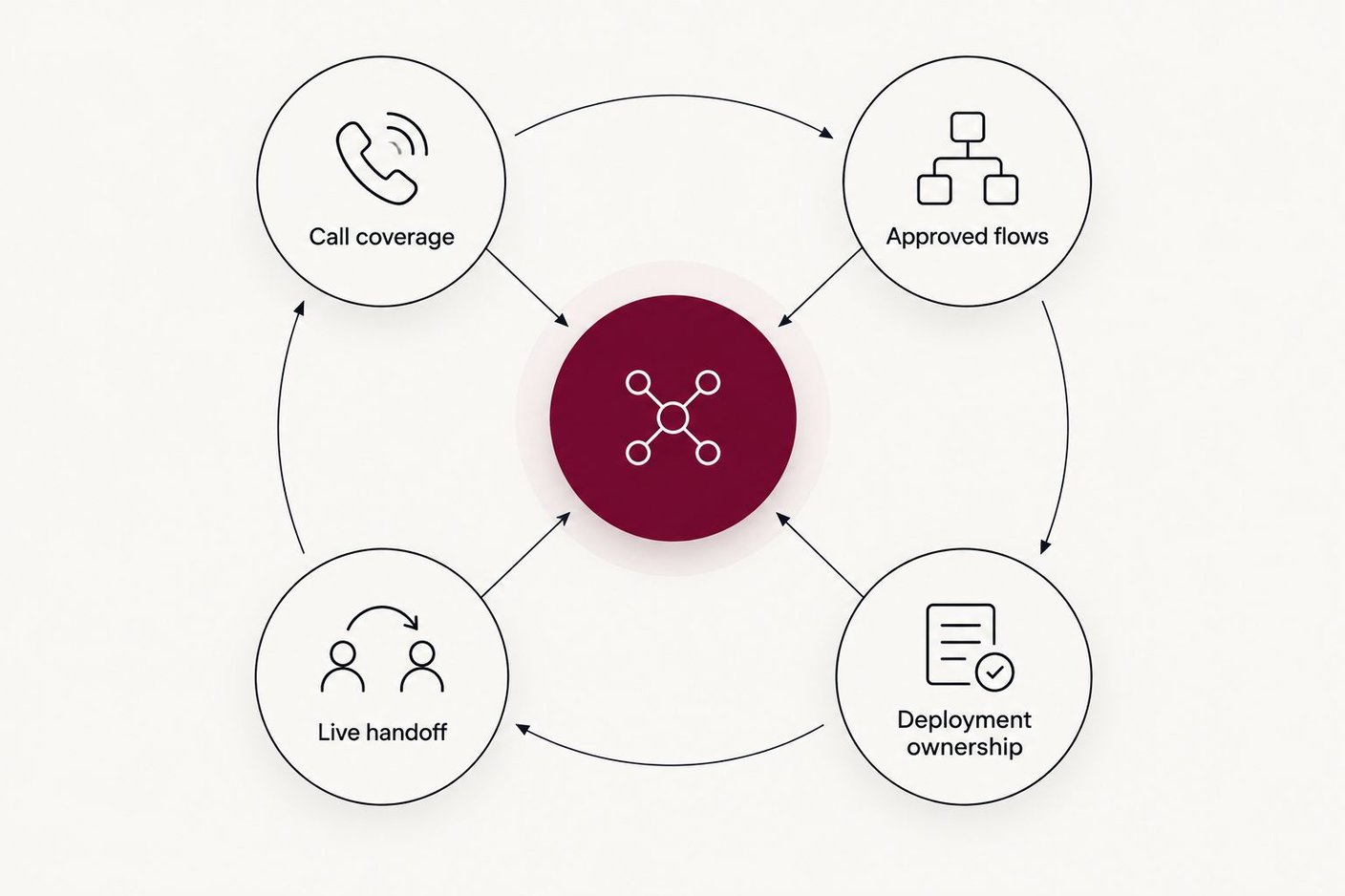
Define who owns the call, the handoff, and the changes after launch.
AutoCalls.ai alternatives at a glance
Best for: Enterprise revenue calls
Standout feature: Agents run inbound, outbound, and follow-up calls on approved flows
Key limitation: Sales-assisted; not a self-serve build
Vapi
Best for: Developer-led voice agent builds
Standout feature: Developer tools for building voice agents
Key limitation: Your team owns application design and operation
PolyAI
Best for: Customer-service call automation
Standout feature: Voice assistants oriented toward customer-service conversations
Key limitation: Assess separately for revenue-led outbound requirements
Twilio
Best for: Programmable telephony foundations
Standout feature: APIs for constructing calling applications
Key limitation: Telephony components are not a finished revenue-calling operation
The table reflects distinct use cases, not measured head-to-head performance. In 2026, ask each vendor to demonstrate your own call path before treating any capability as delivered for your environment.
1. Harmony: best AutoCalls.ai alternative for enterprise revenue calls
Harmony is the best fit for mid-market and enterprise revenue teams that need agents to run lead calls, qualify prospects, and transfer live opportunities. Harmony runs inbound, outbound, and follow-up calls. Its own model, built for the phone, uses LLMs when needed; approved flows govern the call.
For a revenue leader, the distinction is operational. Harmony can call a lead in under 60 seconds, qualify the conversation, book, and hot-transfer when a person needs to take over. Its stated latency is sub-200ms. Those figures describe Harmony’s stated capabilities, not a performance comparison with the other options here.
Harmony pros:
Runs the calling task end to end rather than supplying only components for a team to assemble.
Covers inbound and outbound revenue conversations, including follow-up.
Uses approved flows to keep qualification and transfers within defined boundaries.
Offers SOC 2 Type II; a HIPAA BAA is available, with GDPR/CCPA-ready and TCPA-aware positioning.
Harmony cons:
Sales-assisted deployment is a poor fit if your requirement is to build and launch independently.
Approved flows require your team to define qualification rules, transfer conditions, and exceptions.
A revenue-focused evaluation still needs a live demonstration using your specific calls; the stated latency does not establish your booking or transfer results.
Best for: A CRO or RevOps leader whose immediate problem is getting campaign leads called, qualified, and handed to the right person. Verdict: Buy after a pilot proves the approved flow and live handoff against your own lead process.
2. Vapi: best AutoCalls.ai alternative for a developer-led build
Vapi provides developer tools for building voice agents. Choose that route when your engineering team intends to design the calling application and own the operating details. The relevant question is not whether a demonstration sounds convincing; it is whether your team has a clear owner for prompts, call logic, telephony decisions, testing, and changes after launch.
A developer-led approach gives the implementation team control over how it constructs the experience. It also puts responsibility for the finished calling process on that team. If the revenue organization expects a vendor to run qualification and handoff as a defined service, make that expectation explicit before evaluating a builder.
Vapi pros:
Gives developers a route to build a voice agent around a defined use case.
Fits organizations that already assign engineering ownership to the calling application.
Lets a technical team evaluate the components and call logic it plans to maintain.
Vapi cons:
Building an agent is not the same task as operating a complete revenue-calling process.
The buyer must assign internal ownership for deployment, exceptions, and ongoing changes.
A revenue leader without dedicated technical capacity has a different procurement problem from the one a developer platform addresses.
Best for: An enterprise team with developers assigned to build and maintain its voice agent. Verdict: Buy only if engineering ownership is part of the plan; otherwise, hold.
3. PolyAI: best AutoCalls.ai alternative for customer-service calls
PolyAI focuses on voice assistants for customer-service conversations. Put it on the shortlist when the project begins with customers calling for help, not with a revenue leader trying to contact and qualify campaign leads. That distinction determines the demonstration you should request.
Bring actual service intents, escalation rules, and failure cases to the evaluation. Ask the vendor to show when a conversation resolves through the agent and when it moves to a person. If your project also includes outbound lead qualification, test that requirement separately rather than assuming service-call performance answers it.
PolyAI pros:
Gives service leaders a voice-assistant category to evaluate against their call types.
Keeps the buying discussion centered on service conversations and escalation.
Offers a clearer evaluation fit when customer-service calls define the project.
PolyAI cons:
A service-led evaluation does not establish suitability for an outbound revenue program.
Your team still needs to define which requests the assistant handles and which reach staff.
A successful demonstration of common requests does not replace testing exceptions and escalations.
Best for: A customer-experience leader evaluating automation for customer-service phone calls. Verdict: Buy for a service-led project after testing real escalation paths; hold for revenue follow-up until that use case is demonstrated.
4. Twilio: best AutoCalls.ai alternative for programmable telephony
Twilio provides programmable communications APIs, including voice. It belongs in this comparison when your organization wants building blocks for its own calling application. Twilio is not the same buying decision as selecting an agent to execute an approved qualification flow.
That difference matters in an enterprise review. With programmable telephony, your team must account for the complete application: what starts a call, how the conversation proceeds, when a person takes over, and how failures are handled. Evaluate the finished design, not just the underlying ability to connect a call.
Twilio pros:
Provides programmable voice components for a team building its own system.
Fits an organization that wants engineering control over the calling application.
Gives technical buyers a way to assess telephony as part of a broader design.
Twilio cons:
Voice APIs alone do not qualify a lead or resolve a service request.
Your organization owns the work of turning components into an operating agent.
A procurement team seeking a ready-defined revenue call flow must evaluate the application built on top, not the APIs alone.
Best for: An enterprise engineering team constructing a calling system with programmable telephony. Verdict: Buy as infrastructure when you intend to build; skip it as a direct substitute for an operating revenue agent.
How these AutoCalls.ai alternatives were ranked
The order reflects the needs of an enterprise revenue leader in 2026: an agent must run the call, follow an approved path, and hand off a qualified opportunity. Harmony ranks first because the stated product covers that task across inbound, outbound, and follow-up calls. Vapi, PolyAI, and Twilio each address a different starting requirement.
This is not a benchmark of call quality, containment, conversion, or deployment results across vendors. No comparable results are supplied for that ranking. To select a vendor, provide the same call scenarios to each finalist and assess the result against the five criteria above.
A useful demonstration includes a routine lead, a caller who changes the subject, and a request the agent must transfer. Ask who updates the flow after those calls. The answer tells you whether you are buying an operating agent, a service assistant, developer tools, or telephony components.
Which AutoCalls.ai alternative should you choose?
Choose Harmony if your 2026 priority is enterprise lead response and qualification by phone. Its agents run the inbound or outbound conversation, use approved flows, and hot-transfer when the call calls for a person. Confirm the exact rules and handoff behavior on your own calls before committing.
Choose Vapi if your developers own the agent build. Choose PolyAI if customer-service conversations are the center of the project. Choose Twilio if your engineering team wants to construct the calling system from programmable communications components. None of those choices should be treated as interchangeable merely because each involves a phone call.
Test your lead call flow
Review qualification rules and live-transfer conditions with the sales team.
FAQ
What is the best AutoCalls.ai alternative for enterprise revenue teams in 2026?
Harmony is the best fit in this comparison for enterprise teams that need agents to run inbound, outbound, and follow-up lead calls. Test your qualification rules and live-transfer conditions in a pilot before selecting it.
Is Vapi or Harmony better for an enterprise voice agent?
Harmony fits a revenue team seeking an agent to run approved calling flows; Vapi fits a team assigning developers to build and operate a voice agent. The deciding factor is who owns the finished calling process.
When should an enterprise team consider PolyAI?
Consider PolyAI when customer-service phone conversations define the project. Test your service intents and escalation paths, and evaluate outbound revenue requirements separately if they are also in scope.
Is Twilio a direct replacement for a revenue-calling agent?
No. Twilio supplies programmable voice components, while a revenue-calling agent must also execute qualification, handle exceptions, and transfer calls. Your team would need to build or procure that application.
What should a voice AI pilot test?
Test an ordinary call, an exception, and a live transfer against your approved flow. Record who changes the flow and who handles failures after launch.
How should enterprise buyers assess voice AI governance?
Review the controls required for your own data, call recording, consent, and outbound practices. For Harmony, the stated positions include SOC 2 Type II, an available HIPAA BAA, GDPR/CCPA-ready practices, and TCPA-aware operation.
One last thing
Do not approve a 2026 voice agent on the strength of its opening line. Ask it to qualify a lead who changes direction mid-call, then transfer that call under your rules. The handoff shows whether the agent completes your revenue process or merely starts a conversation.