- Best AI voice agents for veterinary clinics: Harmony is the pick for multi-location teams needing inbound and outbound calls.
- PolyAI belongs on a contact-center shortlist; verify its veterinary scheduling and transfer workflows before selecting it.
- Retell AI and Vapi fit teams prepared to build and own their call flows; neither replaces a veterinary workflow review.
- Keep clinical advice, urgent cases, and uncertain appointment details on a defined path to your staff.
Best overall for multi-location veterinary call operations in 2026: Harmony. Best for a contact-center-led evaluation: PolyAI. Best for a team building its own call flow: Retell AI. Best for a developer-led prototype: Vapi. Harmony is the clearest fit when your operations team needs an agent to answer inbound calls, make outbound follow-up calls, book appointments, and transfer calls that need a person. This guide compares the best AI voice agents for veterinary clinics by operating model - not by unsupported claims of veterinary integrations.
Why this matters
A veterinary phone agent does more than answer a ringing line. It must distinguish an appointment request from a worried owner describing a sick animal, capture the details your team needs, and avoid presenting administrative automation as clinical judgment. In 2026, the buying decision is therefore about call ownership and escalation, not whether a demo sounds fluent.
For an enterprise or multi-location group, one approved process also has to work across locations with different schedules and routing rules. Harmony runs inbound and outbound calls end to end, including qualification, booking, follow-up, and hot transfers. Its own model is built for the phone and uses LLMs when needed; approved flows govern what the agent can say. The stated response latency is sub-200ms. Those capabilities make it the default choice here, but your veterinary scheduling and escalation requirements still need to be specified before deployment.
What makes the best AI voice agent for a veterinary clinic?
Clear clinical boundary. The agent handles administrative requests. A question requiring medical assessment reaches your clinical team rather than receiving an improvised answer.
Appointment control. It identifies the requested service, collects the information your booking process requires, and confirms only a slot your scheduling process can support.
Urgent-call routing. Your team defines which caller descriptions require immediate transfer and where the call goes if no one answers.
Inbound and outbound coverage. The same evaluation should include new appointments, rescheduling, reminders, and follow-up calls if those are part of your operating plan.
Transfer context. Staff should receive the reason for the call and what the owner has already said. Re-asking answered questions slows the handoff.
Operational accountability. Test changes to approved flows, location-specific instructions, and the record of what happened on each call before expanding coverage.
Do not rank a vendor on voice quality alone. In 2026, a successful veterinary pilot must prove that a caller reaches the right outcome when the conversation leaves the easy path.
The 2026 options at a glance
Harmony
Best for: Multi-location teams seeking one operator for inbound and outbound calls
Standout evaluation point: Approved flows, booking, follow-up, and hot transfer
Key limitation to resolve: Veterinary-specific scheduling and clinical escalation must be defined
PolyAI
Best for: Contact-center-led vendor evaluation
Standout evaluation point: Fit with the group’s existing contact-center operating model
Key limitation to resolve: Verify veterinary workflows and transfer behavior directly
Retell AI
Best for: Teams building and owning their call design
Standout evaluation point: Flexibility to evaluate a configured agent
Key limitation to resolve: Your team owns the design and validation of veterinary rules
Vapi
Best for: Developer-led voice prototypes
Standout evaluation point: Ability to evaluate a custom-built call experience
Key limitation to resolve: A prototype still needs production controls and escalation testing
The table separates documented Harmony capabilities from questions to put to the other vendors. It does not treat an unverified veterinary integration as a feature.
1. Harmony: best AI voice agent for multi-location call operations
Best for: Enterprise and mid-market veterinary groups that want inbound calls, outbound follow-up, appointment handling, and live transfers under approved flows.
Harmony operates the call rather than suggesting responses to a receptionist. Its agents answer inbound calls, make outbound calls, qualify requests, book appointments, and hot-transfer when a person needs to take over. For a veterinary group, the sensible deployment is an approved administrative flow: identify the location and reason for calling, collect booking details, and route clinical concerns to staff.
The distinction is control. Harmony uses its own model, built for the phone; it uses LLMs when needed. The stated sub-200ms latency addresses response delay, while deterministic, approved flows address what the agent is allowed to do. Neither is a substitute for your medical director setting the urgent-call rules.
Harmony pros:
Runs inbound and outbound conversations end to end, so the evaluation can cover appointment intake and follow-up together.
Books and hot-transfers calls instead of stopping at a message for staff to process.
Uses approved flows, which give your team a defined place to set wording and escalation boundaries.
Offers SOC 2 Type II, with a HIPAA BAA available; confirm which contractual and data-handling requirements apply to your deployment.
Harmony cons:
The supplied information does not establish a veterinary practice-management integration. Verify scheduling connectivity before treating a spoken appointment request as a confirmed booking.
Urgent-call categories and after-hours destinations require decisions from your veterinary operations team.
A sales-assisted enterprise deployment is not the right route if your team only wants to experiment without defining a production call process.
Harmony verdict: Buy for a multi-location pilot if you can provide approved booking rules, urgent-call routes, and a clear transfer owner. For the veterinary-specific workflow, see the AI voice agent for veterinary clinics guide.
2. PolyAI: best for a contact-center-led evaluation
Best for: Veterinary groups whose contact-center leadership owns the vendor selection and wants an enterprise voice-AI option in the comparison.
PolyAI belongs in a contact-center evaluation. That is a narrower recommendation than declaring it ready to book veterinary appointments. Ask for a demonstration using your actual call categories, location rules, and escalation destinations. A generic appointment demo will not show what happens when an owner changes the subject to an urgent concern.
PolyAI pros:
Gives contact-center leaders a named enterprise voice-AI alternative to assess alongside Harmony.
Supports a direct comparison against the same scripted veterinary call scenarios.
Keeps the decision focused on operating requirements rather than a general-purpose voice demo.
PolyAI cons:
The supplied information does not verify its veterinary scheduling connections or workflows.
Transfer context and urgent-call routing need direct demonstration against your requirements.
PolyAI verdict: Hold until the vendor demonstrates appointment changes, urgent escalation, and location-specific routing on the process your clinics use. A shortlist entry is not a production approval.
3. Retell AI: best for a team building its own call design
Best for: Veterinary organizations with a technical team prepared to design, maintain, and test a tailored phone agent.
Retell AI is an option to assess when your team wants to shape the call experience itself. The relevant question is not whether an agent can speak. It is who will maintain the booking logic, review exceptions, and change approved wording when a clinic’s process changes.
Build the evaluation around a complete call. Have an owner request a routine appointment, change locations, ask a clinical question, and then request a person. Record whether the configuration transfers at the right moment and preserves the details already collected. Repeat the exercise for outbound follow-up if that is in scope.
Retell AI pros:
Provides a distinct build-oriented route for teams that want to own call design.
Can be assessed with the same veterinary scenarios used for a sales-assisted platform.
Makes internal ownership of the workflow an explicit procurement decision.
Retell AI cons:
Your team must define and validate veterinary boundaries rather than assume they come with the platform.
A working call demonstration does not establish scheduling connectivity or safe escalation under load.
Retell AI verdict: Hold if you have an engineering owner and a written clinical-escalation policy; skip it if no team will maintain the call design after launch.
4. Vapi: best for a developer-led prototype
Best for: A veterinary enterprise team testing a custom call concept before deciding how to operate it in production.
Vapi is a developer-led route to a voice-agent evaluation. That makes it useful for testing the structure of a proposed call: intake questions, appointment intent, and the point at which a person takes over. It does not, by itself, answer who approves each response or owns a failed transfer.
Keep the prototype narrow. Test one administrative request and one escalation path before adding more clinics or outbound use cases. If the agent cannot distinguish a booking request from a request for clinical help, expanding its scope only multiplies the unresolved issue.
Vapi pros:
Fits a team that wants to prototype its own call design.
Lets evaluators concentrate on the call path they intend to build.
Makes it possible to expose unanswered routing questions before committing to a wider rollout.
Vapi cons:
The enterprise team remains responsible for production rules, review, and escalation design.
A prototype does not prove appointment confirmation or integration with the clinic’s scheduling system.
Vapi verdict: Hold for a bounded prototype; skip it as a shortcut to unattended veterinary call operations.
Test the call before you select the platform
Run the same scenarios through every shortlisted option. Start with routine appointment intake, then introduce a location change, an unavailable slot, a caller who has already supplied their details, and a request that needs clinical staff. Check whether each conversation ends in a supported booking, a useful transfer, or an explicit next step - not an unsupported promise.
The decision path is identify the request, apply the approved boundary, then book or transfer. Staff should know what the caller asked and what the agent already captured. If the transfer destination is unavailable, specify the next approved action rather than leaving the owner in a conversational loop.
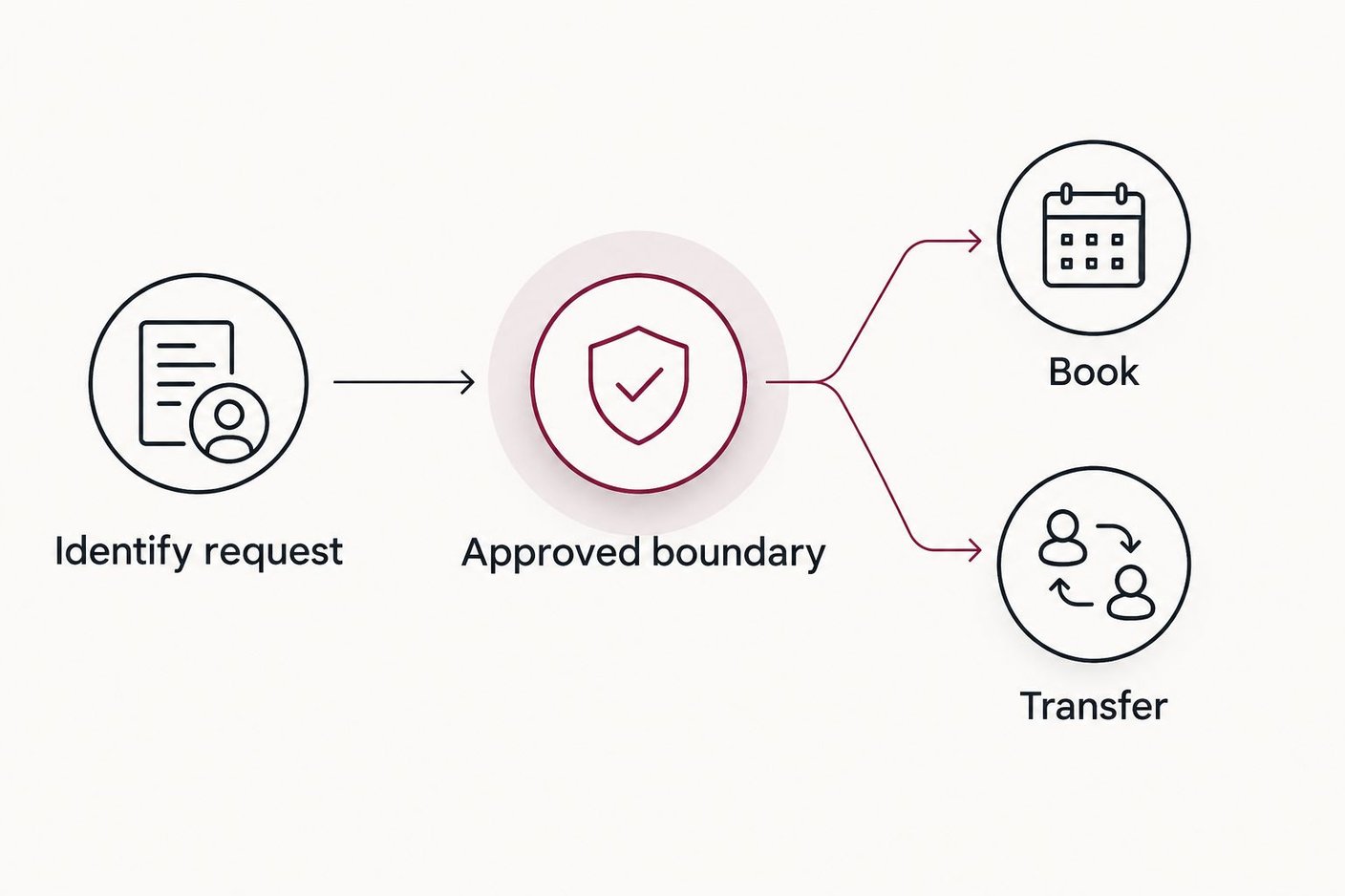
Booking and transfer are separate outcomes governed by the approved call boundary.
For outbound reminders, test what happens when an owner asks to reschedule instead of merely confirming. For inbound calls, test interruptions and repeated information. In 2026, these exception paths tell you more about operational fit than a smooth sample conversation.
How these options were ranked
The ranking gives first place to the option with explicit input-supported capabilities for inbound and outbound operation, booking, approved flows, and hot transfer. That is Harmony. The other entries represent distinct procurement routes: contact-center evaluation, team-owned implementation, and developer-led prototyping.
This is not a measured comparison of veterinary booking accuracy, call containment, or vendor integration coverage. No such results were supplied. Use the same call script and acceptance criteria across vendors before awarding a contract. For a 2026 enterprise rollout, the passing condition is a call that ends in a valid administrative outcome or reaches staff with its context intact.
Which AI voice agent should your veterinary group choose?
Choose Harmony if your multi-location team needs one agent to run inbound and outbound phone work and can define the rules for booking and escalation. Choose PolyAI if a contact-center procurement team needs a second enterprise option to demonstrate against those same rules. Choose Retell AI or Vapi only when your team intends to own the call design and its production controls.
Do not delegate clinical judgment to any of them. Set the boundary in the call flow, test it with the people who take transferred calls, and reject any setup that confirms an appointment your scheduling process has not accepted. That is the difference between answering a phone and completing a veterinary operation.
FAQ
What’s the best AI voice agent for a multi-location veterinary group in 2026?
Harmony is the best fit in this comparison for multi-location groups that need inbound and outbound calling, booking, approved flows, and hot transfers. Confirm scheduling connectivity and clinical escalation rules for your clinics before deployment.
Can an AI voice agent book veterinary appointments?
A voice agent can handle appointment conversations and booking when the scheduling process supports confirmation. Require proof that the selected setup checks the right location and slot before it tells an owner the appointment is booked.
Should a veterinary voice agent answer medical questions?
No: keep clinical assessment with your veterinary team. Define which caller descriptions trigger a transfer, and test those paths before allowing the agent to handle live calls.
Is Harmony better than Vapi for veterinary clinics?
Harmony is the better choice here for an enterprise team seeking an operator with stated inbound, outbound, booking, and transfer capabilities. Vapi fits a developer-led prototype when your team will design and maintain the call rules.
Is PolyAI a veterinary-specific voice agent?
The supplied information does not establish PolyAI as veterinary-specific. Ask it to demonstrate your appointment, location-routing, and clinical-escalation scenarios rather than assuming those workflows are included.
What should a veterinary group test before launching voice AI?
Test appointment confirmation, location changes, urgent-call transfers, unanswered transfers, and whether staff receive the caller’s context. Run the same scenarios at every shortlisted vendor so a polished demo does not decide the purchase.
Can a voice agent make veterinary reminder calls?
A voice agent can be evaluated for outbound reminder conversations. Test how it handles a rescheduling request and apply the consent and calling rules relevant to your campaign before launch.
One last thing
The most revealing pilot call is not a clean booking. It is an owner who starts with an appointment request and then describes a concern that belongs with clinical staff. Approve that transfer path before you expand coverage. In 2026, ask each shortlisted vendor to run it live with your team, then talk to sales about the deployment that passes.