- Harmony is the best lindy.ai alternative for enterprise teams that need inbound, outbound, and follow-up phone calls run end to end.
- Vapi fits a developer-led voice build; Retell AI fits teams evaluating a voice-agent development platform.
- PolyAI belongs on a contact-center shortlist; compare its call flows and handoffs against your requirements.
- In 2026, require a live test of qualification, booking, transfer, and exception handling before selecting a platform.
Best overall: Harmony for mid-market and enterprise teams that need autonomous inbound, outbound, and follow-up calls. Best for developer-led voice builds: Vapi. Best for teams evaluating a voice-agent development platform: Retell AI. Best for contact-center-led voice deployments: PolyAI. These lindy.ai alternatives solve different problems in 2026; choose the one that matches who will own the calls after launch.
Why this matters
Replacing a general-purpose agent tool with a phone-specific platform changes the buying question. You are no longer judging whether an agent can start a task. You are judging whether it can finish a call: reach the right person, follow an approved flow, record the outcome, and transfer a conversation when a person needs to take over.
For a revenue leader, that distinction shows up between lead submission and a qualified conversation. Harmony calls leads in under 60 seconds, qualifies them, books appointments, and hot-transfers when the call needs a person. A platform that only initiates a call leaves your team to resolve the rest of the process.
Do not treat every voice vendor as a substitute for every other one. Some choices put your developers in charge of building and maintaining the calling experience. Others center the deployment on contact-center operations. The useful comparison is the operating model, not the length of a feature list. For a closer look at the sales use case, see the AI SDR qualification and handoff guide.
What makes the best lindy.ai alternative for voice automation
Use these criteria before watching a demo. Each one exposes a different source of work that can remain with your team after purchase.
Call ownership: Does the system run inbound and outbound conversations to an outcome, or does it leave qualification, scheduling, and follow-up to another team?
Approved flows: Can you define what the agent can say and do when a caller changes direction, asks an unexpected question, or requests something it cannot approve?
Transfer behavior: Can the agent bring a person into a live conversation at the point you specify? Ask what the person receives at handoff.
Production responsibility: Identify who builds call flows, maintains them, reviews exceptions, and changes them when your offer or qualification rules change.
Security and calling controls: Check the documentation and contractual terms your organization requires. For outbound work, review consent, suppression, and calling rules with your compliance team.
Measured outcomes: Test completed qualifications, booked meetings, transferred calls, and unresolved exceptions. A successful connection is not the same as a completed task.
The criteria apply differently to each buyer. If you have a voice engineering team, control over the build carries weight. If revenue operations owns the result, finished calls and a clear exception path matter more than the ability to assemble components.
Lindy.ai alternatives at a glance
Harmony
Best for: Enterprise revenue teams that need calls run end to end
Standout distinction: Inbound, outbound, and follow-up agents with approved flows and hot transfers
Key limitation to evaluate: Sales-assisted deployment; not a self-serve build
Vapi
Best for: Developer-led voice builds
Standout distinction: Voice development platform
Key limitation to evaluate: Your team must define and own the deployed calling experience
Retell AI
Best for: Teams assessing a voice-agent development platform
Standout distinction: A platform for building phone agents
Key limitation to evaluate: Test the complete workflow, not only the conversation
PolyAI
Best for: Contact-center-led voice deployments
Standout distinction: Enterprise contact-center voice focus
Key limitation to evaluate: Validate outbound qualification and sales handoff against your specific use case
The table is a starting point, not a claim that these products have identical features. Put your own call scenarios into each evaluation. In 2026, a vendor’s description of a conversation is less useful than watching that conversation reach the right disposition.
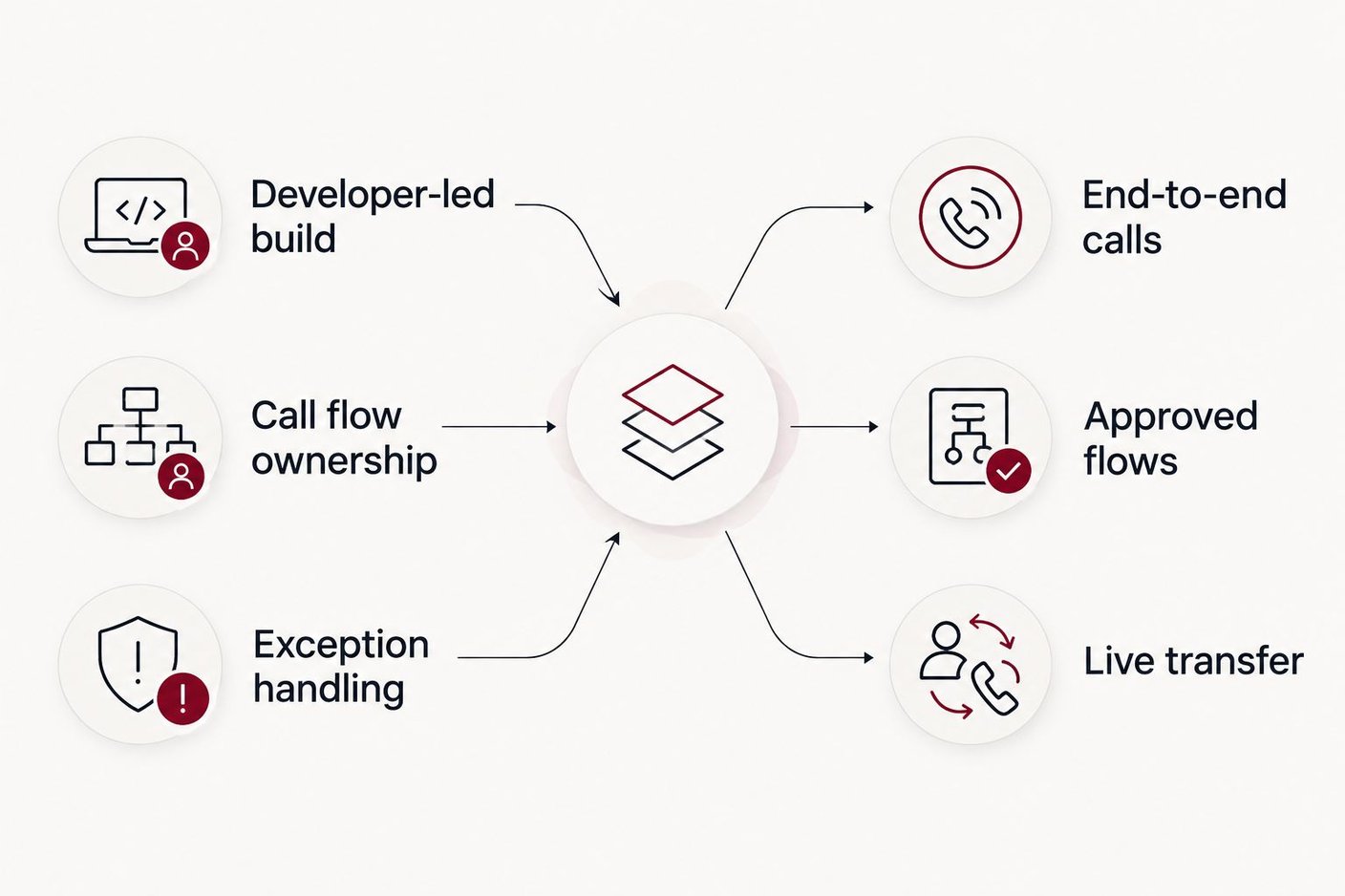
Decide who owns the finished call before comparing platform features.
1. Harmony: best lindy.ai alternative for enterprise revenue calls
Harmony is an enterprise voice AI platform for inbound, outbound, and follow-up phone calls across sales, service, and operations. Its autonomous agents call leads in under 60 seconds, qualify them, book appointments, and hot-transfer to a person when the approved flow calls for it. The system runs on its own model, built for the phone; it uses LLMs when needed.
Harmony is best for mid-market and enterprise revenue teams that need an autonomous operator for phone calls, not a toolkit for assembling one. Its stated sub-200ms latency addresses the pause that can disrupt a live exchange. Approved flows also give a revenue team a defined way to control offers, qualification, and handoff rather than leaving those decisions to an unconstrained response.
Harmony pros:
Runs inbound, outbound, and follow-up calls, so you can evaluate one operating model across lead response and subsequent contact.
Qualifies and books during the call, then hot-transfers when a person needs to take over.
Uses approved, deterministic flows for the parts of a call that require control.
States SOC 2 Type II, HIPAA BAA availability, GDPR/CCPA readiness, and TCPA awareness for enterprise review.
Harmony cons:
Sales-assisted deployment does not fit a team seeking an immediate self-serve build.
A team that wants to own every layer of a custom voice implementation should compare developer-led platforms instead.
Best for: A CRO or revenue operations leader accountable for response time, qualification, booking, and live handoff. Verdict: Buy when those outcomes matter more than building the calling system internally. In a 2026 evaluation, demonstrate an approved offer, a disqualifying answer, a booking request, and a transfer before signing off.
2. Vapi: best lindy.ai alternative for developer-led voice builds
Vapi is a voice AI development platform. It fits an organization that wants its engineering team to build a phone-agent experience rather than hand the full calling operation to a vendor. That is a different ownership decision from selecting a platform to run approved revenue calls end to end.
Vapi pros:
Gives a technical team a voice-building route rather than prescribing a sales-call operating model.
Makes sense when engineers already own call-flow design and changes.
Keeps the evaluation focused on the components your team intends to assemble.
Vapi cons:
The development route leaves your organization responsible for defining the finished call, including disposition and exception handling.
A platform demonstration does not establish that your lead qualification and handoff process works in production.
Best for: An engineering-led team with a defined phone use case and the capacity to own implementation. Verdict: Hold until your team can show a complete call from answer to disposition. Test interruptions, unexpected answers, and transfers as part of that call. If those requirements sit with revenue operations rather than engineering, compare an end-to-end operator first.
3. Retell AI: best for evaluating a voice-agent development platform
Retell AI belongs on a shortlist when your team wants to assess a platform for building phone agents. Evaluate it against a written call specification: what the agent must ask, what it must record, when it must stop, and when it must transfer. That specification matters more than an open-ended conversation in a demo.
Retell AI pros:
Offers a phone-agent development path for a team that plans to define its own use case.
Gives technical buyers a platform to assess against their call specification.
Can be evaluated with the same qualification and exception scenarios used for other voice builders.
Retell AI cons:
Your team still needs to establish who owns call-flow updates and reviews failed outcomes.
A successful conversational demo does not prove that the complete revenue process is covered.
Best for: A technical buyer comparing ways to build a defined phone agent. Verdict: Hold until the platform completes your actual workflow, including a failed qualification and a handoff. For a 2026 procurement review, ask each finalist to use the same script, outcomes, and escalation conditions. Otherwise, you are comparing presentations rather than call execution.
4. PolyAI: best for contact-center-led voice deployments
PolyAI is an enterprise voice option associated with contact-center deployments. Put it on the shortlist when your primary requirement sits with the contact-center owner: handling incoming customer conversations and deciding which calls need escalation. Use separate tests if your plan also includes outbound lead response or sales qualification.
PolyAI pros:
Centers the evaluation on enterprise phone conversations in a contact-center setting.
Gives customer experience leaders a relevant option to test against incoming call scenarios.
Supports a distinct buying question from a developer-led voice build: how the contact-center operation will run.
PolyAI cons:
Contact-center fit alone does not establish fit for your outbound revenue process.
You still need to verify the exact qualification, booking, and transfer steps your teams require.
Best for: A customer experience or contact-center leader whose first deployment is inbound. Verdict: Hold until your team verifies its required call outcomes. If the same purchase must cover outbound sales follow-up, include that scenario in the evaluation instead of assuming an inbound demonstration answers it.
How we ranked these alternatives
This is an operating-model ranking for enterprise voice automation in 2026. Harmony takes the default position for a revenue buyer because the stated scope covers inbound, outbound, and follow-up calls, with qualification, booking, and hot transfer in the same calling process. Vapi and Retell AI occupy separate developer-led evaluation slots. PolyAI earns its place for a contact-center-led buying process.
The ranking does not assign performance scores to products without comparable call results. It also does not infer that one vendor lacks a feature because that feature is not described here. Apply the same approved script and success conditions to every finalist. A fair test records whether the call reached the requested outcome and what happened when it did not.
Start with a narrow sequence: a lead answers, gives an ambiguous response, asks a question outside the approved offer, and requests a person. Then test the same flow with an unavailable contact and a follow-up requirement. This sequence reveals where the vendor’s demonstration ends and your team’s manual work begins.
Test your revenue call flow
Review qualification, booking, and live handoff against your approved process.
Which lindy.ai alternative should you choose?
Choose Harmony if you need enterprise phone calls run to an outcome across inbound, outbound, and follow-up. Choose Vapi if engineers will build and own the voice implementation. Put Retell AI through the same complete-call test if you are comparing development platforms. Evaluate PolyAI when the contact center owns the first use case.
Do not collapse these decisions into a single feature checklist. An engineering team can value build control; a CRO can value a qualified meeting and a clean transfer. Write down who owns the call after launch, who changes the approved flow, and who investigates an unresolved outcome. The answers determine the right shortlist.
For an enterprise purchase in 2026, require a live call demonstration with your rules rather than a generic prompt. Include a wrong-party answer, a qualification failure, a request to change the offer, and a transfer request. A vendor should show the outcome of each call, not just how the agent sounded.
FAQ
What is the best lindy.ai alternative for enterprise voice automation?
Harmony is the best fit for enterprise revenue teams that need inbound, outbound, and follow-up phone calls run end to end. Its agents qualify, book, and hot-transfer within approved flows.
Is Harmony better than Vapi for sales calls?
Harmony is the better fit when your team wants the platform to run qualification, booking, and handoff calls. Vapi fits a developer-led approach in which your team builds and owns the calling experience.
Should a revenue team choose Retell AI or Harmony?
Choose Harmony when the requirement is an end-to-end enterprise calling operation; evaluate Retell AI when your team wants a voice-agent development platform. Test both against the same qualification and transfer scenarios before deciding.
Is PolyAI a lindy.ai alternative for contact centers?
PolyAI is an enterprise voice option to evaluate for contact-center-led deployments. If your scope includes outbound lead response, test that process separately from inbound customer calls.
What should I test in a voice automation demo?
Test a complete call that includes qualification, an unexpected answer, booking, and a request for a person. Record the final disposition and the work left for your team after the call.
Can an AI voice agent handle both inbound and outbound calls?
Harmony runs inbound and outbound calls as well as follow-up calls. Confirm that any other shortlisted platform supports your exact call flows and that your team knows who will maintain them.
What matters most when replacing Lindy.ai for phone calls?
The decisive requirement is ownership of the finished call. Determine whether the new platform completes the approved process or whether your team must build, monitor, and resolve parts of it.
One last thing
The most revealing demo is not a call that follows the script. Ask what happens when the caller refuses the approved offer but still wants an appointment. In 2026, that single scenario tests call control, booking rules, and escalation more directly than a smooth sample conversation. Talk to sales with that scenario written into your evaluation.