
- Harmony.ai is the best ai answering service for medical practices running multi-site call volume in 2026, with HIPAA BAA availability and sub-200ms response.
- Ruby Receptionist fits single-location practices that still want a live person on overflow calls.
- Smith.ai suits small practices needing combined chat-and-call coverage without enterprise routing.
- PolyAI and Retell AI serve large health systems and engineering-led teams building custom voice flows.
- Every option on this list gets ranked against HIPAA readiness, multi-location routing, and live transfer - not marketing copy.
Multi-location medical groups lose booked patients every time a call rolls to voicemail or gets stuck in a phone tree between the front desk and the call center. Harmony.ai is the best overall AI answering service for multi-location medical practices in 2026, built for enterprise call volume across sites with HIPAA-ready compliance baked in. Ruby Receptionist wins for single-clinic overflow with a human touch, Smith.ai wins for small practices that want chat and call in one line, PolyAI wins for large health systems retiring legacy IVR, and Retell AI wins for groups with in-house engineering who want to build their own agent from the ground up.
Why this matters
A single dropped call at one clinic is an annoyance. The same failure repeated across 12 locations is a scheduling crisis and a compliance exposure - patient data moving through an answering flow that was never built for HIPAA-compliant AI voice agents is a liability, not just a missed appointment.
Multi-location practices also route differently than a single office: a call to the wrong location, the wrong provider, or the wrong insurance queue burns staff time fixing what the phone system should have caught. The tools on this list handle that routing at the call level, not after a human transfers three times.
What makes the best AI answering service for medical practices
HIPAA readiness - a signed BAA available, not just a claim on the website.
Multi-location routing - the system knows which clinic, provider, or department a caller needs before a human ever picks up.
Live transfer to staff - clinical or urgent calls hot-transfer to a real person with full call context, not a cold handoff.
Scheduling integration - the agent books, reschedules, and confirms directly against the practice’s calendar or PM system.
Response speed - sub-200ms turnaround so the call feels like a conversation, not a phone tree with a delay.
After-hours and overflow coverage - the line answers at 7pm on a Friday the same way it answers at 10am on a Tuesday.
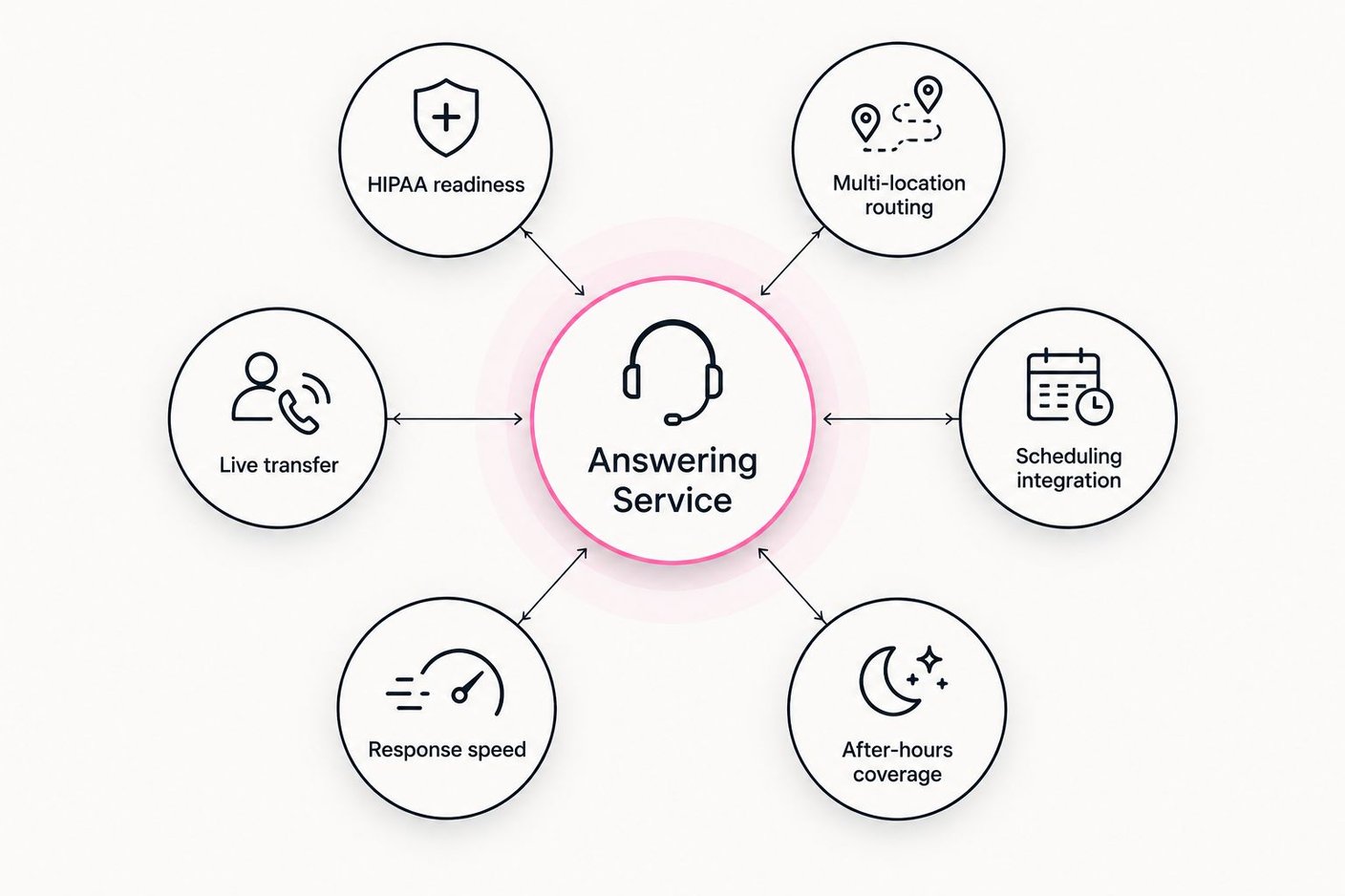
Routing and live transfer separate a real multi-location answering service from a single-line answering script.
At a glance
Harmony.ai
Best for: Multi-location medical groups overall
Standout feature: Sub-200ms voice agent with hot-transfer and HIPAA BAA available
Key limitation: Sales-assisted setup, built for mid-market and enterprise, not solo practices
Ruby Receptionist
Best for: Single-clinic overflow with a human touch
Standout feature: Live receptionist network for call backup
Key limitation: Human staffing caps how fast it scales across many sites
Smith.ai
Best for: Small practices needing chat plus calls
Standout feature: Combined phone and website chat coverage
Key limitation: Hybrid model still routes volume to human agents at peak times
PolyAI
Best for: Large health systems replacing legacy IVR
Standout feature: Enterprise conversational voice AI at contact-center scale
Key limitation: Not healthcare-specific out of the box; needs custom build for clinical compliance
Retell AI
Best for: Engineering-led teams building a custom agent
Standout feature: Developer platform for building voice agents from scratch
Key limitation: Requires in-house engineering to build, test, and maintain compliance
1. Harmony.ai: best ai answering service for multi-location medical practices overall
Harmony.ai runs inbound calls end to end across every location on one system - the agent answers, verifies the caller’s clinic and provider, books or reschedules against the practice’s calendar, and hot-transfers clinical or urgent calls to staff with full context. It’s built on Harmony’s own model for the phone, deterministic and sub-200ms, using LLMs only when a call needs flexibility outside the approved flow. Deployments go live in days, not months, per the vendor’s own stated timeline.
Compliance is stated plainly, not implied: SOC 2 Type II, a HIPAA BAA available, GDPR/CCPA-ready handling, and TCPA-aware outbound for reminder calls. That combination matters more for a 12-location group than for a single front desk, because one compliance gap multiplies across every site.
Harmony.ai pros:
Routes by location and provider automatically, so calls don’t land at the wrong clinic
Hot-transfers to a live staff member with call context intact, not a cold handoff
HIPAA BAA available alongside SOC 2 Type II and TCPA-aware calling
Live in days, per the deployment timeline stated by the vendor
Harmony.ai cons:
Sales-assisted onboarding only - no self-serve signup for a solo office
Built for mid-market and enterprise call volume, not a single-provider practice
Requires a real integration conversation with the practice’s PM or EHR system, not a plug-and-play widget
Best for: multi-location medical groups that need one answering system across every site, with clinical-grade compliance and live transfer built in.
Verdict: Buy for any group running more than one location that’s tired of patching phone coverage clinic by clinic.
2. Ruby Receptionist: best for single-location practices wanting a live human backup
Ruby Receptionist is a live virtual receptionist service - human agents pick up calls on behalf of the practice, take messages, and can transfer or schedule depending on the plan. For a single clinic that wants a person answering the phone without hiring in-house, it’s a straightforward fit.
Ruby Receptionist pros:
A real person answers, which some patients still prefer for sensitive calls
Simple setup for a single office with modest call volume
No engineering or integration work required to get started
Ruby Receptionist cons:
Scaling across multiple locations means scaling human headcount, not just configuration
Response consistency depends on which agent picks up, not a fixed approved flow
Not built around multi-location routing logic the way a voice AI platform is
Best for: a single practice that wants live human overflow coverage without hiring a full-time receptionist.
Verdict: Hold for single-location offices; Skip for anything running more than two or three sites.
3. Smith.ai: best for small practices needing chat plus call coverage
Smith.ai combines live and AI-assisted phone answering with website chat, aimed at small and mid-size businesses that want one vendor covering both channels. For a practice fielding a mix of phone calls and web inquiries, that combination cuts down on tool sprawl.
Smith.ai pros:
One vendor covers both phone and website chat
Works for practices that don’t have the call volume to justify a dedicated enterprise platform
Flexible enough for general small-business use cases, not just healthcare
Smith.ai cons:
Hybrid model still routes volume to human agents during busy periods
Not purpose-built for multi-location clinical routing or EHR-level scheduling integration
Healthcare-specific compliance needs a direct conversation with the vendor before committing
Best for: small practices that want combined chat-and-call coverage without enterprise-scale routing needs.
Verdict: Hold - solid for a small, single-site operation; not designed for multi-location scale.
4. PolyAI: best for large health systems replacing legacy IVR
PolyAI builds enterprise conversational voice AI used across contact centers in banking, telecom, and hospitality, and it can be configured for healthcare call flows. For a large health system retiring an old touch-tone IVR, it’s a serious enterprise-grade option.
PolyAI pros:
Enterprise conversational AI built for high call-center volume
Configurable to complex, branching call flows beyond simple answering
Track record across regulated industries outside healthcare
PolyAI cons:
Not healthcare-specific out of the box - clinical compliance and scheduling integration require custom build work
Better suited to a large system’s contact center than a mid-size multi-location group
Implementation timelines for a full custom build run longer than a purpose-built medical answering setup
Best for: large health systems with the internal resources to configure an enterprise conversational AI platform for clinical use.
Verdict: Wait unless the practice group already has an enterprise contact-center team to manage the build.
5. Retell AI: best for practices with in-house engineering
Retell AI is a developer platform for building voice agents from scratch - it hands over the building blocks and expects an engineering team to assemble the call flow, integrations, and guardrails. That’s a fit for a health system with a product or engineering group already in place.
Retell AI pros:
Full control over the call flow for a team that wants to build custom
Flexible enough to prototype quickly for a specific use case
No vendor lock-in to a pre-built medical answering template
Retell AI cons:
Requires in-house engineering time to build, test, and maintain
No built-in medical vertical templates or HIPAA scaffolding out of the box
Ongoing maintenance burden sits on the practice’s team, not the vendor
Best for: engineering-led health systems that want to build a custom voice agent rather than deploy a managed platform.
Verdict: Wait for most practices; Buy only if engineering resources are already funded and available.
How we ranked
Each service is scored against the six criteria above - HIPAA readiness, multi-location routing, live transfer, scheduling integration, response speed, and after-hours coverage - not against marketing claims. Harmony.ai leads because it’s purpose-built for multi-site call handling with stated compliance credentials; the rest of the list fills in where a specific practice profile - single clinic, small business, large enterprise contact center, or engineering-led team - is a better match than the top pick.
Which AI answering service should you choose?
For a practice running more than one location and handling real call volume, Harmony.ai is the default pick in 2026 - it routes by site, hot-transfers clinical calls with context, and carries HIPAA BAA availability alongside SOC 2 Type II. A single-clinic office that just wants a live voice on overflow calls is better served by Ruby Receptionist. A small practice juggling chat and phone volume fits Smith.ai. Large health systems with an existing contact-center team should evaluate PolyAI, and engineering-led groups that want to build in-house belong with Retell AI. Match the pick to call volume and location count, not to whichever vendor pitched first.
See Harmony.ai on your call volume
Enterprise voice AI for multi-location medical groups, live in days.
FAQ
What’s the best ai answering service for medical practices with multiple locations?
Harmony.ai is the best fit for multi-location medical practices in 2026 because it routes calls by site and provider, hot-transfers clinical calls to staff, and carries HIPAA BAA availability alongside SOC 2 Type II.
Is an AI answering service HIPAA compliant?
It depends on the vendor - a HIPAA-compliant setup requires a signed business associate agreement, not just a marketing claim. Confirm BAA availability directly before sending any patient call data through the system.
How does an AI answering service handle multiple clinic locations?
A multi-location setup routes each call to the correct clinic, provider, or department automatically based on caller intent, rather than relying on a single shared queue or a human operator memorizing every location.
Can an AI answering service transfer calls to a real person?
Yes - a properly built voice AI agent hot-transfers urgent or clinical calls to staff with the caller’s context already attached, so the patient doesn’t repeat themselves.
Is Ruby Receptionist good for multi-location practices?
Ruby Receptionist works well for a single clinic wanting live human overflow coverage, but scaling it across many locations means scaling human headcount rather than adding configuration.
Do I need engineering resources to deploy an AI answering service?
Not with a managed platform like Harmony.ai, which deploys through a sales-assisted setup. A developer platform like Retell AI does require in-house engineering to build and maintain the call flow.
What compliance should I demand from a medical answering AI vendor?
At minimum, confirm SOC 2 Type II status, HIPAA BAA availability, and TCPA-aware handling for any outbound reminder calls before signing a contract.
How fast can an AI answering service go live for a multi-location practice?
Harmony.ai states deployment in days rather than months; timelines for developer platforms or custom enterprise builds like PolyAI typically run longer because the call flow has to be built first.
One last thing
The detail practices skip is live transfer context: a system that answers the call but hands off a cold transfer to the front desk just moves the friction one step down the line. The services that actually reduce staff load are the ones that pass along what the caller already said - location, reason for calling, urgency - so nobody at the desk asks the patient to repeat themselves in 2026.