- Bilingual voice AI Spanish setup starts with a Spanish-native call flow, not a translated English script.
- Route language early, preserve the caller's answers across language changes, and define a bilingual transfer path.
- Harmony is best for enterprise teams that need approved phone-call flows and live transfers; verify Spanish handling in a pilot.
- Review disclosures and measure completion and transfer outcomes separately for Spanish calls.
Set up bilingual voice AI for Spanish-speaking callers by routing the call to a Spanish-native flow, allowing language changes without restarting, and transferring exceptions to a bilingual team member with context intact. Test Spanish disclosures and call outcomes separately from English before rollout. In 2026, a translated English script is not a substitute for a tested Spanish call flow.
How to Set Up Bilingual Voice AI for Spanish-Speaking Callers
Build the call path in this order. Each step has an acceptance test: if the agent cannot complete it on a recorded test call, keep that scenario out of the launch scope.
Identify how each call reaches the Spanish flow. Choose whether the caller selects a language, the agent detects it from the opening response, or an existing campaign or phone-number route identifies it. Do not assume the agent can infer language from a name or location. Document the route in the same plan used for voice agent localization, then test what happens when that signal is wrong.
Write the Spanish flow around the caller’s task. Start with the reason for the call: booking, qualification, service, or another approved task. Have a native Spanish reviewer check the greeting, questions, confirmations, refusals, and transfer language. Decide which form of address and regional terms fit the callers you serve; do not treat a literal English translation as the finished script.
Preserve intent when the caller changes languages. Test an English opening followed by a Spanish request, a Spanish opening followed by an English answer, and a mixed-language response. The agent should keep the answer already given. If it loses the thread, route that scenario to a bilingual person rather than asking the caller to start over.
Define what the agent can finish. List the tasks it can resolve within an approved flow and the requests that require a transfer. Set rules for unclear answers, unsupported requests, and caller requests for a person. Do not let a general response override a required disclosure or invent an offer that the approved flow does not contain.
Design the bilingual transfer. Specify the receiving team, the information passed with the call, and what happens if that team cannot take it. The handoff should include the caller’s stated need, language preference, and answers already collected. Test the receiving experience, not just the agent’s transfer attempt.
Review Spanish compliance language on its own. Check the wording and placement of every required disclosure, consent request, and opt-out instruction for the use case. Have the appropriate legal and compliance owners approve the Spanish version. A correct English flow does not establish that its Spanish counterpart is ready; the TCPA compliance guide for AI calls is a starting point for outbound review, not a substitute for script approval.
Pilot and inspect outcomes by language. Test the entire path with Spanish-speaking reviewers who reflect the dialects your callers use. Record whether the agent completes the intended task, transfers with context, repeats a question, or fails to resolve the request. Compare those outcomes with English calls before expanding the launch scope.
This is a deployment sequence, not a claim that every voice AI platform supports every step. Ask the vendor to demonstrate language routing, mid-call language changes, and Spanish disclosures in your actual call flow. A Spanish greeting alone proves none of those capabilities.
Why this matters
The operating risk is a call that appears to be covered but fails at the moment a Spanish-speaking caller needs an answer. An agent can deliver a polished opening and still lose the task when the caller changes languages, uses an unanticipated term, or asks for a person. Test completion, not the greeting.
For an enterprise contact center, the failure also affects routing and oversight. A transfer without the answers already collected creates repeat work. A Spanish disclosure that has not passed review creates a separate approval gap. Keep those issues visible in the pilot rather than combining Spanish and English results into one completion figure.
Harmony is best for mid-market and enterprise revenue or customer experience teams that need approved phone-call flows and live transfers. Harmony runs calls on its own model, built for the phone, and uses LLMs when needed; its stated response latency is sub-200ms. Those platform facts do not establish Spanish detection, dialect coverage, or code-switching performance. Require a demonstration of each before putting Spanish-speaking callers on the flow.
Which language-routing approach fits the call?
Choose the entry route based on the information you have when the phone rings. Each option solves a different problem and has a failure case to test.
Caller language selection
Best for: Calls where the caller should control the choice
Advantage: Makes the initial preference explicit
Limitation to test: Adds a selection step and needs a way to change languages later
Opening-response detection
Best for: Shared inbound lines without a language signal
Advantage: Lets the caller begin in their preferred language
Limitation to test: Needs a safe fallback when the opening response is short or ambiguous
Campaign or number routing
Best for: Calls with a known Spanish-language entry source
Advantage: Sets an initial route before the conversation
Limitation to test: The source does not prove the individual’s preference; the caller still needs a way to switch
Use the route you can test end to end. For example, if a campaign supplies the initial Spanish route, place an English-language test call through that same source. Check that the agent changes course without discarding the caller’s request. If you rely on opening-response detection, test silence and a short answer as well as full sentences.
The routing decision should remain reversible throughout the call. A caller who starts in Spanish can ask a question in English; another caller can do the opposite. Decide whether the agent continues in the new language or confirms a preference, then test that decision against the approved flow. Do not use a language switch to bypass identity checks, consent, or an existing transfer request.
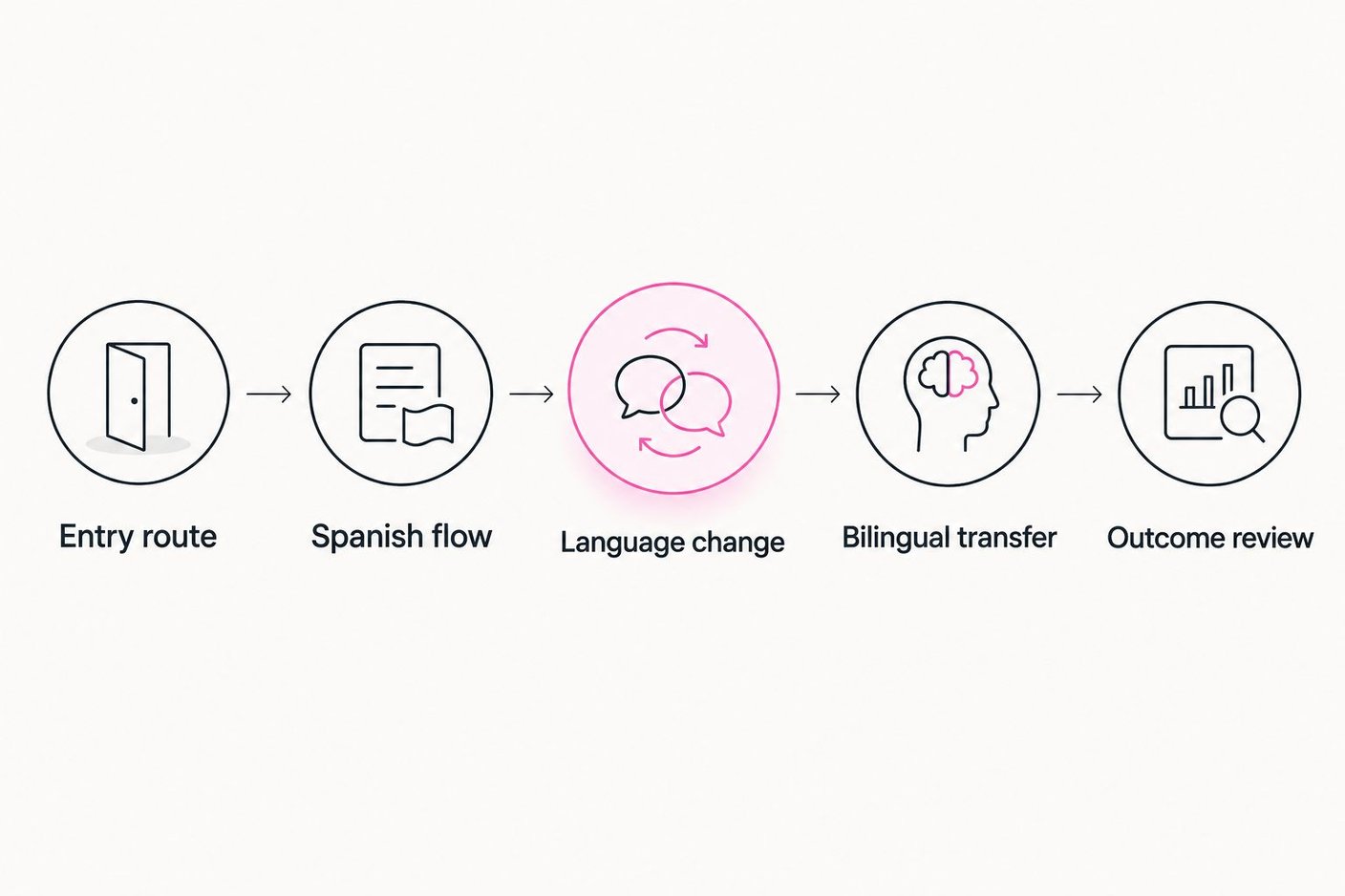
Test the route, the conversation and the handoff as one call path.
What should the Spanish flow contain?
Give the Spanish flow the same operational detail as the English one. Include the opening, task questions, confirmation language, error handling, required disclosures, and closing. Then review how a caller actually answers those questions in Spanish. The goal is an approved call path that completes the task, not a set of translated sentences that sounds complete in a document.
Test the moments where the caller can change the outcome. Can the caller correct a name or appointment detail? What happens when they decline to answer? Can they request a person in either language? Does the agent recognize that an answer already given in Spanish still counts after the conversation switches to English? Each test needs an expected result and a recorded observation.
For outbound calls, review the approved campaign language separately from inbound support language. The call purpose, consent basis, and opt-out path determine what the agent is allowed to say and do. Harmony describes its platform as TCPA-aware; that does not replace approval of a specific Spanish outbound script. The same distinction applies to its stated SOC 2 Type II status, HIPAA BAA availability, and GDPR/CCPA-ready positioning: platform controls do not approve an individual call flow.
Why bilingual setup effort varies
These factors determine how much design and testing the Spanish flow needs. Assess them before you set a rollout scope:
Call purpose. An appointment confirmation and a service complaint need different questions, exceptions, and transfer rules. Keep the first pilot to an explicitly defined task.
Caller language patterns. Decide whether callers use Spanish throughout, change languages between turns, or mix languages within an answer. Test the patterns your team actually encounters.
Regional vocabulary. Have reviewers familiar with your callers inspect terms used for appointments, account issues, and service requests. A phrase that passes a general translation check can still confuse the intended caller.
Approval requirements. Identify the disclosures and consent language that compliance owners must review in Spanish before the flow goes live.
Receiving team coverage. A hot-transfer rule only works when there is a defined bilingual destination and a tested outcome when no one answers.
Connected records. Check whether the call writes the correct language preference, task result, and transfer reason into the systems your team uses. Do not infer that a completed conversation created a usable record.
Do not set a single success target for all of these cases. Record the intended task and acceptable outcome for each call type. A completed appointment request and a properly transferred complaint both have value, but they are not the same result.
How do you verify the flow before launch?
Write a test script that covers a normal Spanish call, a normal English call, a mid-call language change, an ambiguous opening, an unsupported request, and a transfer request. Include a case where the caller changes an earlier answer. For each call, record the entry route, language used, task result, disclosure result, and handoff result.
Have Spanish-speaking reviewers check what the agent said and what it did. A transcript can show the words; the audio reveals whether the response timing and interruptions made the exchange usable. Review failed calls individually. Group them by routing, language handling, flow design, disclosure, and transfer so the owner of each issue can change the right part of the setup.
In 2026, keep the launch decision tied to observed calls. Expand the flow only after the approved test cases pass and the receiving team confirms it gets usable context. If the agent repeatedly asks for information the caller already supplied, fix that behavior before adding more call types.
Do Spanish-speaking callers need a separate phone number?
No. A separate number is an attribution or routing choice, not a requirement for a Spanish call flow. A shared number works when the caller has a reliable way to reach the Spanish flow and change languages if the initial route is wrong.
Can one call move between English and Spanish?
Yes, that is the behavior to require from a bilingual deployment; verify that the specific platform and configured flow perform it in a live test. In 2026, test both directions and confirm that the agent retains previously collected answers rather than restarting the task.
When should the agent transfer a Spanish call?
Transfer when the caller asks for a person, the request falls outside the approved flow, or a required step cannot be completed. Define the bilingual receiving team and the context it receives. A transfer that loses the caller’s answers has not completed the handoff.
FAQ
What’s the first step in setting up bilingual voice AI for Spanish callers?
Choose and test the route into the Spanish flow. The caller must also have a way to change languages if the initial route is wrong.
Can I translate my English voice AI script into Spanish?
Use the English flow as a task reference, not as the finished Spanish script. Have native Spanish reviewers approve the questions, confirmations, exceptions and required disclosures.
Does bilingual voice AI need to handle code-switching?
Yes, if your callers change languages during a call. Test whether the configured agent preserves their answers across the switch; do not assume a Spanish greeting proves that capability.
What happens if the agent cannot finish a Spanish call?
It should follow an approved fallback or transfer the call to a defined bilingual team. Test what information the receiving person gets and what happens if no one answers.
Does a Spanish flow need its own compliance review?
Yes. Review required disclosures, consent requests and opt-out wording in Spanish for the specific call use case. Approval of the English script does not approve its Spanish version.
How should an enterprise measure Spanish voice AI calls?
Track task completion, transfer outcomes, repeated questions and unresolved requests separately for Spanish calls. Review the failed calls to distinguish language-handling problems from routing or flow-design problems.
One last thing
Do not sign off after hearing the Spanish greeting. In 2026, the decisive test is a complete call that changes languages, reaches an exception, and transfers with its answers intact. Put that call in the acceptance plan, then ask Harmony to demonstrate it against your approved flow. Talk to sales with the test cases in hand.