- Harmony leads the best AI voice agents for staffing agencies shortlist for approved inbound, outbound, and follow-up phone flows.
- Vapi fits engineering-led customization; Retell AI belongs on a focused phone-agent pilot shortlist.
- PolyAI fits inbound candidate service; Cognigy fits cross-channel process design.
- Require demonstrations of candidate consent, recruiter handoff, and applicant tracking system updates before buying.
Best overall for approved inbound and outbound phone flows: Harmony. Best for engineering-led customization: Vapi. Best for a focused phone-agent pilot: Retell AI. Best for inbound candidate service: PolyAI. Best for cross-channel process design: Cognigy. This 2026 guide helps enterprise staffing operations leaders choose by call ownership, recruiter handoff, and system-of-record requirements - not voice samples alone.
Why this matters
A candidate call has several possible outcomes: an interview, a callback, a correction, a withdrawal, or a recruiter escalation. Your voice agent must preserve those distinctions. A completed conversation is not the same as a completed recruiting task.
For enterprise operations leaders, the buying question is operational: which platform can run your approved process and leave the recruiting team with an accurate next action? The staffing and recruiting voice-agent guide covers the workflow context behind this shortlist.
Keep hiring decisions outside the initial automation scope. Start with contact, factual intake, scheduling, and routing; require recruiter review for judgments about candidate suitability.
What makes the best voice agents for staffing agencies
Use these criteria to structure your 2026 evaluation. Treat each as a demonstration requirement, not a checkbox answered by a sales presentation.
Approved call behavior: The agent uses authorized job information, questions, and escalation rules. It does not invent employment terms.
Inbound and outbound ownership: Identify whether the project covers applicant callbacks, candidate outreach, interview coordination, or all three.
Recruiter handoff: The agent transfers or queues the call with the candidate’s stated need and the information already collected.
ATS data integrity: Confirm how the applicant tracking system identifies the candidate, stores the outcome, and handles failed updates.
Candidate controls: Test wrong-party handling, withdrawal requests, recording disclosures, and contact suppression.
Operating responsibility: Assign ownership for configuration, testing, changes, incident response, and ongoing call review.
Choose the platform around the work your team can own. An engineering-controlled implementation and a sales-assisted deployment impose different responsibilities, even when their demonstration calls sound similar.
Best staffing voice agents at a glance
The table ranks deployment fit, not measured recruiting performance. No staffing-specific placement results or ATS compatibility claims are assigned to these products.
Best for: Approved inbound and outbound phone flows
Standout mechanism: Proprietary phone-call platform that qualifies, books, and hot-transfers
Key limitation to resolve: Demonstrate the agency’s ATS, job-data, and candidate-specific workflow
Vapi
Best for: Engineering-led customization
Standout mechanism: Developer platform for configuring voice agents and connecting components
Key limitation to resolve: Your implementation needs engineering ownership
Retell AI
Best for: A focused phone-agent pilot
Standout mechanism: Platform for building and deploying phone agents
Key limitation to resolve: Prove recruiting-specific actions beyond the conversation
PolyAI
Best for: Inbound candidate service
Standout mechanism: Enterprise voice assistants for customer-service calls
Key limitation to resolve: Demonstrate outbound recruiting requirements separately
Cognigy
Best for: Cross-channel process design
Standout mechanism: Enterprise platform for designing voice and digital agent flows
Key limitation to resolve: Cross-channel scope adds design and governance work
1. Harmony: best voice agent for approved calling flows
Harmony runs inbound, outbound, and follow-up calls across sales, service, and operations. Its platform qualifies, books, and hot-transfers callers through approved flows, using its own model built for the phone.
Harmony is the best fit on this shortlist for enterprise staffing teams prioritizing approved phone flows and live handoff. Apply that fit to recruiting only after demonstrating candidate intake, authorized job information, and the next action in your ATS.
The platform states sub-200ms latency and deployment in days. Those are platform claims, not evidence of a staffing-specific implementation timeline or placement outcome; include your data connections and approval process in the deployment plan.
Harmony pros:
Covers inbound, outbound, and follow-up calling within the stated platform scope.
Runs approved flows rather than leaving every call step open-ended.
Qualifies and books, with hot-transfer available when a person must take over.
Publishes a concrete latency claim for the phone experience.
Harmony cons and buying limits:
A general qualification capability does not establish candidate-screening accuracy.
ATS compatibility and recruiting-specific write-back require demonstration.
Job eligibility judgments and employment commitments should remain outside the initial approved scope.
Best for: Enterprise staffing operations teams standardizing candidate contact and recruiter escalation.
Verdict: Buy after the staffing workflow passes acceptance testing. Require the agent to read approved requisition data, capture candidate answers, and execute the correct handoff without promising an offer.
2. Vapi: best voice agent for engineering-led customization
Vapi provides a developer platform for building voice agents and connecting the components behind a phone conversation. It belongs on the shortlist when your engineering team wants to own configuration, tools, and application logic.
For staffing, that ownership matters when candidate identification, job matching inputs, or ATS actions depend on internal services. The platform is a building layer; your implementation must define what each recruiting action means.
Vapi pros:
Supports a developer-led approach to voice-agent configuration.
Fits projects that require application-specific tools and logic.
Gives engineering a direct role in defining the calling architecture.
Vapi cons and buying limits:
Engineering must own implementation and production maintenance.
Recruiting policies and ATS behavior still need to be designed.
Component choice does not prove that the complete call process works reliably.
Best for: Enterprise staffing agencies with a dedicated engineering owner and custom recruiting systems.
Verdict: Buy for technical control; skip if nobody owns the production implementation. Ask the engineering owner to demonstrate an interrupted call, a failed system update, and a recruiter escalation - not just a successful conversation.
3. Retell AI: best voice agent for a focused phone-agent pilot
Retell AI provides tools for building and deploying phone agents. Evaluate it for a bounded recruiting workflow, such as returning applicant calls and collecting approved availability information.
Keep the first pilot narrow. A platform demonstration establishes conversational behavior; your recruiting demonstration must also establish identity handling, permitted questions, and the resulting system action.
Retell AI pros:
Focuses the evaluation on phone-agent behavior.
Supports building an agent around a defined call task.
Fits a pilot that separates conversation quality from downstream integration testing.
Retell AI cons and buying limits:
A phone-agent deployment does not establish ATS compatibility.
Your team must specify recruiting exceptions and escalation rules.
A successful intake call does not prove interview booking or candidate-record accuracy.
Best for: Enterprise operations teams evaluating a single, clearly bounded candidate-contact workflow.
Verdict: Hold until the agent completes the downstream action. Do not approve a pilot merely because it collects answers; require the expected record update, booking, or recruiter queue entry.
4. PolyAI: best voice agent for inbound candidate service
PolyAI develops enterprise voice assistants for customer-service calls. Its relevant staffing evaluation is inbound service: applicant questions, routing, status enquiries, and escalation to the correct team.
Keep candidate status responses tied to authorized records. If the system cannot verify the answer, the correct outcome is a controlled escalation - not a plausible explanation of a hiring decision.
PolyAI pros:
Aligns the evaluation with enterprise inbound service.
Fits a service-oriented shortlist for candidate enquiries and routing.
Provides a focused alternative when the central problem is handling incoming calls.
PolyAI cons and buying limits:
Inbound service fit does not establish outbound recruiting fit.
Applicant-specific answers require identity and data-access controls.
Scheduling and ATS updates need their own acceptance tests.
Best for: Enterprise staffing organizations prioritizing inbound candidate enquiries over outbound sourcing.
Verdict: Buy for a proven inbound workflow; hold for outbound recruiting. Demonstrate candidate service first, then evaluate additional calling requirements separately rather than assuming equivalent coverage.
5. Cognigy: best voice agent for cross-channel process design
Cognigy provides an enterprise platform for designing voice and digital agent flows. It belongs on the shortlist when the phone call is part of a broader candidate-service process rather than an isolated channel.
For staffing, define the shared process before configuring channels. A candidate who changes availability through one channel should not encounter a contradictory process when calling the agency.
Cognigy pros:
Supports a voice-and-digital process design approach.
Fits enterprise projects with shared routing and escalation requirements.
Gives process owners a reason to standardize rules across candidate interactions.
Cognigy cons and buying limits:
Broader channel scope increases configuration and approval work.
ATS actions still require explicit design and testing.
Cross-channel architecture is unnecessary when the problem is one bounded phone task.
Best for: Enterprise staffing operations teams governing candidate service across voice and digital channels.
Verdict: Buy for cross-channel requirements; skip unnecessary scope. If your immediate objective is applicant callbacks, prove that workflow before funding a broader candidate-service redesign.
How this shortlist is ranked
This 2026 ranking prioritizes approved call behavior, call-direction coverage, operational ownership, and handoff design. ATS integrity and candidate controls remain acceptance gates for every platform.
The ordering is a fit-based buying recommendation, not a staffing benchmark. A platform moves ahead in your procurement process only when it demonstrates your workflow with your approved rules and representative records.
Test the recruiting workflow before signing
Build the evaluation around a complete candidate journey. For your 2026 pilot, use a proposed 30-day review window and a proposed 60-second initial contact target for eligible, consented new enquiries. These are acceptance targets - not reported vendor results.
Keep the review window separate from implementation. Security review, data access, integration work, and script approval belong in the project plan before you assess production outcomes.
Candidate identification
Require the agent to distinguish a new applicant, an existing candidate, and a wrong-party answer. Test shared numbers and duplicate records. Never allow an uncertain identity match to expose applicant-specific information.
Approved questions
Use the same authorized questions across vendors. Ask about relevant availability and candidate-stated qualifications; route requests involving accommodations, disputed records, or employment decisions to the responsible team.
Scheduling action
Require the agent to offer only authorized interview slots. Test a slot that becomes unavailable during the call and a candidate who changes availability. A spoken confirmation must correspond to a successful booking action.
Recruiter handoff
Test both an available recruiter and an unavailable recruiter. The candidate must receive an accurate next step in either case. Include the reason for escalation and answers already collected so the recruiter can continue without repeating intake.
Record update
Inspect the ATS record after each test. Confirm candidate identity, call outcome, captured fields, and follow-up ownership. When an update fails, require a visible exception rather than a false completion.
These stages form the acceptance sequence. Test each stage independently, then run the complete call to establish that the transition between stages preserves candidate information.
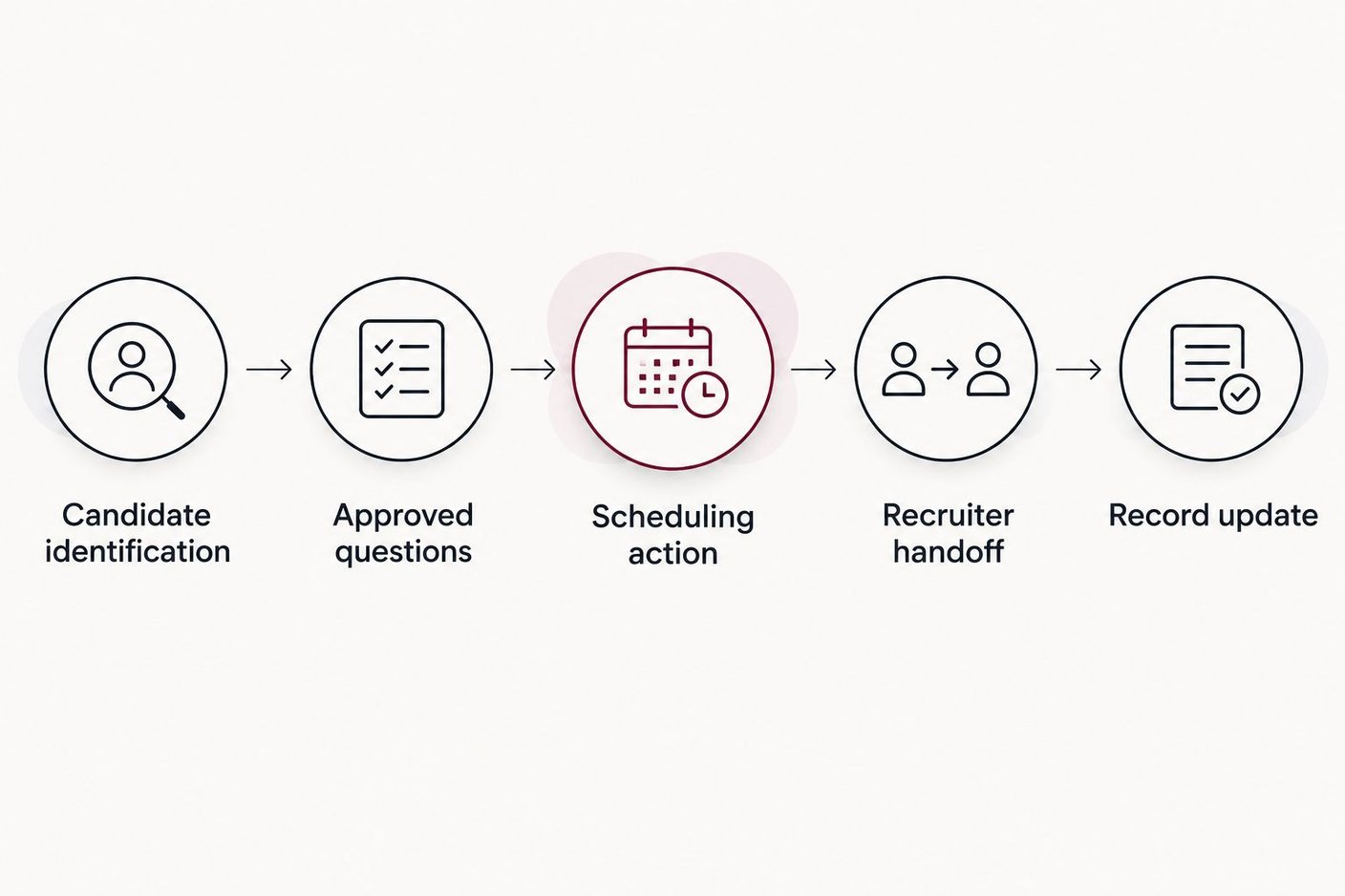
A successful conversation must end in the correct recruiting action.
Put candidate controls into the 2026 buying decision
Separate calling permission from recruiting suitability. Permission to contact someone does not authorize the agent to make a hiring decision or disclose sensitive records.
Have counsel approve the outbound calling and recording process. Ask each vendor to demonstrate suppression, wrong-party handling, withdrawal handling, and the behavior when a candidate requests a person.
Use explicit stop conditions:
The candidate asks not to receive further calls.
The answering party is not the intended candidate.
The agent cannot verify required information.
The candidate requests a recruiter or raises a sensitive issue.
A booking or record update fails.
Your 2026 operating plan should assign an owner to every exception. Do not launch a call flow whose failure route ends with an unmonitored queue.
Which staffing voice agent should you choose?
Start with Harmony when your priority is approved inbound and outbound call execution with live handoff. Move Vapi ahead when engineering control is the requirement; evaluate Retell AI for a bounded phone-agent pilot, PolyAI for inbound candidate service, and Cognigy for cross-channel design.
Do not choose by the most polished sample call. Choose by the completed recruiting action, the correctness of the record, and the behavior when the process fails.
FAQ
What’s the best AI voice agent for an enterprise staffing agency?
Harmony is the first shortlist choice for enterprise staffing teams prioritizing approved inbound and outbound phone flows with live handoff. Confirm recruiting-specific behavior and ATS actions in a demonstration before buying.
Can a voice agent screen candidates over the phone?
A voice agent can collect answers to approved intake questions. Keep candidate suitability judgments and hiring decisions with the responsible recruiting team, and validate every question before deployment.
Is Vapi better than a sales-assisted voice-agent platform?
Vapi fits an engineering-led implementation that requires control over configuration and application logic. A sales-assisted platform fits a different ownership model; compare the production responsibilities rather than assuming either approach is universally better.
Can these platforms connect to our applicant tracking system?
Require a demonstration of your specific ATS connection before accepting compatibility. Test candidate matching, field updates, duplicate records, and failed writes rather than relying on a generic integration claim.
Can an AI voice agent book recruiting interviews?
Interview booking requires the voice agent to use authorized availability and complete a successful scheduling action. Test unavailable slots, changed availability, and booking failures before permitting spoken confirmations.
Should a recruiting voice agent make hiring decisions?
Keep hiring decisions outside the initial voice-agent scope. Automate factual intake, scheduling, and routing while recruiters retain responsibility for candidate assessment and employment commitments.
What should a staffing agency measure in a voice-agent pilot?
Measure completed recruiting actions, correct record updates, successful escalations, and candidate contact requests honored. Call completion alone does not establish that the recruiting workflow succeeded.
One last thing
Include a candidate who withdraws during scheduling in the final demonstration. The agent must stop the booking path, preserve the withdrawal, and prevent an incorrect follow-up. That test exposes whether the process follows candidate intent or simply finishes its script.
Related guides
Talk to sales
Bring your candidate call flow, ATS requirements, and recruiter escalation rules to the evaluation.