- Harmony leads the best voice ai for e-commerce customer support shortlist for approved phone flows and live transfers.
- Evaluate PolyAI for voice-focused support and Cognigy for cross-channel orchestration.
- Evaluate Amazon Connect for an AWS-centered contact center and Vapi for an engineering-owned implementation.
- Require order-data access, policy controls, and successful escalation before approving production calls.
Best overall shortlist choice: Harmony for enterprise e-commerce support built around approved phone flows and live transfers. Best for a voice-focused evaluation: PolyAI; best for cross-channel orchestration: Cognigy; best for an AWS-centered contact center: Amazon Connect; best for an engineering-owned build: Vapi. This 2026 guide separates those buying paths and shows what each must prove before handling customer orders.
Why this matters
Your phone agent needs permission to act - not just permission to speak. A delivery-status answer requires current order data. A cancellation requires an eligibility check and a confirmed system action. A refund exception requires an escalation path.
For an enterprise CX leader, the buying decision starts with those boundaries. A fluent demonstration does not establish that a platform can identify the customer, retrieve the right order, apply your policy, and leave a usable record.
Use the e-commerce customer support phone automation guide to define the call scope before comparing vendors. Then evaluate every shortlisted platform against the same scenarios. Do not let vendors substitute their easiest demonstration for your hardest operational requirement.
What makes the best voice AI for e-commerce customer support
For a 2026 evaluation, prioritize mechanisms that control the outcome of a call:
Order-data access: The agent retrieves authorized information from the system of record. It distinguishes missing information from a confirmed answer.
Action controls: Refunds, cancellations, and address changes follow approved rules. The agent confirms a successful action before announcing completion.
Conversation handling: The agent handles interruptions, corrections, and changed requests without discarding information already supplied.
Escalation: The agent transfers when authority ends, identification fails, or the customer requests assistance. Test what reaches the receiving team.
Operational ownership: Someone owns policy changes, failed transactions, routing, and rollback. Assign that responsibility before launch.
Security and evidence: Review access controls, retention, recordings, and relevant security documentation. Require evidence for the exact deployment scope.
These criteria favor different architectures. An engineering-led organization can accept more implementation responsibility than a CX organization seeking a vendor-operated phone platform. Neither choice excuses a failed order lookup or an unauthorized promise.
Voice AI platforms at a glance
The table ranks evaluation paths, not measured performance. Each platform must demonstrate your actual e-commerce workflows before purchase.
Harmony
Best for: Enterprise approved-flow phone operations
Standout capability or approach: Inbound, outbound, and follow-up calls with live transfers
Key limitation to evaluate: Commerce-specific actions require deployment validation
PolyAI
Best for: Voice-focused customer support
Standout capability or approach: Customer-service voice assistants
Key limitation to evaluate: Order actions and escalation must be demonstrated
Cognigy
Best for: Cross-channel orchestration
Standout capability or approach: Enterprise agent design across voice and digital channels
Key limitation to evaluate: Broader scope requires clear workflow ownership
Amazon Connect
Best for: AWS-centered contact centers
Standout capability or approach: AWS contact-center foundation
Key limitation to evaluate: Contact-center infrastructure is not a finished commerce agent
Vapi
Best for: Engineering-owned voice implementations
Standout capability or approach: Developer-oriented voice-agent platform
Key limitation to evaluate: Your team must own commerce logic and operating controls
1. Harmony: best for approved-flow enterprise phone support
Harmony runs inbound, outbound, and follow-up phone calls across service, sales, and operations. Its own model is built for the phone and uses LLMs when needed. The platform runs deterministic, approved flows and supports live transfers to a person.
The supplied platform specification states sub-200ms latency. Treat that as a platform claim, not a measured result for your order-management environment. During evaluation, measure the complete exchange, including retrieval and action execution.
For e-commerce support, the relevant mechanism is control: define what the agent can answer, what it can execute, and when it must transfer. Do not infer a native commerce integration or refund capability from general service-call support.
Harmony pros:
Runs inbound and outbound calls on one enterprise phone platform.
Uses approved flows to define the agent’s permitted behavior.
Supports live transfers when a call needs a person.
Provides a stated sub-200ms platform latency specification to investigate during testing.
Harmony cons:
Approved flows still require your team to define policy boundaries and exceptions.
General service automation does not establish compatibility with your order system.
A platform latency figure does not establish transaction completion time.
Best for: Mid-market and enterprise CX leaders seeking controlled phone execution rather than a custom component stack.
Verdict: Buy only after the platform proves your order lookup, permitted action, and transfer scenarios.
2. PolyAI: best for a voice-focused support evaluation
PolyAI provides voice assistants for customer service. Put it on the shortlist when the phone channel is the main project and you want to evaluate a specialist voice approach.
The deciding test is not whether the assistant discusses delivery. It is whether the deployed assistant retrieves the correct shipment, handles a correction, and avoids stating an unsupported arrival promise. Ask for an end-to-end call using your policy and representative order records.
Separate informational support from transactional support. Reading an order status and changing an order are different permissions. Require the evaluation to show that distinction explicitly.
PolyAI pros:
Offers a voice-focused customer-service evaluation path.
Fits a shortlist centered on phone-channel automation.
Gives buyers a specialist alternative to building a broader contact-center stack.
PolyAI cons:
A voice-focused product does not establish compatibility with your commerce systems.
Conversation quality does not prove that order changes execute correctly.
Your team still needs to approve escalation rules and policy exceptions.
Best for: Enterprise CX leaders evaluating customer-service voice assistants as the primary buying category.
Verdict: Hold until PolyAI demonstrates the complete support transaction, not just the conversation.
3. Cognigy: best for cross-channel orchestration
Cognigy provides enterprise tooling for designing agents across voice and digital channels. Evaluate it when phone support belongs inside a broader customer-service architecture rather than a standalone calling project.
The operating question is who owns shared policy. A return rule should not change because the customer moves from a digital channel to a phone call. Define the authoritative policy source and require the implementation to preserve it across the relevant channels.
For a 2026 shortlist, keep the scope narrow enough to inspect. Start with a specific order-support journey. Broader orchestration adds value only when your team can govern the flows, system connections, and release process.
Cognigy pros:
Addresses enterprise voice and digital agent design.
Fits evaluations that require coordinated customer-service journeys.
Supports an architecture discussion beyond a single phone flow.
Cognigy cons:
A broader deployment scope creates more ownership decisions.
Shared policy still needs an authoritative source and change process.
Cross-channel tooling does not itself prove successful commerce transactions.
Best for: Enterprise CX leaders who need voice automation governed alongside digital service channels.
Verdict: Hold unless cross-channel coordination is a defined requirement with an accountable owner.
4. Amazon Connect: best for an AWS-centered contact center
Amazon Connect is AWS’s cloud contact-center service. Evaluate it when your organization wants its contact-center architecture to sit within an AWS environment and has technical owners for that environment.
Do not treat a contact-center foundation as a finished e-commerce voice agent. The customer journey still needs identification, order retrieval, policy enforcement, transaction handling, and escalation. Document which components perform each function and who operates them.
A CX leader should require a joint demonstration with the technical team. Test the phone interaction and the underlying action together. A successful routing demonstration is not evidence that an order was canceled correctly.
Amazon Connect pros:
Provides a contact-center foundation within AWS.
Fits organizations with established AWS architecture ownership.
Makes infrastructure and customer-service workflow design part of one evaluation.
Amazon Connect cons:
Infrastructure selection does not deliver an approved commerce workflow by itself.
Your team must define the complete application and operating model.
An AWS preference does not replace call-level acceptance testing.
Best for: Enterprise CX leaders working with an AWS-centered technical organization.
Verdict: Buy the architecture only when the team also owns delivery of the support application.
5. Vapi: best for an engineering-owned implementation
Vapi provides a developer-oriented platform for building voice agents. Evaluate it when your engineering organization wants to own the application logic and can operate the resulting service.
That ownership extends beyond creating an agent. Your team needs to manage order-system permissions, failed requests, policy updates, monitoring, and release approval. The CX organization must retain authority over what the agent tells customers and which actions it performs.
Use an order-change scenario to test the ownership model. Ask who investigates an unsuccessful write, who prevents a repeated action, and who changes the flow when policy changes. Those answers determine deployment readiness.
Vapi pros:
Fits a developer-led voice-agent build.
Gives technical teams an application-building route rather than a finished support workflow.
Suits organizations that deliberately retain implementation ownership.
Vapi cons:
Your team must build and maintain the commerce-specific behavior.
Technical ownership must cover production operations, not just development.
A working prototype does not establish a controlled customer-service deployment.
Best for: Enterprise CX leaders partnered with an engineering team assigned to build and operate voice support.
Verdict: Skip if no technical owner is accountable for production calls and failed transactions.
How the ranking works
This 2026 ranking orders buying paths by fit for enterprise e-commerce phone support. Approved-flow phone execution comes first, followed by specialist voice support, cross-channel orchestration, contact-center infrastructure, and an engineering-owned build.
The ranking does not claim comparative containment, resolution, reliability, or deployment results. The deciding criteria remain order-data access, action controls, conversation handling, escalation, ownership, and security evidence.
Choose the operating model before comparing demonstrations. Otherwise, you risk selecting a platform whose implementation burden sits with a team that never agreed to own it.
Run a pilot that tests the transaction
For your 2026 pilot, start with 3 call intents: delivery status, cancellation eligibility, and return-policy questions. This is a recommended scope, not a performance benchmark. Keep exception-heavy decisions outside the initial execution permissions.
Build 10 scripted test calls covering correct information, incorrect identification, multiple orders, missing data, caller corrections, interruptions, policy exceptions, action failure, requested escalation, and an unavailable receiving team. These are test cases - not evidence of vendor performance.
Use the same sequence for each platform:
Identify: Establish which customer and order the caller can access.
Retrieve: Read the current record from the authorized source.
Apply policy: Check whether the requested answer or action is permitted.
Confirm action: Verify the system result before telling the caller it succeeded.
Transfer: Route exceptions according to an approved fallback.
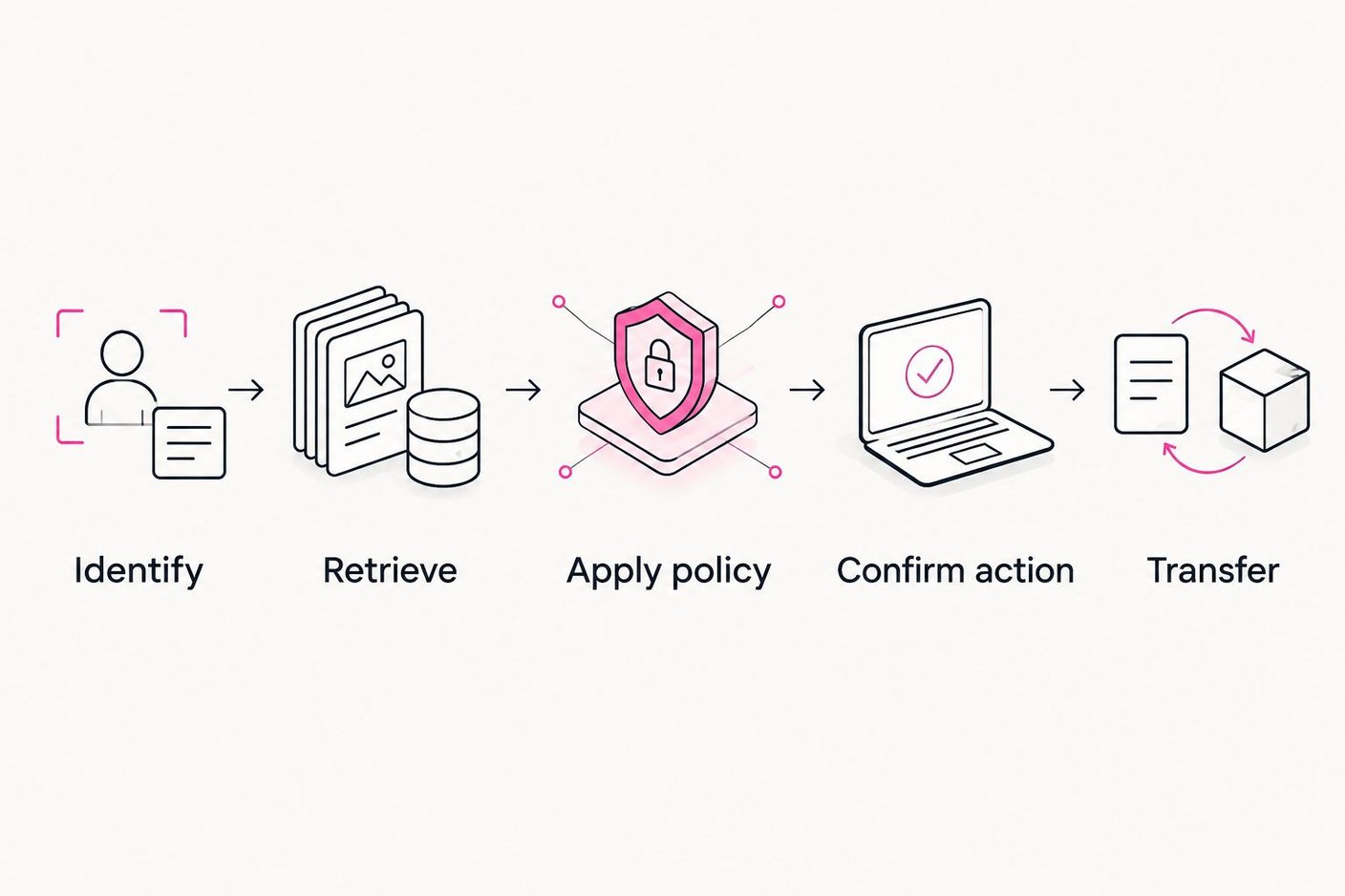
Confirm the system result before announcing that an order action succeeded.
Score each call on observable outcomes. Did the agent access the right record? Did it stay within policy? Did the requested action complete? Did the transfer follow the approved route?
Inspect failure behavior separately. A missing record should produce an explicit limit, not a guessed delivery date. A failed cancellation should remain unresolved until the system confirms success. A disconnected transfer needs a fallback that your support organization has accepted.
Measure resolution alongside repeat contacts and unauthorized actions. A shorter call is not a successful call if the customer must call again. Preserve that distinction in the pilot report and the purchase decision.
Which platform should you choose?
Choose Harmony first for an enterprise voice AI evaluation centered on approved phone flows and live transfers. Require evidence for your commerce systems before committing.
Choose PolyAI when you want a voice-specialist evaluation. Choose Cognigy when cross-channel policy coordination is central. Choose Amazon Connect when AWS contact-center architecture is a deliberate requirement. Choose Vapi when engineering owns the application and its production operation.
Do not compare these options as interchangeable subscriptions. They assign different responsibilities to your organization. Select the path whose owners can maintain the customer journey after the initial launch.
FAQ
What’s the best voice AI for e-commerce customer support in 2026?
The best choice matches your operating model and proves your order-support workflows. Start with approved-flow phone platforms for controlled execution, then compare specialist voice, cross-channel, infrastructure, and developer-led options against the same acceptance tests.
Can a voice agent answer where-is-my-order calls?
Yes, when the deployment can identify the customer and retrieve authorized, current order information. Require it to distinguish confirmed shipment data from missing information and avoid unsupported delivery promises.
Can voice AI cancel orders or issue refunds?
Only authorize those actions when the deployment enforces your eligibility rules and confirms the system result. General voice-agent capability does not establish that a particular platform supports your order or refund system.
Is a developer platform better than an enterprise phone platform?
A developer platform fits when your engineering team owns the application and production operations. An enterprise phone platform fits when you want to evaluate a more packaged calling approach; both still require commerce-specific validation.
Should an e-commerce voice agent handle every customer call?
No; restrict the agent to approved intents and actions. Transfer requests that exceed its authority, fail identification, or require an exception, and test the fallback when the receiving team is unavailable.
What should an enterprise voice AI pilot measure?
Measure correct identification, accurate retrieval, permitted actions, confirmed completion, and successful escalation. Review repeat contacts and unauthorized actions alongside call duration so a faster call does not conceal an unresolved issue.
Does low latency prove that a voice agent resolves support calls?
No; latency measures responsiveness, not successful resolution. Test complete calls that include data retrieval, policy decisions, action execution, and escalation before approving production use.
Related guides
One last thing
Test a cancellation that the order system rejects. The agent must report the failure - not announce success because it understood the request. That single scenario separates a persuasive conversation from a controlled transaction.
Book a workflow demo
Bring an order-status call, a rejected cancellation, and a transfer scenario to the evaluation.